The room was small and bare a single window looked out onto a quiet street there were no neighbors close by, no traffic sounds, no voices drifting through the walls. I had rented this place for one reason only: I needed somewhere I could speak without anyone hearing me. Somewhere I could make mistakes without feeling foolish. Somewhere I could build the confidence that had always slipped through my fingers the moment I tried to talk to a real person.
For months, I had been learning words and studying grammar. But every time I imagined opening my mouth in a real conversation, my throat tightened. I would picture the face of the person I was supposed to talk to, and my mind would go blank. I knew the language on paper. But I did not know it in my voice. And I understood, finally, that I would never build speaking confidence before my first conversation by studying alone. I needed to practice speaking out loud, in full sentences, in situations that felt real.
That empty room became my kitchen every morning, I walked through the door, closed it behind me, and entered a world where no one was watching. I brought only my phone and a small notebook. On the notebook, I had written a simple recipe: Opening a bank account. It was something I would need to do in real life, and the thought of doing it in another language had always scared me. But in this kitchen, the fear had nowhere to hide. There was only me, the ingredients, and the voice that was finally learning to cook.
Why I needed solitude before I could ever face a real person
I had tried to practice speaking in my own room before. But the walls were thin. I could hear my neighbour moving around, and I was sure they could hear me. Every time I tried to speak, I held back. My voice came out in a whisper. I was too aware of being heard, and that awareness stopped me from truly trying.
The rented room was different. It was far from everyone I knew. I could shout if I wanted to. I could stumble and repeat and sound foolish, and no one would ever know. That freedom was exactly what I needed. Because confidence, I discovered, does not come from being good. It comes from being bad, over and over, in a place where no one can see you. It comes from making every mistake possible, until the mistakes run out and only the correct words remain. It is like learning to cook: nobody expects the first dish to taste perfect. You burn things. You add too much salt. You forget an ingredient entirely. But each failure teaches you something, and eventually, you can prepare a meal without even looking at the recipe.
The room did not change the walls stayed bare the window stayed closed. But inside those walls, something was simmering. A voice that had been silent for years was starting to speak. And the more it spoke, the stronger it became.
The method I used was simple I found a quiet place where I could speak freely. I chose one real‑life scenario like opening a bank account and I practiced it with an AI chatbot that had a voice function. First, I played the client and the chatbot played the clerk. I answered its questions until I could do it without hesitation. Then I swapped roles. I became the clerk, and the chatbot became the client. By the time I walked into a real bank, I had done that conversation so many times that the words came out on their own.
The confidence was not something I found in the moment. It was something I had already built, one repetition at a time, in that empty kitchen. The first few attempts were like a soup that was missing something essential. You could tell it wasn’t quite right, but you couldn’t yet name what was absent. Only with repeated tasting and adjusting did the flavour finally come together I had tried to learn any foreign language by myself with a self built system but I had been missing the most important piece. The system had to include a way to practice speaking not just listening or reading in a setting that felt real. The empty room and the AI chatbot gave me that missing piece.
The freeze that happened every time I thought about speaking
I had spent months learning vocabulary I could read articles and follow along with slow audio. I could write simple sentences in a notebook. But none of that helped when I thought about speaking to a real person. The fear was not about the words. It was about the moment. The pressure of being face‑to‑face with someone, of needing to understand and respond in real time, made my mind go blank before I even opened my mouth. It was the same panic I felt the first time I tried to cook a meal for guests the recipe I knew by heart suddenly seemed foreign, the timer felt like a countdown to disaster, and my hands forgot how to hold a knife.
This freeze was not a sign that I was weak or incapable it was a sign that my brain had never practiced speaking under pressure. The only way to fix that was to create pressure in a safe place. To simulate the moment so many times that the fear had no room left to grow. That was why the empty room mattered so much. And that was why I needed the AI chatbot. It was my practice kitchen, the place where I could burn the sauce a hundred times before anyone ever tasted it.
The difference between knowing a language and being ready to use it
Knowing a language and being ready to use it are two very different things. Knowing is passive. You recognize words. You understand grammar. You can pass a test. It is like owning a cookbook and memorizing every recipe. Being ready is active. Your mouth knows how to shape the sounds. Your brain knows how to respond without translating. Your body knows how to stay calm when someone is waiting for your answer. It is walking into a real kitchen, with real heat and real hunger, and producing a meal that satisfies.
The only bridge between knowing and being ready is repetition. Not the repetition of flashcard review, but the repetition of real, spoken conversation. You have to say the words out loud, in context, under some kind of pressure, until your brain stops treating speaking as a threat.
The freeze was never about vocabulary it was about pressure. When you are face‑to‑face with someone, your brain switches into a different mode. It tries to plan, predict, and perfect all at once, and that overload causes the freeze. The way to overcome this is to practice the exact situation you are afraid of, many times, until your brain learns that it is safe. The more you repeat the scene, the less your brain treats it as a threat. Eventually, the words come out before the fear has a chance to stop them.
The freeze was never a sign of failure it was a sign that I had not yet practiced the moment enough times for my brain to trust it. Once I understood that, the path forward became clear. I just needed to repeat the scene until it felt ordinary, until the recipe became so familiar I could cook it with my eyes closed.
My first role play the bank scene I rehearsed a hundred times
I sat in the empty room, my phone on the small table in front of me. I had already written down the basic exchange for opening a bank account. Now I needed to bring it to life. I opened the AI chatbot the one with a voice speaking function and I typed my instructions. “You are a bank clerk. I am a client who wants to open an account ask me questions and if I answer wrong, correct me.”
The chatbot responded in a calm, clear voice. “Good morning. How can I help you today?” I took a breath. “I would like to open a bank account.” The words came out slowly, but they came out. The chatbot asked me for my name, my address, the type of account I wanted. I answered each question. When I stumbled, I paused the chatbot and tried again. When I used the wrong word, the chatbot gave me the correct one, and I repeated it.
I did this same scene ten times that first day. By the tenth run, I was not pausing as much. The words were starting to feel familiar. The fear was still there, but it was smaller. The repetition was working. Each attempt was like adding a pinch more salt, adjusting the heat, until the dish began to taste like it was supposed to.
The mistakes I made the corrections I received and why I kept going
The chatbot never got tired it never looked at me with confusion or impatience. It simply asked the next question, and when I made a mistake, it gave me the right word and waited for me to try again. That patience was a gift. In a real conversation, I would have felt embarrassed by my errors. But with the chatbot, I felt safe. The mistakes were not failures. They were just information signals that showed me where I needed more practice. In cooking, you don’t throw away the pan because the first pancake sticks. You adjust the heat and try again.
I also realized that I had been speaking alone without freezing in a way I had never thought possible the chatbot was not a real person, but it gave me something that felt very close to a real exchange. My brain was learning the rhythm of a conversation the back‑and‑forth, the listening and responding without the weight of another person’s expectations.
After a week of daily practice I had done the bank scene over a hundred times. And something had shifted. I no longer needed to think about what I was going to say. The responses came automatically. My mouth knew the words before my mind had time to search for them. The scene had become a part of me. The recipe had been absorbed into my hands, and they moved on their own.
I repeated the bank scene many times before I felt truly ready. But I did not count. I felt the shift. One day, I started the scene and realized I was not thinking about the words anymore. They were just coming out. That is when I knew the repetition had done its work. I kept going until that moment arrived.
The bank scene taught me something I carry with me still. Confidence is not a feeling you wait for. It is a result you earn, one repetition at a time, in a room where no one can see you try and fail and try again. It is the dish you have cooked so many times that you no longer measure the ingredients you just know.
I remember the first time I finished the bank scene without a single mistake. I sat back in my chair and stared at the ceiling. The chatbot was silent, waiting for the next question that would never come. I had done it. Not perfectly there were still rough edges but I had done it. And in that moment, I knew that if I could do it alone, I could do it with a real person.
Swapping roles how I became the clerk and the client
The bank scene had become familiar I could walk through it as the client without stumbling. The questions came, and my answers followed. But something was still missing. In a real conversation, I would not only be answering questions. I would also be asking them. I needed to know how the other side felt. What words the clerk would use. What questions they would ask and why. This was like learning to cook by only eating I knew what the final dish should taste like, but I had no idea what happened in the kitchen to make it that way.
So I changed the setup I opened the AI chatbot and typed a new instruction. “You are the client. You want to open a bank account. I am the clerk. I will ask you questions. If I make a mistake, correct me.” The chatbot replied in that same calm voice. “Hello. I would like to open an account.” And I became the clerk.
It felt completely different I was no longer the person waiting for the next question. I was the person leading the exchange. I had to know what to ask, when to ask it, and how to respond to the answers. The pressure shifted, but the safety remained. The empty room was still there. The chatbot was still patient. And I was still learning.
I changed the setup and let the chatbot play the client while I asked the questions
The first few attempts were clumsy I forgot the word for “identification.” I used the wrong verb when asking about the type of account. The chatbot gently corrected me, and I repeated the phrase until it felt right. By the fourth or fifth run, I had the rhythm. I knew the sequence. I knew the words.
This role‑swap taught me something that answering alone never could language is not just about responding. It is about initiating. It is about holding the floor and guiding the conversation where it needs to go. When I only played the client, I learned how to answer. When I played the clerk, I learned how to lead. It was the difference between following a recipe and creating one.
How playing both sides made the conversation feel complete
After a week of swapping roles every day, the bank scene felt whole. I had walked through it from every angle. I knew what the client needed to say and what the clerk would ask in return. There were no more surprises. No moments where I would freeze because I did not know what might come next. I had been on both sides of the desk, and that knowledge made me feel ready. I had been both the chef and the customer, and now I understood the meal from every perspective.
I realized that I was no longer just learning isolated phrases. I was learning how whole exchanges were built. I was learning sentence patterns not as separate words but as complete structures that could bend and flex depending on which role I played. The words were no longer items on a list. They were tools I could pick up and use, whichever side of the conversation I stood on to learn sentence patterns instead of isolated words I had to step into both roles and feel the language from every direction.
Playing both roles was helpful because it taught me the whole exchange. When I only played one role, I learned half the exchange. I knew how to answer, but I did not know what the other person would say or how they would say it. When I played both roles, I prepared for everything. I learned the questions and the answers. I learned the words the other person might use that I had never used myself the conversation became familiar from every angle, and that familiarity removed the fear of the unknown.
Playing both sides did not just teach me more words. It taught me that a conversation is not a one‑way street. It is a meeting, and when you have walked down both paths to reach it, the meeting feels like coming home to a kitchen that finally feels like your own.
The daily rhythm that made the words come out on their own
The rented room became my second home every morning, I walked through the door at the same time. I placed my phone on the same small table. I opened the same AI chatbot and loaded the same bank scene. The routine never changed, and that was the point.
For the first twenty minutes I played the client the chatbot asked questions, and I answered. If I stumbled, I repeated the line until it felt smooth. Then I swapped roles. For another twenty minutes, I became the clerk. I asked the questions. I listened to the Chabot’s answers and made sure I understood every word. After that, I spent ten minutes writing down the phrases that had given me trouble, reading them aloud, and recording myself to hear how I sounded.
This daily session lasted less than an hour. But the consistency was what mattered. I did not skip days. I did not make excuses. The room was always there, waiting. The chatbot was always ready, no matter how many times I needed to repeat the same sentence. It was like preparing the same meal every day eventually, the knife finds the cutting board before you even think about it.
Every morning the same scene the same words until my mouth moved without me
After two weeks of this daily rhythm, something strange happened. I sat down, opened the scene, and began to speak. But I was not thinking. The words were simply coming out. My mouth knew the shape of them before my mind could catch up. The pause that used to stretch between the chatbot’s question and my answer had shrunk to almost nothing.
That was the moment I understood what automatic speech felt like. It was not about being perfect. It was about the words arriving on their own, without the need for translation or planning. The hundreds of repetitions had carved a path so deep in my brain that the words flowed down it naturally. The dish was no longer a recipe it was a reflex.
I did not need any complex review method to make this happen. The words I used in the role‑plays stuck because I was using them in a full, real context every single day. The repetition itself was the review. And the more I repeated, the less I needed to stop and think.
The repetition that turned fear into automatic speech
There is no shortcut to this no app can make your mouth move automatically after one or two tries. The only thing that works is doing the same thing over and over, in the same place, with the same focus, until the effort disappears that is what I did in that rented room. And that is what made the difference.
Every day I reviewed the words from the previous session before I started the new one just five minutes I opened my notebook, read through the phrases I had written down, and spoke them aloud once more. That small habit kept the words alive between sessions. Over time, I found that this brief return was the simplest way to keep vocabulary fresh without ever feeling burnt out the words did not fade because I never let them.
I aimed for about an hour each day twenty minutes as the client, twenty as the clerk, and ten minutes of review and writing. But the exact time mattered less than the consistency. A shorter session done every day is far more powerful than a long session done once a week. I found a length that fit my life and protected it.
The daily rhythm was not exciting. It was ordinary. But it was the ordinariness that made it work. When practice becomes as regular as brushing your teeth, the language stops being a subject and starts being a part of you, like the smell of fresh bread that fills the house without you noticing.
There were mornings when I walked into that room feeling tired and empty. I did not want to speak. I did not want to repeat the same scene again. But I sat down anyway. I opened the chatbot anyway. And every single time, within five minutes, the words started flowing. The hardest part was never the speaking. It was the walking through the door.
Beyond the bank how I practised every real life situation I could think of
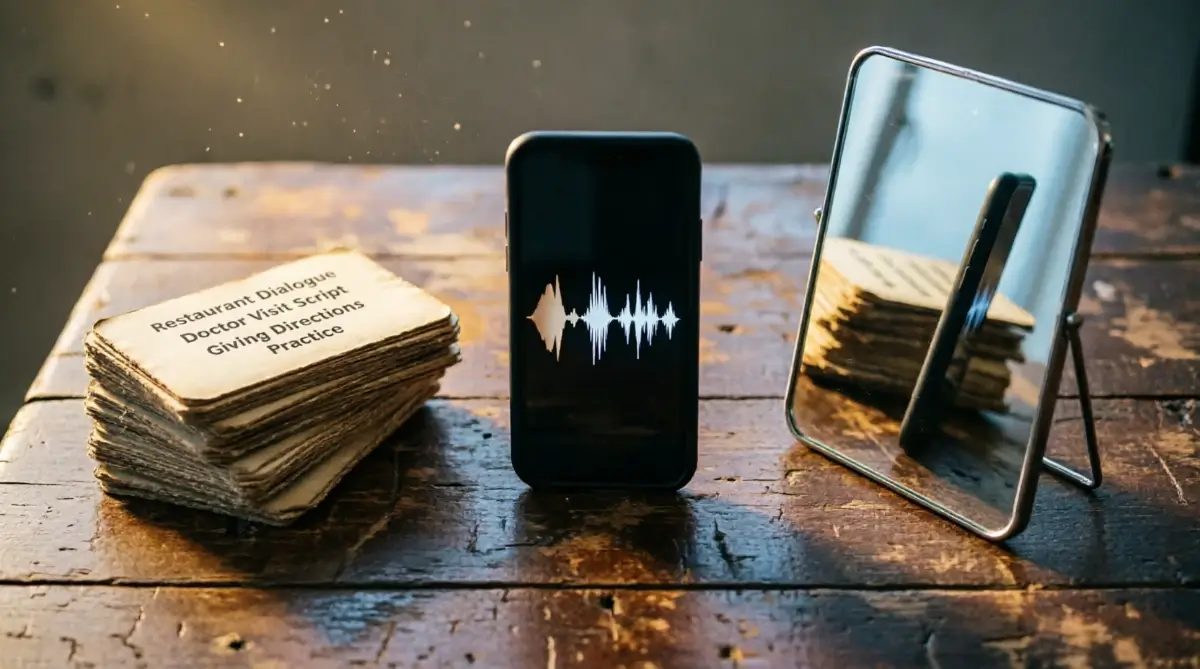
The bank scene was the first, but it was not the last. Once I felt confident with that one exchange, I began to build more. I sat down with my notebook and wrote a list of every real‑life situation I might need to handle in the language I was learning. Ordering food at a restaurant. Visiting a doctor and describing my symptoms. Asking for directions on a street corner. Making a phone call to book an appointment each one became a new recipe to master.
I wrote out the basic exchanges then I took them into the rented room, one by one, and practised them with the AI chatbot. First as myself, then in the opposite role. The same method. The same rhythm. The same patience with my own mistakes.
Ordering food visiting a doctor, asking for directions I rehearsed them all
The restaurant scene was the first I added after the bank. “You are a waiter. I am a customer. Ask me what I want to order.” The chatbot played its part. I stumbled through the menu, forgot the word for “spoon,” and had to pause and look it up. By the end of the week I could order a full meal without a single pause.
The doctor scene was harder. I had to describe symptoms. “I have a pain in my chest.” “I feel dizzy.” These were not phrases I had ever used before, in any language. But the chatbot walked me through them. It asked the questions a real doctor would ask. I answered. I learned words for parts of the body, for types of pain, for medicines. And when I finally needed to see a doctor in real life, those words were waiting for me.
How a handful of scenarios prepared me for almost anything
After a few months I had rehearsed maybe ten different scenes. A small number. But those ten scenes covered a huge part of daily life. They taught me the patterns that most conversations follow greetings, questions, requests, explanations, goodbyes. Once I knew those patterns, I could adapt them to new situations without needing to practised every possible variation. A chef who has mastered ten core techniques can cook a hundred different dishes.
I also realized something else the more I listened to the chatbot’s voice, the better my ear became at understanding real speech the listening practice was happening naturally, alongside the speaking. I was beginning to understand why listening matters so much early on my ear was learning the rhythm of questions and answers, and that made real conversations feel less like a test and more like a familiar song.
I started with one scene and only added a new scene when the previous one felt automatic. Over time, I built a small collection of maybe ten scenes. That was enough to cover most of my daily needs. The key was depth, not breadth. It is better to know five scenes deeply than to have practised twenty scenes once. I drilled each one until the words came without effort. Then I moved on to the next.
The scenes I rehearsed were not endless they were a handful of ordinary moments. But they covered the ground I needed to walk. And when I stepped out of that rented room and into the real world, the ground felt familiar beneath my feet. You do not need to practiced every possible conversation. You need to practiced the ones that matter to your life when you know those deeply, the other conversations will follow. The patterns are the same the words may change, but the structure holds. Build your foundation strong, and the rest will stand.
The quiet work that nobody saw
There were no witnesses to what happened in that room no teacher nodded at my progress. No friend gave me encouragement. There was only the bare walls, the single window, and the voice of the chatbot coming through my phone. The hours I spent in there left no trace in the outside world. To anyone else, I was simply absent for a while each morning. But inside that room, I was building something. It was the unseen work of a kitchen at dawn the dough rising while the world slept, the stock simmering while nobody watched.
The work was repetitive the same scenes, day after day. The same mistakes, corrected and re‑corrected. The same words, spoken until my jaw ached. There were stretches when I felt no progress at all. The chatbot would flag a sound I had fixed the day before, and it would feel like I was moving backwards. But I kept going. Not because I felt motivated most days I did not. But because I had promised myself I would not stop until the words came out on their own.
The hours alone that felt like nothing but were building everything
I learned to trust the quiet hours even when I could not see the change, I believed it was happening. The brain needs time to absorb the patterns that repetition creates. The words I spoke into the empty room were sinking into my memory, laying down pathways that would later carry real conversations. I could not feel those pathways forming. But they were there, growing stronger with every repetition.
There is a kind of growth that is invisible to the person doing it. You cannot measure it day by day. But if you keep showing up, if you keep speaking into the silence, one day the words will be there when you need them. They will not announce themselves. They will simply arrive, and you will speak them before you even realize you knew them.
I also noticed that my ear was improving alongside my voice. The chatbot’s speech, which had once felt fast and blurred, was now clear. I could hear the separate words. I could catch the subtle rise at the end of a question. I was not only learning to speak. I was learning to listen. And the two skills were growing together, feeding each other I was training my ear to understand fast native speech without ever setting out to do it the listening had come as a gift, a side effect of all the speaking.
Trusting the invisible process when there was no one around to tell me I was improving
The hardest part of the journey was the lack of proof there were no tests. No scores. No one to tell me I was on the right path. I had to trust a process I could not see. That trust was a skill in itself, harder than any grammar rule or pronunciation drill. But once I learned it, it carried me through every plateau and every moment of doubt.
I began to recognize the small signs a word that came faster today than it did yesterday. A phrase I no longer needed to pause and think about. A scene I could complete without the chatbot correcting me. These were tiny victories, easy to miss. But when I paid attention, I saw them. And they told me the work was not wasted.
I stopped looking for improvement every day instead, I looked back over a week, or a month. When I compared where I was to where I had been, the progress was clear. The daily view hides the growth. The weekly view reveals it. Trust the process, even when it feels like nothing is changing the work is happening where you cannot see it.
The quiet hours did not announce their results they did not need to. One day, when I opened my mouth to speak, the words were simply there, waiting. And I knew then that every silent repetition had been heard by something inside me, even when I could not hear it myself. It was the moment you taste the sauce and realize it’s finally ready.
The walk into the real bank and the words that were already waiting
The day came without ceremony. I had not marked it on a calendar. There was no final test, no certificate of readiness. I simply woke up, walked to the bank, and pushed open the door. The room was bright and clean. A clerk looked up from behind the counter. I walked toward her, and I did not feel the old fear. I felt something else a quiet, steady readiness.
She greeted me in the language I had been learning. I understood her perfectly. And I answered. “I would like to open a bank account.” The words came out just as they had in the empty room, hundreds of times before. My voice did not shake. My mind did not freeze. I answered her questions one by one my name, my address, the type of account I wanted and I understood every word she said in return. The conversation was not perfect. I stumbled once, on a word I had rarely used. But I corrected myself and kept going. The clerk smiled and handed me the papers.
I pushed the door greeted the clerk and opened my mouth without fear
I walked out of that bank with a new account and something far more valuable. The proof that I could do it. The rented room, the AI chatbot, the hundreds of repetitions they had all been building toward this ordinary moment. And when the moment arrived I was ready.
The feeling was not excitement it was deeper than that. It was the quiet knowledge that I had prepared for this, and my preparation had held. The bridge between the empty room and the real world had been crossed. And it had held. It was the moment you serve the meal, and the guests fall silent because they are too busy eating to speak.
The confidence I felt that day did not come from the clerk’s smile or the successful transaction. It came from the days I had spent alone, with no one watching, repeating the same words until they became a part of me I had learned that staying disciplined without a mentor when you study alone is not about forcing yourself. It is about showing up, day after day, because you trust the process more than you fear the result.
The conversation that felt like something I had already lived
There was a strange familiarity to the whole exchange. It was not that I had met this clerk before. It was that I had played her role so many times, and my own role so many times, that the real conversation felt like a rerun the words she used were the same ones the chatbot had used. The questions followed the same order. The rhythm of the exchange was already in my body.
That familiarity is the gift of role play when you rehearse a scene from both sides, you remove the unknown. The real conversation becomes a version of something you have already experienced and when there is no unknown, there is nothing to fear.
The real conversation felt similar, but not identical the person used slightly different words and spoke faster than the chatbot. But because I had rehearsed the core exchange so many times, I had a frame to hold onto. The unexpected parts were small adjustments, not walls. And because I was not panicking, I was able to handle them.
The bank did not know I had rehearsed for it the clerk did not know about the empty room or the chatbot or the hundred attempts that had come before. All she saw was a person who spoke to her calmly, and that was enough. The preparation had been invisible. But it had been real. The real conversation is not the test. It is the performance. And every performance is only as strong as the rehearsals that came before it. When you rehearse deeply, the real moment becomes an echo of something you have already lived and echoes do not scare us. They remind us.
I walked out of the bank and stood on the street for a moment. The sun was warm. People passed by, not knowing what I had just done. I wanted to tell someone. But I just smiled to myself and walked home the victory was mine, and that was enough.
The room is still there and so is the confidence it gave me
The rented room is still available to me I go back sometimes, when I need to prepare for something new. The walls are still bare. The window still looks out onto that quiet street. The chatbot is still on my phone, ready to play any role I need. The method has not changed, because it works.
What has changed is how I feel when I walk through that door. I no longer enter with fear. I enter with purpose. I know exactly what I am there to do. I pick a scene. I set up the chatbot. I rehearse. And when I leave, I am ready for whatever version of that scene the real world has waiting for me. The room gave me more than practice. It gave me the knowledge that confidence is not a gift. It is a skill. And like any skill, it can be built, one repetition at a time, by anyone willing to do the work. It is the kitchen where I learned to cook, and I will never stop being grateful for the meals it taught me to make.
I still go back to that quiet place whenever I need to prepare for something new
The room taught me that preparation is the antidote to fear. When I know what to expect, when I have walked through the scene from every angle, the fear has no room to grow. It is crowded out by familiarity. The words have already been spoken. The questions have already been answered. The only thing left is to walk into the real moment and let the rehearsal do its work.
I also learned that purpose makes the repetition bearable. When I knew why I was practicing when I could see the bank clerk’s face and feel the papers in my hand the hours in the room felt meaningful. The purpose pulled me forward when motivation faded I was not just learning words I was preparing for a life I wanted to live and that purpose kept the fire lit long after the excitement had cooled. It was the hunger that kept me in the kitchen long after I wanted to leave.
What I tell anyone who is afraid to speak find a room pick a scene and start
If someone asked me how to build confidence before speaking, I would tell them this. Find a quiet place. Anywhere you can be alone and speak without fear of being heard. Pick one scene something you will actually need to do. Write down the exchange. Open an AI chatbot with a voice function. Tell it to play the other person practised until you can answer without hesitation. Then swap roles. Become the other person. Lead the conversation repeat until the words feel automatic.
Do not wait until you feel ready the readiness comes from the doing. The confidence is not something you find inside yourself before you start. It is something you build, brick by brick, in the hours you spend alone, speaking into the silence, trusting that the words are sinking in even when you cannot feel them.
What is the single most important thing to do today? Find your room. It does not need to be rented. It could be a corner of your home, a park bench, a car. Anywhere you can speak without holding back. Then choose your scene. Write down the first three lines. Open your AI chatbot and begin. Do not wait for the perfect moment. The perfect moment is the one you create by starting.
I started with a fear that locked my throat every time I thought about speaking. I had words and grammar, but I had no voice. So I found a quiet place, far from everyone, and I started speaking. I chose a scene a simple visit to a bank and I rehearsed it with an AI chatbot that never judged me. First as the client. Then as the clerk over and over, day after day, until the words came out on their own.
The work was invisible there were no witnesses but the hours I spent in that room built something real they built a bridge between the silence of my fear and the sound of my own voice, speaking clearly, without hesitation, in a language I once thought I would never use.
When I finally walked into a real bank and spoke to a real clerk, the conversation felt like something I had already lived. The preparation had done its work. The fear had been replaced by familiarity and I knew, in that moment, that the method was not just something that worked for me it was something anyone could do.
The room did not give me talent. It gave me a place to fail without witnesses, and the patience to keep failing until the failures became successes. The confidence I now carry was not born there. It was built there, one word at a time, like a dish perfected over years of practice.
If the room where you built your confidence could speak back to you, what would it say would you recognize its voice as your own?