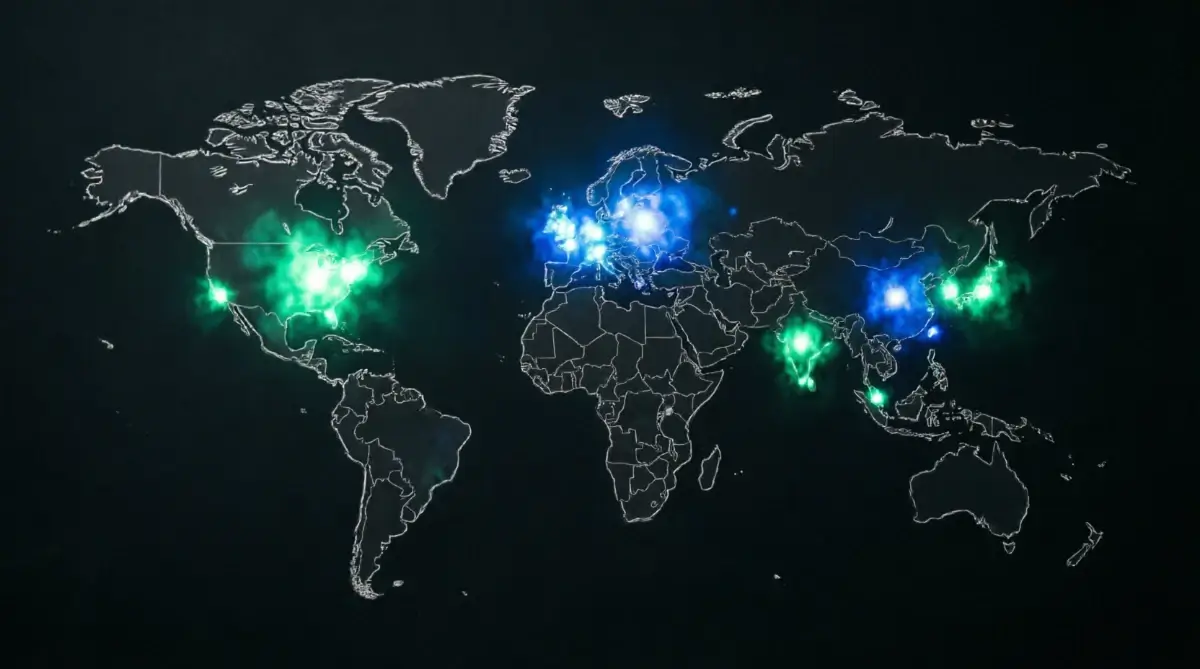
Your early traffic locations are not just dots on a map they are a direct signal of your content’s global relevance, the content relevance, and the true reach of the digital asset you are building. In my first month, 6 readers in the USA, 2 in Georgia, and 2 in Hong Kong proved this signal is real and this article will show you exactly how to read it.
The Early Geographic Snapshot That Caught My Attention
The geographic data in Month 1 was sparse. 6 users in the USA. 2 in Georgia. 2 in Hong Kong. That was the entire international footprint. In Month 2, the map expanded sharply 85 users in the USA, plus new entries from the United Kingdom, India, and China. This section unpacks what those early snapshots actually meant, and why the shift from Month 1 to Month 2 contained more strategic insight than any visitor count.
Month One: 6 Users From the USA, 2 From Georgia, 2 From Hong Kong
When I first looked at the location data, the numbers were tiny. But the fact that there were any users at all outside my own country people I had never met, in places I had never promoted to told me the search engine was already distributing the content globally. I had not shared the site on social media. I had not run a single advertisement. The only explanation for those 6 readers in the USA was that they had typed a query into a search bar, and the search engine had decided my article was a relevant result. The mechanism had worked, silently and without my intervention.
That realization changed how I viewed the entire project. I had assumed that a new site would remain invisible until I did something to promote it. The geographic data proved otherwise. The search engine was not waiting for my optimization. It was already testing the content against real queries, in real countries, with real people. The 6 users in the USA were not a marketing success. They were a search success. And that distinction between promotion and discovery is one of the most important concepts a site owner can internalize. The library I was building did not need a megaphone. It needed to be indexed, relevant, and clear. The geography data was the first proof that those conditions were being met.
The presence of users in Georgia and Hong Kong was even more striking. These were not countries I had ever targeted. I had no cultural connection to them. The articles were written in English, from a personal perspective rooted in my own experiences. Yet someone in Tbilisi and someone in Kowloon had both found their way to the content that suggested the topics self‑study, persistence, building skills with limited resources were not bound by geography. They were human topics, relevant wherever a person faced the challenge of learning something on their own. The geographic spread was the earliest signal that the content had carrying the capacity.
The 6 users in the USA did not arrive by chance they arrived because the search engine had crawled the articles, indexed them, and begun testing them against real queries. The process is invisible, but it follows a logic. The engine looks at the content and asks: what question does this page answer? It then matches that question against the millions of queries it receives. When a match is found, the page is shown to the user.
If the user taps and stays, the match is reinforced if the user bounces, the match is weakened. The 6 users in the USA were the result of successful matches queries where the article was deemed relevant enough to show, and the user found it relevant enough to stay. Each of those 6 visits was a tiny vote of confidence in the content’s relevance. The geography data was the map of where those votes came from.
Understanding this mechanics removes the mystery from the early numbers the site was not lucky. It was functioning. The search engine was doing exactly what it was designed to do, and the content was doing exactly what it was designed to do. The geography data was the feedback cycle that confirmed both were working for a new site owner, this is the most important early validation you can receive.
It means the infrastructure is sound, the content is indexable, and the topics are relevant. Everything else traffic volume, rankings, revenue is downstream from this fundamental functioning. The process I used to later map and protect every ranking signal during the platform migration was a direct continuation of that early discipline of paying attention to what the data was telling me.
I remember the exact moment I first saw the world map in my analytics dashboard. It was a standard built‑in view, a map with countries shaded in different intensities based on user count. The USA was the darkest shade. There were faint dots in Georgia, Hong Kong, and a few other places. The map was mostly empty, but it was global.
I stared at it for a long time I zoomed in on Georgia I had never been to Georgia. I had never written about Georgia. Yet someone there had found the site. That moment of connection, across thousands of miles, was one of the most profound experiences of my entire publishing journey. It made the work real. It made the audience real. It made the internet, for all its noise and distraction, feel like what it was always meant to be: a bridge between one mind and another.
That emotional impact is something I wish every new site owner could experience. It is the moment when a blog stops being a hobby and becomes a global platform. The numbers do not need to be large for the impact to be felt. 2 users in Georgia is enough. The geography signal, even at its smallest, carries a weight that no vanity metric can match. It is the weight of real human connection, unmediated by algorithms and advertising the search engine may have delivered the reader, but the content earned the connection that is a feeling worth chasing, and it is available to anyone who builds with honest intent.
Month Two: The Shift to 85 in the USA, Plus the UK, India, and China
By the second month, the geography had expanded the USA jumped from 6 active users to 85, and new countries appeared. The United Kingdom contributed a small but consistent of readers. India and China appeared on the map for the first time. The spread was no longer a curiosity; it had become a pattern that demanded a closer reading. The USA, in particular, had become the largest single audience, growing by more than tenfold in a single month. That growth was not driven by any action on my part. It was entirely organic the compounding effect of more articles being indexed, more queries being matched, and the search engine gaining confidence in the domain.
The emergence of the UK, India, and China added a new dimension. These are countries with enormous English‑speaking populations, but also with distinct cultural and economic contexts. A reader in Mumbai faces different obstacles than a reader in Manchester. The fact that both were finding value in the content suggested that the articles were not just accessible they were adaptable. The principles I was writing about applied across a wide range of circumstances the geographic data was telling me something that no amount of keyword research could: the content was relevant at a human level, not just a search‑optimization level.
I began to study the geographic report with the exact intensity I had previously reserved for visitor counts. Each new country that appeared even if it contributed only a single user was a data point. It represented a real person, in a real place, who had asked a question and found an answer in my words. The map was no longer an abstract visualization. It was a record of impact and impact, measured across borders, is the truest indicator of a content library’s value.
The geographic expansion from Month 1 to Month 2 was directly tied to the increasing number of indexed pages. In Month 1, only a handful of articles were in the search index. By Month 2, the indexed count had risen significantly, thanks to consistent publishing and the search engine’s growing crawl frequency. Each newly indexed article opened a new door for international readers. An article about self‑study might attract a reader in the UK, while an article about persistence might attract a reader in India.
The geographic spread was, in part, a reflection of the expanding surface area of the library. More articles meant more entry points. More entry points meant more countries that expanding footprint was something I studied carefully when analyzing how a site’s crawl frequency and indexation rate evolve as the library grows, and the patterns I observed then continue to hold true.
This relationship between indexation and geography is often overlooked. Site owners tend to focus on rankings and traffic volume, but the geography report tells a different story. It tells you whether your content is reaching beyond your immediate environment a site that is only indexed for a few queries will have a narrow geographic footprint.
A site that is indexed for hundreds of queries across multiple topics will naturally attract readers from a wide range of countries. The geography data is a proxy for indexation breadth. The broader your indexation, the broader your geography. The geography signal of Month 2 was, in essence, an indexation report disguised as a map.
The geographic expansion also revealed something about the relationship between language and reach. The articles were written entirely in English, yet they found readers in countries where English is not the first language. This suggests that the topics transcended the language barrier that enough people in those countries search in English when looking for self‑education resources.
Either way, the data confirmed that writing in a widely spoken language, combined with a themes that creates a powerful distribution engine. I did not need to translate the content to reach new regions. The search engine handled the matching, and the readers self‑selected based on their comfort with the language.
Geographic Diversity as a Direct Relevance Signal
When content resonates across continents, it is not an accident. It is a signal that the topics are addressing fundamental human challenges the kind that do not change with latitude. This section examines why geographic spread is a far more reliable indicator of content quality than any single engagement metric, and what it reveals about the universality of the material.
How Cross‑Border Readership Proves a Topic Is Not Hyper‑Local
If the content were only useful to a specific city or language group, the geography would stay narrow. Seeing readers from multiple continents told me the articles were touching on human experiences that crossed cultural boundaries. A topic like “how to stay motivated when learning alone” is not a local problem. It is a human problem. The geographic data confirmed that the content was addressing a need that existed everywhere.
This is a critical insight for content strategy many site owners assume they need to narrow their focus to a specific demographic to succeed. The geography data from Month 2 argued the opposite. The content was already reaching across borders without any localization. That meant the core message was strong enough to carry across different contexts. The implication was clear: instead of narrowing, I should continue writing for a broad, human audience. The geography had validated a universal approach, and I leaned into it with every subsequent article.
Cross‑border readership serves as a natural quality filter. Content that only appeals to a narrow slice of users will, by definition, show a narrow geographic footprint. Content that appeals broadly will show a wide one. The geography report is therefore a direct measure of universality. A site that attracts readers from 10 countries is, all else equal, producing more universally relevant material than a site that attracts readers from one. The 85 users in the USA were valuable, but the 2 users in Georgia were equally important not for their volume, but for their signal. They proved the content could travel.
The content that satisfies user intent is not the same as generic content that tries to appeal to everyone by avoiding specifics the articles that attracted readers in Georgia and Hong Kong were not watered‑down, one‑size‑fits‑all pieces they were detailed, personal, and grounded in real experiences.
The usefulness came from the emotional truth of the experiences, not from the absence of detail. A story about learning a language with no money and plenty of excuses is specific, but the underlying theme overcoming obstacles to build a better future is focusing on solution geography data proved that a specific story, told honestly, travels further than a normal article.
This is a crucial lesson for content creators who fear that being personal will limit their audience. The opposite is true. Personal stories, when they touch on usefulness, are the most shareable, memorable, and resonant content. The geography data from the early months confirmed this. The articles that attracted the most international readers were the ones where I had been most honest about my own struggles. The honesty did not limit the audience. It expanded it, because people everywhere recognize honesty. The geography signal was, in a sense, a truth detector it showed that authenticity crosses borders more effectively than polish.
The Broad Content Strategy Means the Writing Answers Broad Needs
The topics I chose self‑study, persistence, building skills with limited resources are challenges that exist everywhere. The geographic spread confirmed that I was not speaking to a niche audience but to a shared condition. A student in Delhi and a professional in London may look very different on paper, but both face the internal struggle of staying consistent when no one is watching. The articles addressed that internal struggle the geography data showed that the struggle was everywhere regarding the article intent.
That usefulness is one of the strongest foundations a digital asset can have. A site that serves a broad human need is not dependent on any single market, any single language, any single economic condition. It is resilient. If one country’s economy dips, the readership from other countries remains. If a search algorithm changes in one region, the site’s global footprint insulates it from total collapse. The geographic diversity of the early audience was not just a nice statistic. It was a structural advantage that would protect the site’s long‑term viability.
Writing for a. audience does not require stripping away personality context I wrote from my own specific experiences learning languages with limited resources, rebuilding after hardship, building a site from absolute zero. Those experiences were deeply personal. But the principles they illustrated persistence, resourcefulness, self‑belief were providing the solution the geographic data proved that a personal story, told honestly, can resonate far beyond its origin. The lesson is not to write generically. It is to write authentically about things that matter, and to trust that the human themes will carry across any border.
When I analyzed which articles were attracting the most international traffic, a pattern emerged. The articles that performed best across borders were the ones that addressed internal struggles motivation, consistency, overcoming doubt. These are not problems that require a specific income level, a particular educational background, access to certain technology.
They are human problems a reader in a developing country faces the internal battle to stay disciplined as a reader in a wealthy one. The external circumstances differ, but the internal experience is identical. The geography data proved that by writing about the internal experience.
In contrast, articles that focused on specific tools or platforms tended to have a narrower geographic reach an article about a particular language‑learning app, for example, might only attract readers in countries where that app is available. The geography data taught me to emphasize the principles over the tools. Tools change. Principles endure. The international audience was voting with their visits for the enduring content. I listened to that vote and adjusted my content mix accordingly. The site’s global reach is a direct result of that adjustment.
The Silent Confirmation That the Content Was Not Bound by My Own Background
I wrote from a specific personal context, yet the articles found resonance in places I have never lived. That detachment from any single location proved the library had a much wider carrying capacity than I had imagined. The content was not about my life. It was about the reader’s life. The geography data showed that the readers were finding themselves in the content, regardless of where they were.
That realization was humbling it meant the site was not a personal diary. It was a public resource. The responsibility shifted. I could no longer write only for myself. I had to write for the person in Hong Kong, the person in Georgia, the person in Ohio all of whom were arriving with a genuine need and a limited amount of time. The geography data transformed the site from a private project into a public trust. That shift in mindset from creator to steward is one of the most significant transitions a site owner can make. It changes how you approach every article, every heading, every paragraph. You stop asking “what do I want to say?” and start asking “what does the reader need to hear?”
The separation of the content from my own background had a practical benefit. It meant the site could grow independently of my personal network. I did not need to be known in a country for the content to reach it. The search engine was the intermediary, and it was agnostic to my identity it cared about relevance, clarity, and depth.
The geography data proved that those qualities were present, and that they were sufficient to cross borders without any personal brand behind them. That is the power of a true digital asset: it works for you, in places you will never visit, for people you will never meet.
The realization that the content was not bound by my own background had a counterintuitive effect: it made me more comfortable being personal. Knowing that the specific details of my life were not limiting the audience that readers in other countries could still connect with the underlying themes freed me to be even more specific. I did not need to generalize my experiences to make them accessible. I could tell the story exactly as it happened, trusting that the human core would carry across any cultural distance. The geography data was the proof that this trust was well‑founded.
That freedom to be specific is one of the greatest gifts a global audience can give a writer. It removes the pressure to appeal to everyone by being vague. Instead, you can appeal to everyone by being vividly, unapologetically yourself. The geography data from Month 1 and Month 2 told me that my specific story, rooted in a particular time and place, was finding readers in places I had never imagined. That knowledge has shaped every article I have written since. I write from my life, with all its particularity, and I trust the geography signal to tell me whether it is working. So far, it always has.
What the USA and UK Concentration Taught Me About Content Validation
The concentration of early traffic in the USA and UK carried a specific meaning that had nothing to do with economic value. These are among the most competitive search markets in the world. For a brand‑new site with no backlinks and no promotion to attract readers in those regions was a validation of content quality a signal that the articles were strong enough to rank where competition is fiercest. This section explores why that competitive validation matters, and how it informed my long‑term view of the site without ever making me value one reader over another.
The USA and UK as Competitive Proving Grounds for New Content
These regions are home to dense, mature search ecosystems. Millions of sites compete for attention. For a new domain to appear in front of American and British readers even in small numbers the search engine must have judged the content as relevant and worthy enough to show. That judgment, made algorithmically and without human bias, is a meaningful quality signal. The 85 readers in the USA in Month 2 were not just a statistic they were evidence that the content had passed a high competitive bar.
I did not target these markets I simply wrote articles that answered real questions, and the search engine matched those articles to queries from users in those countries. The fact that the matches were occurring at all told me the content was not just visible it was competitive. In a crowded search landscape, visibility is earned through relevance and depth the geography data was proof that the earning had begun.
A Small, Engaged Audience in Competitive Markets Confirms Content Strength
85 readers in the USA, combined with a strong early traffic from the UK, meant the site was gaining traction where content standards are high. The readers who arrived from these regions were not doing me a favour. They were finding genuine answers to their queries. Their presence told me the content was meeting a real need, not just filling a gap in a less saturated market. That validation was far more meaningful to me than any advertising metric.
The respect extended to every reader from every country. The 2 users in Georgia were just as real, just as valuable, just as much a part of the library’s purpose. No hierarchy exists among people who are seeking knowledge. The geography data is beautiful precisely because it is diverse a single reader from a small nation carries the similar human weight as a hundred from a large one. I never measured the worth of my audience by their location. I measured it by whether the content helped them.
Using the Competitive Signal to Understand the Site’s Potential Without Chasing Metrics
The presence of readers in highly competitive markets gave me confidence that the content quality was on the right track. I did not change my strategy to chase more readers from those regions. I did not localize my topics for American search trends. I simply noted the signal and continued writing for the audience themes that had attracted readers from so many different places in the first place. The geography signal was not a directive to narrow. It was a confirmation to stay broad.
That discipline of seeing a positive signal and not overreacting is essential. Many site owners, upon noticing a concentration of readers in a particular country, pivot their entire content strategy to serve that market. I resisted that urge. The strength of the library was its universality. To narrow it would have been to weaken it. The geography data told me the content was working across borders my job was to continue doing what had produced that result.
The presence of readers in highly competitive search markets gave me a long‑term confidence that no motivational quote could provide. It was evidence‑based confidence, grounded in data. I knew the content could compete where competition was fiercest. That knowledge became a reserve I could draw on during difficult months when traffic dipped or a new article failed to gain traction, I would remind myself: the content has already proven itself in the hardest markets. The current struggle is temporary.
The foundation is solid the geography signal was a permanent confidence booster, stored in the analytics and available whenever I needed it the daily discipline of showing up to write, even when the metrics were silent, was something I developed during those early months, and it remains the backbone of the site’s growth.
The Root of the Reach Search Visibility Alone
The geographic spread was not engineered I spent no money on ads, never posted on social platforms, and did not exchange links with anyone. The only force at work was the slow, and consistent process of search engines indexing the articles and presenting them to users who had typed a relevant query. This section isolates that single variable, because understanding it is essential to replicating the result.
No Paid Promotion, No Social Campaigns, Just Consistent Publishing and Indexing
The reach was purely organic that fact is the most important takeaway of this entire case study. The library did not need a budget to cross borders. It needed to be published, indexed, and relevant. The search engine handled the distribution. The geography data was the proof that this distribution mechanism works, even for a site with no reputation, no backlinks, and no marketing.
This is the democratizing power of search it does not care about your credentials, your location, your budget. It cares about whether your content answers a query. If it does, the content will be shown to anyone, anywhere, who asks that question. The geography data from Month 1 and Month 2 was a direct reflection of that principle in action. The 6 readers in the USA did not know who I was. They did not need to. They needed an answer, and the article provided it. The search engine connected them to it. The entire transaction was completed without any human intermediary.
The implication for site owners is profound you do not need to build a personal brand to reach a global audience. You do not need a social media following. You need a library of clear, honest, useful content, and the patience to let the search engine do its work. The geography signal is the feedback that tells you the work is being done. When a new country appears in your analytics, it is not because you promoted to that country. It is because your content earned the right to be shown there. That is a far more durable form of reach than any paid campaign could ever achieve.
The organic nature of the reach has a profound implication for content strategy: the best promotion is publication. Every article I publish is a new entry point for a future reader in a future country. I do not need to plan a global marketing campaign. I need to plan a global content library. The search engine handles the distribution.
My job is to ensure that every article is the best possible answer to the question it addresses. If I do that, the geography will take care of itself. The technical foundation that allowed the search engine to access the site reliably from day one was something I built deliberately, making sure the hosting and domain setup would never become a barrier to global reach.
This flips the traditional marketing model on its head. Instead of creating content and then promoting it, I create content that promotes itself through search. The geography data is the proof that this model works. The 85 readers in the USA in Month 2 were not the result of a promotional push. They were the result of 50 articles, each carefully crafted to serve a specific need, each silently working in the background the library was the promotion the articles were the marketers. The geography signal was the sales report.
Paid reach disappears the moment the budget stops organic reach, once earned, can persist for years. The geography data from Month 1 and Month 2 was entirely organic. I had not paid for a single visitor. That meant every reader who arrived from the USA, the UK, India, anywhere else was a permanent acquisition. They had found the site through a search, and the search engine had recorded that successful match. As long as the content remained online and relevant, the engine would continue to serve it for similar queries, generating a consistent stream of international readers indefinitely.
This durability is the defining advantage of organic search over paid promotion. A paid ad buys a moment of attention. An indexed article buys a permanent presence. The geography data was the earliest proof that the site had achieved a permanent presence in multiple countries. The 85 readers in the USA in Month 2 were not a one‑time spike. They were the beginning of a curve that would continue to rise, without additional spending, for as long as the library continued to grow. The return on investment for organic content is not measured in weeks. It is measured in years. The geography signal was the first indication of that long‑term return.
The democratization of global reach is one of the most underappreciated aspects of organic search. A person with no budget, no connections, and no reputation can build a library that reaches every continent. The geography data is the proof that this is not theoretical. It happened. It is still happening. Every new article published here adds another entry point for another reader in another country. The library is borderless by design, and the geography signal is the ongoing confirmation that the design is working.
From a Private Project to a Public Resource
Before the geographic data appeared, the blog felt like a personal archive. Seeing user locations across 4 continents changed that. It became clear that the library was no longer mine alone; it was serving people I would never meet. This section is about the internal shift that accompanied that realization, and the responsibility it brought.
The Internal Shift When I Realized Strangers Across Oceans Were Reading
The moment I saw the country list, the site transformed it was no longer a collection of personal reflections. It was a public resource, actively being used by people in circumstances I could only imagine. That shift was not intellectual; it was visceral. I felt a new weight behind every article I published. The words were no longer just for me. They were for the person in Hong Kong, the person in Georgia, the person in London all of whom had arrived with a need and a limited amount of time.
That weight was not a burden it was a motivator it gave the daily writing session a sense of purpose that no visitor count could provide. I was not writing for a dashboard. I was writing for a real person, in a real place, who would read the words and either find what they needed to leave disappointed. The geography data made that person tangible. They had a location they had a time zone. They were real.
The internal shift from private to public is one of the most significant transitions a creator can make. It changes the standard you hold yourself to. A private journal can be sloppy, incomplete, self‑indulgent. A public resource cannot. It must be clear. It must be accurate. It must respect the reader’s time. The geography data forced me to adopt those standards, not because anyone was complaining, but because I now knew there was someone on the other side of the screen.
Writing for a global audience became a daily practice before I published an article, I would ask myself: “Would this make sense to someone who does not share my cultural background?” I would check for assumptions about technology access, about economic conditions, about educational systems. I would replace local examples with more practical tips that explain the local context so that an outsider could follow. This practice did not dilute the content. It strengthened it, because it forced me to clarify my thinking. The geography signal was the motivation, but the benefit was a more rigorous writing process.
That practice has become second nature I now write with the awareness that the reader could be anywhere. That awareness keeps the writing honest, clear, and grounded. It prevents me from taking shortcuts that rely on shared assumptions. The geography data of Month 1 and Month 2 was the first lesson in global communication. It taught me that the internet is not a local medium. It is a global one, and the writer who respects that fact will build a library that outlasts trends, platforms, and borders.
The daily practice of writing for a global audience involved a simple but powerful shift in perspective. Before I wrote, I would pause and picture a reader in a different country not as an abstract demographic, but as a real person sitting at a desk, on a bus, in a library, looking for an answer. That mental image shaped my tone. It made me write more clearly, more warmly, more directly. The geography data gave me the faces I needed to make that practice real. I no longer write for “traffic.” I write for the person in Georgia, the person in Hong Kong, the person in Ohio. That person is my editor, my audience, and my reason for showing up every day.
Accepting That the Content Now Belonged to Anyone Who Needed It
That realization brought a sense of responsibility the articles were not just expressions; they were now answers for real individuals navigating their own difficult learning journeys. The geography signal cemented the site’s role as a public transcript. I could no longer write casually. I had to write with the awareness that someone, somewhere, might be relying on the information to make a decision, to solve a problem, to keep going when they wanted to quit.
That responsibility is the price of reach the more people who find your content, the more accountable you become for its quality. The geography data was an early warning of that accountability. It told me that the site was already serving an audience I could not see. I had to write as if that audience were sitting in the room with me, reading over my shoulder. That standard has never left me. Every article I publish now is written with the awareness that the next reader could be anywhere, and they deserve the best I can offer.
When you know your content is being read internationally, the standard for accuracy rises. A reader in India may not have the cultural references as a reader in the UK. A comparison that makes sense in one country may be confusing in another the geography data forced me to audit my writing for clarity.
I began avoiding idioms that were too local, examples that assumed a specific economic context, and references that required insider knowledge. The goal was not to strip the writing of personality, but to ensure that the personality was accessible. The geography signal was a clarity check. It asked: would this sentence make sense to someone in Hong Kong? If the answer was no, I rewrote it.
That discipline has made me a better writer it forced me to express complex ideas in simple, concrete language. It forced me to explain my assumptions. It forced me to earn the reader’s understanding rather than assuming it. The geography data, by revealing the diversity of the audience, indirectly improved the quality of every article I published.
The site is stronger today because I learned, early on, to write for a reader who might be on the other side of the world the responsibility to maintain that accuracy and clarity extended to the technical side making sure the site remained stable and error‑free so that readers anywhere could access the content without interruption.
Deeper Insights Hidden in the Geographic Data
Beyond the broad patterns of growth and concentration, the geographic data contained subtler insights that shaped how I approached content strategy, audience empathy, and the long‑term direction of the site this section explores 4 of those deeper readings.
The Common Thread Was the English Language, but the Needs Were Culturally Distinct
The language of publication created the entry point but a reader in India, the UK, and the USA may face very different economic and social conditions. The fact that the content still resonated suggested it was built on fundamentals that transcend circumstance. The English language was the bridge, but the substance of the content the human experience of struggle and persistence was what kept readers engaged across those different contexts.
That insight shaped my writing in a specific way I became more deliberate about separating the normal content from my personal example. I would state the framework clearly “consistency matters more than intensity” and then illustrate it with my own story. The reader in a different culture could then map the principle onto their own situation, even if my specific example did not match their life. The geography data taught me to write in layers: a hard truth, supported by a personal story, leaving space for the reader to insert their own context. That technique has made the content more accessible to a global audience without sacrificing authenticity.
English is the bridge, but it is not the destination the fact that the content was in English certainly contributed to its international reach, because English is the most widely spoken second language in the world. But English alone does not explain why the content resonated in so many different cultures. Plenty of English‑language content never leaves its home country. The geography data suggested that something deeper was at work. The content was not just linguistically accessible; it was emotionally accessible the themes struggle, persistence, growth are not bound by language. They are bound by shared human experience.
That insight has implications for any content creator if you write in a widely spoken language, you have a distribution advantage. But that advantage only translates into international reach if the content itself is universally relevant. The geography signal is the test of that relevance. If your English‑language content is not attracting readers from multiple countries, the language is not the barrier. The substance is. The geography data from Month 1 and Month 2 showed that the substance was crossing borders. The language was the vehicle; the substance was the fuel.
The Geographic Spread Reflected the Evergreen Nature of the Topics
Topics like overcoming information overload, building consistency, and staying motivated do not expire. Their relevance is consistent regardless of time zone season, which likely contributed to the international discovery the search engine can serve an evergreen article for years, accumulating readers from different countries as it slowly climbs the rankings. The geographic data was a preview of that long‑term accumulation. The readers in Month 2 were just the first wave of a much longer process.
Evergreen content is the foundation of a durable digital asset. It does not require constant updating. It does not lose relevance when the news cycle changes. It simply sits in the index, waiting for the next person to type the right query. The geographic data confirmed that the topics I had chosen were evergreen by nature they were not tied to a particular event, technology or trend.
They were tied to the permanent human condition that meant the library would compound in value over time, with each article attracting a slow, consistent stream of international readers indefinitely. The tiny country counts in Month 1 were the first drops of what would become a global river.
Evergreen content compounds internationally because it is not tied to any single event an article about “how to build a daily learning habit” is as relevant in January as it is in July, in Mumbai as in Manchester. The search engine can serve it for years, gradually expanding its reach to new countries as it gains authority.
The geography data from Month 2 was just the first layer of that expansion over the months and that followed, the country list grew longer. New nations appeared, each representing a new group of readers who had found the article through a search. The evergreen nature of the content meant that the library was not just growing in depth; it was growing in geographic breadth, automatically, without any additional effort.
This compounding effect is the ultimate reward for building a library of evergreen content. Each article is a permanent employee, working around the clock to attract readers from every time zone. The geography data is the time sheet. It shows you where your employees are working. The 85 readers in the USA in Month 2 were just the first shift. The second shift was in Europe. The third was in Asia the library never sleeps, and the geography data is the proof.
Even the Smallest Countries on the List Represented a Real Person
2 users in Georgia or 2 in Hong Kong might seem negligible as a statistic. But each was a human who found the site through a search and that individual connection is the core of what a digital asset built on value actually achieves. The geography data, when you study it closely, is not a set of numbers. It is a map of human connections. Each country on the list represents at least one person who arrived with a question and left with an answer.
That perspective guards against the numbing effect of analytics. When you see a country listed with a single user, it is easy to dismiss it as noise. I trained myself to do the opposite. I would pause on those small numbers and remind myself: that is a person. That person is sitting somewhere in Tbilisi, in Kowloon, in a place I have never been reading words I wrote. The odds of that connection, across all the noise of the internet, are astronomically small. Yet it happened. The search engine made it happen. The content earned it. That is not noise. That is the entire purpose of a digital asset, achieved in miniature.
I made a habit of celebrating the appearance of a new country in the analytics, even if it contributed only a single user. I would note the country, look up its location on a map, and take a moment to appreciate that the library had reached someone there. This practice was not just sentimental. It was strategic it kept me connected to the human reality behind the data.
When you are building a digital asset, it is easy to become obsessed with aggregate numbers and lose sight of the individual connections that make up those numbers. The geography data, with its granular country‑by‑country breakdown, is a built‑in antidote to that abstraction. Each country is a person. Each person is a validation.
That practice helped me identify emerging markets before they became statistically significant. A single reader in Brazil in Month 2 might become 10 readers in Month 6, and a hundred in Month 12. By paying attention to the earliest signals, I could anticipate growth and prepare content that would serve those emerging audiences. The geography data is a leading indicator of future traffic patterns. The site owner who ignores it until the numbers are large misses the opportunity to shape the library for the audience that is already beginning to form.
The Data Gave Me A Signal to Keep Writing for a General Audience
Knowing the content was already reaching multiple countries, I stopped worrying about whether I should narrow the focus. The geography validated a broad, inclusive approach, and I leaned into it with every subsequent article. The pressure to niche down is strong in the content world. The geography data gave me a reason to resist it. The content was not too broad; it was exactly broad enough to reach across borders.
That idea was liberating I could write about motivation, about self‑study, about resilience topics that transcend any single niche without fearing that I was diluting the site’s focus. The geography data showed that the focus was not a narrow topic. The focus was a human theme. That theme was broad enough to encompass multiple subtopics, and the audience was broad enough to sustain them. The site was not a niche blog. It was a human library. The geography confirmed that a human library could attract a human audience, from anywhere.
The strategic value of maintaining a broad approach became clearer over time. A site that niches down too aggressively limits its total addressable audience. The geography data suggested that my total addressable audience was already international and diverse. Narrowing the focus would have reduced that audience. Staying broad preserved it. The decision was not just about content preference; it was about maximizing the long‑term potential of the asset.
A broad approach does not mean a lack of focus it means focusing on a theme rather than a micro‑topic. The theme of this site self‑directed learning, resilience, digital asset construction is broad enough to encompass many subtopics. The geography data confirmed that this breadth was an asset, not a liability. Readers from different countries were finding different entry points into the library, each drawn by a subtopic that resonated with their specific situation.
The broad theme provided a large surface area for the search engine to match against queries. The geography data was the map of those matches. It showed that a broad theme, executed with depth and honesty, can attract a global audience more effectively than a narrow niche ever could.
The broad approach has allowed the site to grow in unexpected directions. Because I was not constrained by a narrow niche, I could follow my curiosity into adjacent topics site building, productivity, resilience that all connected back to the core theme of self‑directed learning. The geography data supported this expansion. Each new topic cluster attracted readers from different countries, broadening the geographic footprint even further. The site became not just a library, but a diverse ecosystem of interrelated content. The geography signal was the thread that tied it all together, showing that the expansion was not diluting the audience but deepening it.
That ecosystem is now self‑reinforcing a reader who arrives for an article about language learning may discover an article about building a digital asset. That cross‑pollination keeps readers on the site longer and exposes them to the full range of what the library offers. The geography data reflects this internal connectivity countries that initially appeared for one topic now appear for multiple topics.
The library has become a global destination, not just a collection of individual pages. The geography signal was the earliest indicator of that transformation. The technical setup that made the site fast and accessible from anywhere was a critical piece of that global reach, and the specific steps I took to connect the domain and configure the hosting are documented in a guide that covers the entire process.
The Geography Signal as a Lasting Guide
The early geographic data became one of the most reassuring signals of the entire early period. It showed that a library built silently, with consistent effort and honest intent, can cross borders on its own. That truth continues to shape how I write and what I publish here, with the understanding that the next reader could be anywhere.
A Borderless Reach, Achieved Without Expenditure, That Guides How I View This Blog’s Role
The geography signal taught me that reach is not something you buy. It is something you earn, article by article, query by query. The site’s role is to be a permanent, growing resource that serves anyone who needs it, regardless of their location. That understanding has become the foundation of every content decision I make. I no longer ask “will this rank?” I ask “will this help someone, somewhere, who is searching for an answer?” The geography data proved that if the answer is yes, the search engine will find them.
The borderless reach of the early months recalibrated my expectations. A site does not need to dominate a single market to be valuable. It needs to be useful to real people, wherever they are. The geography signal is a reminder that the internet, for all its noise, still functions as a connection engine. It connects a question typed in Mumbai with an answer written in a still room thousands of miles away. That connection is the fundamental transaction of a digital asset. The geography data is the receipt.
I still check the geographic report regularly I watch for new countries appearing, even with a single user. Each one is a small confirmation that the library is still doing its work. The signal has not faded with time. It has grown stronger, as the content has deepened and the search engine has learned to trust the site. The early geography data was the first chapter of a story that is still unfolding. The next chapter is being written by the next reader, in the next country, who types a query and finds their answer here.
That is the power of a digital asset built on honest intent. It is not bound by borders, budgets, algorithms. It is bound only by the quality of the content and the persistence of the publisher. The geography signal is the evidence that those 2 factors, applied consistently, are enough to reach the world the method I now use to maintain the publishing consistency that makes this global reach possible is the discipline routine that powered the site from its very first article.
The geography signal has become one of the metrics I track most closely. It tells me things that traffic volume does not. A spike in traffic from a single country could be happened a mention on a local forum, a temporary algorithm fluctuation. A slow, and consistent expansion of the country list is a more reliable indicator of genuine growth. When I see a new country appear and then reappear in subsequent months, I know the content is taking root there. That slow, still expansion is the truest measure of a library’s global reach.
I now use the geography data to guide content decisions. If I notice a growing readership in a particular region, I might write an article that addresses a challenge specific to that region not by changing my voice, but by including examples of case studies that resonate there. The geography signal does not dictate my strategy, but it informs it. It is a compass that points toward the readers I am already serving, helping me serve them better. The early geography data was the first calibration of that compass. It pointed toward a global audience, and I have been following that bearing ever since.
I return to the geography report periodically, not to obsess over the numbers, but to remind myself why I am building this site. The country list is a tangible record of the people the library has served. Each country name is a story a person who arrived with a question and found an answer. That record is more valuable to me than any revenue figure traffic milestone. It is the purest expression of the site’s purpose: to be a permanent, freely accessible resource for anyone who needs it.
That purpose, once internalized, becomes a filter for every decision. Should I write this article? Will it serve the reader in Georgia, the reader in Hong Kong, the reader in Ohio? If the answer is yes, the article is worth writing. If the answer is no, I reconsider. The geography signal, first glimpsed in Month 1, has become the compass by which I navigate every content decision. It points toward the reader. And as long as I follow that bearing, the site will continue to grow in the only direction that matters: toward the people who need it most.
If I had to choose a single metric to measure the value of this site, it would not be traffic volume, revenue, rankings. It would be the number of countries represented in the geographic report. That metric captures everything that matters: relevance, reach, accessibility, and impact. A site that serves readers in 50 countries is more valuable in every sense than a site that serves the number of readers in one country. The diversity of the audience is a form of resilience. It insulates the site from local economic downturns, regional algorithm changes, and cultural shifts. The geography signal is the ultimate measure of a digital asset’s global footprint.
That footprint is not built overnight it is built one article, one query, one reader at a time. The geography data from Month 1 and Month 2 was the first faint outline of that footprint. It has since grown into a detailed map of a global readership. The process is slow, but it is reliable. As long as the library continues to deepen and the quality holds, the map will continue to fill in. The geography signal is the compass that tells me the direction is true the next country, the next reader, the next connection they are already on their way.
Every morning, before I begin writing, I glance at the geographic report I do not study it I simply note the countries that are currently showing readers. That 10‑second reminds me that the work is not abstract. It is reaching real people, in real places, who are searching for something I have chosen to share. That reminder is more motivating than any productivity hack. It turns the writing session from a task into a service the geography signal is my daily connection to the purpose behind the pixels.