For years I believed that if I simply surrounded myself with foreign language sounds videos, podcasts, the murmur of strangers on the street the words would eventually take root and bloom into speech. I was wrong the brain is not a sponge it is a forge and a forge needs fire, not just water.
The last bus of the night ran along a route that took forty minutes from end to end. I sat in the back corner most evenings, the only passenger after the third stop, with a single earbud pressed into my right ear and my jacket pulled tighten streetlights swept across the window in slow, regular arcs.
I had been listening to foreign language recordings every day for months short documentaries, conversations between strangers, a woman describing her morning routine in a language I was trying to absorb. I understood more than I had before. I could follow the shape of a sentence, catch where a question lifted and where a statement settled but something was missing my understanding had grown, but my voice had not moved a single inch.
I had believed quietly, stubbornly that if I just kept listening, the speaking would come. The bus rumbled over a stretch of broken pavement. The earbud wire caught on my sleeve and pulled loose. In the sudden quiet, I heard my own breathing and realized I had not spoken a single syllable in that language all day. Not one. I had consumed hours of content. I had understood fragments. But I had produced nothing the gap between comprehension and voice had become a chasm, and I had been filling it with more and more input, as if enough water would eventually form a passage on its own.
Illustration:AI-generated visual representing”recognition memory not production memory understand but cannot speak”
What I didn’t know then what I only understood much later is that brain research was already beginning to challenge the whole foundation I had been resting on for decades, language learners were told to focus on input: listen, read, absorb. The idea was that if you understood messages slightly beyond your current level, acquisition would happen naturally.
But newer studies using brain imaging were showing something radically different language development is not passive absorption. It is an active, embodied process one that requires interaction, feedback, and multimodal engagement to build lasting neural pathways the brain learns language not by receiving it, but by acting with it. And I had done nothing but receive.
How to Start Speaking When You’ve Only Ever Listened
The way I finally moved from comprehension to speech was by giving my mouth a job before my mind could object I began recording my own voice just a few seconds at a time, speaking back to a phrase I had just heard. I played a sentence from a recording, paused, and repeated it aloud into a cracked corner phone. Then I played both back, side by side my voice sounded wrong to me thin, uncertain, accented in ways I couldn’t control. But I kept doing it not because I saw immediate progress, but because the act of speaking even to an empty room was doing something the videos never could. It was turning my mouth into a learner, not just my ears.
What Happens When You Only Receive and Never Respond
A few weeks before the bus rides became routine, a neighbour stopped me in the hallway. He spoke the language I had been studying not quickly, not with complicated words. He asked if I knew when the hot water would be turned back on in the building. I understood every word the question was simple. The context was clear. I opened my mouth and nothing came my jaw worked silently. Finally, I shrugged and pointed toward the stairwell, mumbling something in my native tongue. He nodded, a little confused, and walked on.
The neighbour who asked a question I could not answer
The shame was not that I didn’t know the answer. It was that I had no voice to give what I knew that night, sitting on the edge of my bed with the phone in my hand, I replayed the conversation in my head. I had watched hundreds of videos in that language. I had listened to podcasts while walking to the market. I could follow the gist of a news report. But the moment real communication was required the moment I had to move from receiving to producing my brain had frozen.
The reason, as I later came to understand, was not a personal failure. It was a neurological reality. Passive listening activates different brain systems than speaking. When you only consume language, you strengthen recognition circuits. When you produce language when you speak, even badly, even with mistakes you engage motor planning areas, auditory feedback loops, and the sensorimotor cortex these systems do not develop through observation they develop through doing.
To truly learn to speak, you need to detect and act on what researchers call “affordances” those perceivable opportunities for action that arise when a learner and their environment meet. A video offers only a narrow set of affordances: pause, replay, read subtitles. A real conversation even a clumsy, broken one offers a much richer set: listen, process, formulate, speak, receive feedback, adjust, try again the gap between those two experiences is not small it is the difference between watching someone lift a weight and actually putting your hand on the bar.
There was a month when I had no one to talk to I started recording my own voice just a few seconds at a time, speaking back to a recording I had saved. I played a sentence, paused, and repeated it into the phone. Then I played both back, side by side. My voice sounded wrong to me thin, uncertain, accented in ways I couldn’t control. But I kept doing it not because I saw immediate progress, but because the act of speaking even to an empty room was doing something the videos never could.
I came to understand later, when I read about how self‑directed learners build their own path to mastery, that speaking first before you feel ready is what actually builds the foundation for fluency to become your own teacher and learn any foreign language by yourself means accepting that production, not just comprehension, must lead the way.
The neighbor’s question had turned into my first real lesson you can recognize a thousand words, but unless your mouth has shaped them, you don’t yet own them.
Illustration:AI-generated visual representing”speaking activates brain feedback loops listening leaves network dark”
Why can I understand so much more than I can actually say?
Understanding draws on recognition memory your brain matches incoming sounds to stored patterns speaking requires production memory your brain must retrieve words, assemble them grammatically, activate motor plans, and monitor your own output in real time. These are distinct neural systems. Recognition develops faster because it is passive. Production lags because it requires the brain to build new motor pathways through repeated, active practice. The gap is not a sign of failure. It is a sign that you have been feeding only one side of the equation.
Take out your phone open a voice recorder play any short phrase in the language you are learning no more than five seconds. Pause. Repeat it aloud. Record your version. Now play both back. Do not judge the accent. Do not compare. Just notice: your voice moved that movement is the beginning of everything the videos cannot teach.
The Brain Science That Changed How I Practice Every Day
What I learned later from brain research gave a name to the frustration I had been feeling language learning is not a process of filling a bucket with drops of input. It is the construction of a living network and that network grows only when you actively participate.
Why your brain lights up when you speak, and stays dark when you only watch
Brain imaging studies have shown that when a person speaks a foreign language, multiple regions activate simultaneously: the motor cortex plans the movements of the mouth and tongue, the auditory cortex monitors the sound of one’s own voice, the prefrontal cortex manages meaning and grammar, and the cerebellum fine‑tunes timing and coordination. This is not a simple retrieval of stored words; it is a full body cognitive act. When you only listen, large portions of that network remain inactive. You are strengthening the recognition pathways, but you are leaving the production pathways untouched.
The static “comprehensible input” model the idea that if you just understand messages slightly beyond your current level, you’ll naturally acquire the language has been challenged by this evidence. Language acquisition is dynamic, interactive, and deeply embodied. It requires that you move from receiving to producing, from observing to doing input gives you the notes. Output teaches you to play the instrument.
The moment I replaced half of my listening time with active speaking practice was the moment my progress stopped feeling like a slow leak. I started shadowing repeating aloud immediately after a recording, matching pitch and rhythm without pausing for meaning I fumbled I stopped.
I started again and slowly, the sounds that had once felt foreign in my mouth began to feel like they belonged there. The key was not more input. It was more output and the research backs this up: learners who engage in regular, active production outperform those who rely on passive methods alone.
My brain had been waiting for me to do something, not just absorb something. The difference was measurable not in some scanner, but in the fact that words I had produced stayed with me, while words I had only heard faded within days.

Illustration:AI-generated visual representing”output-driven acquisition turns fragments into owned language”
If I only have limited time, should I spend it listening or speaking?
Divide your practice so that at least half of your time is spent producing the language speaking aloud, writing sentences from memory, or shadowing audio with your own voice. Listening builds recognition. Speaking builds production. Recognition alone cannot sustain a conversation. Production is what eventually makes listening effortless, because the sounds you have learned to make yourself become the sounds your ear can catch without strain.
Look at your last session count how many minutes you spent watching, reading, or listening. Now count how many minutes you spent talking, writing, or composing in the language. If the second number is less than half the first, adjust tomorrow. Even if all you do is repeat one sentence three different ways out loud, that counts production is not practice for later. It is the practice itself.
The Morning I Stopped Repeating Words and Started Using Them
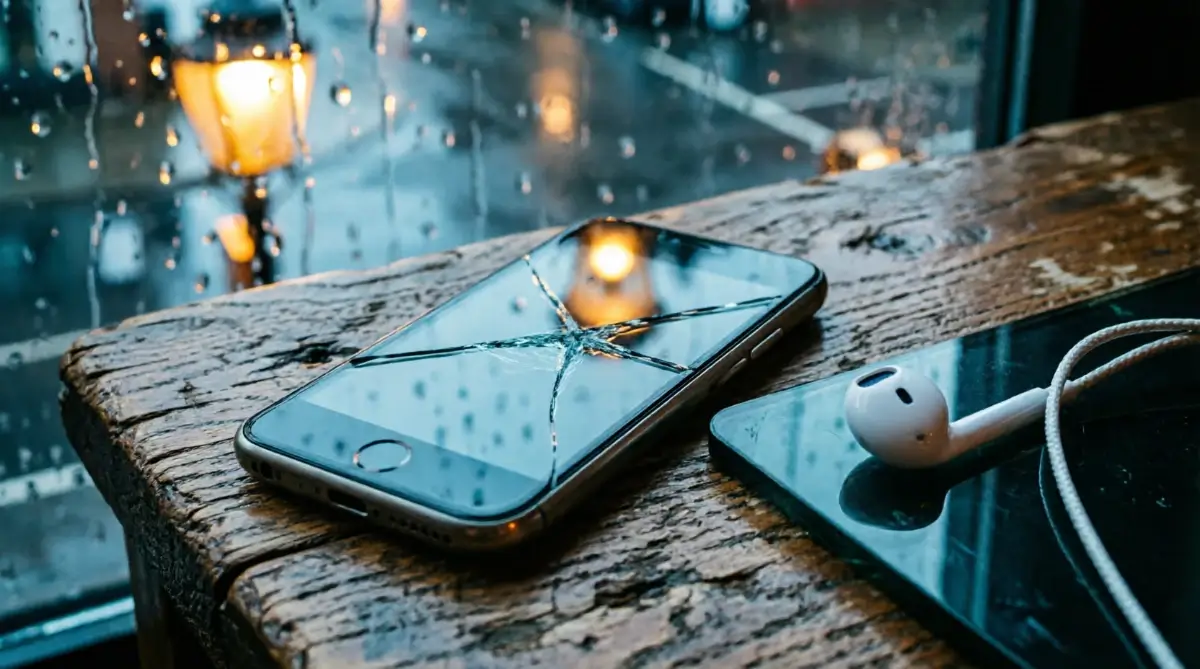
I still have the first voice memo I ever made a seven second clip of me stumbling through a greeting, pausing too long between the first word and the second. The quality is bad. The microphone on that old phone crackled whenever I held it too close. The screen had a hairline fracture running from the top corner to the center, a reminder of a morning I had dropped it on the pavement outside a shop but the file survived. And when I listened to it weeks later, I heard something I had missed in the moment: I had spoken.
A cracked phone screen and a voice memo I almost deleted
That one act opening my mouth and producing sound, however imperfect had changed the architecture of my learning. The research calls this “output‑driven acquisition.” When you speak, your brain does not just retrieve words. It constructs them. It assembles meaning from fragments, tests hypotheses about grammar and pronunciation, and monitors its own output through an internal feedback practice. Every mistake you make while speaking is not a failure; it is data a signal that tells your brain where the gaps are. Input alone cannot generate those signals. Only output can.
I started small. I would hear a phrase on a podcast, pause it, and respond as if the speaker had asked me a direct question. “What did you eat today?” and I would answer, out loud, in the language I was learning, even if the answer was wrong, even if it was only three words. The speaker did not wait for me. The podcast did not care. But my brain did. Over time, I noticed that the words I had produced the ones I had struggled to assemble stayed with me longer than the ones I had only heard they had a weight to them, a physical memory of the effort it took to form them.
This shift from mimicking isolated sounds to actively using words in context echoed something I had once learned about self‑education. When you stop looking for a teacher and start building your own curriculum, the first real skill you acquire is not vocabulary; it is the ability to recognize what you still don’t know a self directed education framework without a degree is built on the principle that your own production your own attempts reveal gaps far more honestly than any test ever could.
The cracked phone had become my first real classroom not because it taught me words, but because it forced me to produce them.

Illustration:AI-generated visual representing”words you produce stay words you hear fade output builds memory”
How do I start speaking if I have no one to practice with?
You do not need a conversation partner to begin producing language record yourself answering simple question “What did I do yesterday?” or “What is outside my window right now?” and play the recording back. Listen not for mistakes, but for the shape of your voice in the new language. When you hear a gap between what you wanted to say and what came out, that gap is the most valuable feedback you will ever receive. It tells your brain exactly where to focus.
Find a recording of any question in the language you are learning. Pause it. Answer it out loud one sentence, no preparation, no translate. Do not write anything down. Do not check if it was right. Just speak. Then do it again with the next question. Tomorrow, try two sentences. The day after, three. Your voice needs to learn that it is allowed to move before your mind is ready.
Why Speaking First Changed Everything About My Memory
Before I began speaking regularly, I forgot words almost as quickly as I learned them I would study vocabulary lists, recognize them in context, and then watch them dissolve a week later. The problem, I eventually discovered, was that I had never truly used those words. They lived only in the part of my brain that recognizes they had never made the journey to the part that produces.
The doorway where a forgotten phrase finally landed
I was walking past a crowded doorway when a quick phrase cut through the noise a fragment of a language I had been studying. My old instinct would have been to translate it in my head. But this time, something different happened. I didn’t translate. I didn’t even consciously recall the phrase simply settled into my awareness, complete and recognizable, like a visitor who had arrived without knocking.
My mouth shaped a quiet response before my mind had finished processing what I’d heard that was the moment I realized that the words I had spoken the ones I had actually produced, even badly had become part of me in a way the words I had only listened to never had.
There is a method that bypasses the mental translation entirely the 200 conversation approach I once stumbled upon, where learners exchange simple dialogues in a language exchange, taught me that speaking without the crutch of translation builds a different kind of memory how I learned English with no teacher and no textbook was not through flawless grammar drills but through raw, unpolished output the mistakes taught me more than the perfect sentences ever could.
The words I had struggled to say became the words that stayed while the ones I had only heard slipped quietly away.

Illustration:AI-generated visual representing”brain strengthens through effort not ease speaking builds structure”
I remember a morning when I replayed a voice memo from three weeks earlier the first few seconds were the same hesitant, full of gaps. But then something shifted. My voice smoothed out on a phrase that had once tripped me I played it back five times. The progress was invisible day by day, but it was undeniable across time the act of speaking, not listening, had been the engine of that change.
How Active Engagement Outperforms Passive Study Every Time
For years, the language learning world was dominated by the belief that input was king listen enough, and you will speak. Read enough, and you will write. But the evidence both from neurolinguistics and from my experience is overwhelming: active engagement beats passive study every time.
The discipline that outlasted motivation
Active engagement means not just hearing words but responding to them. It means producing language even when you are uncertain, even when you are wrong. It means treating every conversation as a laboratory for your own developing voice. The brain’s plasticity responds to effort, not to ease.
When you struggle to speak, your brain strengthens the connections that make future speech easier when you passively listen, your brain coasts. The difference is measurable in brain scans, and it is palpable in the confidence of a learner who has learned to stop observing and start participating.
I used to believe that discipline was something you either had or you didn’t but I learned later that discipline is not a personality trait; it is a structure you build when motivation inevitably fades. How to stop relying on motivation and build a discipline system instead taught me that the same principle applies to language output. You don’t wait until you feel ready to speak you create a system a daily practice, a routine of voice notes, a commitment to shadowing and you follow it whether you feel like it or not the voice follows the structure it doesn’t lead it.
The shift happened when I stopped asking “Do I feel ready?” and started asking “Did I do my five minutes of speaking today?”

Illustration:AI-generated visual representing”silence between attempts is where learning consolidates rest training”
Where the Voice Finds Its First Real Footing
There is a quiet moment in every learner’s journey when the voice stops being a stranger it doesn’t announce itself with fluency. It arrives as a whisper, a stumble, a syllable that comes out wrong but still comes out that moment is not the end of learning. It is the beginning.
The power of pausing between effort and reflection
I learned not in a classroom, but in the stillness of a stairwell where I had gone to be alone that the voice needs rest as much as it needs repetition. When I spent weeks forcing myself to speak constantly, my throat tightened and my confidence frayed. I had to learn to pause not to stop, but to let the silence between attempts become part of the training. That quiet gap, I later realized, was where the brain consolidated what the mouth had just tried to do.
This principle of paced effort applies far beyond language learning. When I faced the chaos of rebuilding my life from nothing, I discovered that stopping the internal noise the constant pressure to do more sometimes created more stability than pushing harder ever could how to stay mentally steady when everything falls apart using internal quiet is not just a survival skill; it is a learning skill the mind needs silence to process what it has attempted, whether it’s a foreign sentence or a broken hope.
The stairwell had no teacher, no textbook, and no audience but it taught me that silence after effort is not emptiness it is where the learning settles.

Illustration:AI-generated visual representing”real language lives in chaos let voice survive noise find shape”
How often should I rest between speaking sessions?
As often as your throat and mind need if you feel tension building in your jaw or fatigue creeping into your focus, pause. A few minutes of silence can consolidate more than an hour of forced repetition the goal is not to exhaust yourself; it is to train your voice to move comfortably, and comfort grows in the spaces between effort.
Taking Your Voice Into the Noisy, Unscripted World
The quiet room is a sanctuary but the language does not live in the quiet room. It lives in the street, in the market, in the hallway, in the overlapping voices of a crowded doorway. The real test of active learning is whether your voice survives the noise.
The open window where two voices overlapped without pausing
I stepped away from listening to recordings and stood by an open window. Two neighbor’s spoke quickly across the yard. Rain tapped the glass in uneven bursts. Their words overlapped. I didn’t reach for a notebook. I didn’t try to isolate individual words. I just traced the rise of their voices with my fingertips along the windowsill. When a short vowel repeated a quick, sharp sound that cut through the rain I matched it softly under my breath. The sound carried through the damp air and disappeared. I didn’t catch every phrase. I didn’t need to. The rhythm moved through the space, and my mouth followed it without hesitation.
This was the environmental transfer the moment when controlled practice met the uncontrolled world. Unscripted speech does not slow down for learners. But the acoustic patterns are the same. The rise of a question sounds the same outside a window as it does inside a recording to test natural phrase retention during daily background routines is to discover that the ear has been training for this chaos all along the quiet room was the workshop the world was the proving ground.
The rain stopped the voices moved on but my voice had finally stepped outside, and it didn’t turn back.

Illustration:AI-generated visual representing”identity shifts when production leads voice finds own weight world”
Tomorrow, find an open window, a doorway, or any place where you can hear natural, unscripted voices close your eyes do not try to identify words just track the rhythm notice the rises and falls, the pauses, the overlapping parts. After a few minutes, try to hum the last tone you heard that hum is your ear’s own translation of the world.
When You Finally Stop Being a Student and Become a Speaker
There is a moment it arrives quietly, without fanfare when the identity shifts you stop being someone who is learning a language and become someone who speaks it. Imperfectly, perhaps. Haltingly at times but genuinely.
The shift doesn’t come from a certificate or a completed course. It comes from the thousands of small acts of production the whispered replies on a late night bus, the voice memos you almost deleted, the sentences you stumbled through and then repeated until they emerged whole. At some point, the language stops feeling like a foreign object you are manipulating and starts feeling like a tool you are using the transition is as much psychological as it is neurological.
I remembered, in that moment of recognition, the first time someone praised my fluency without knowing I had taught myself in a small room, without any teacher or formal class. The stranger’s question “How did you learn to speak like that?” hung in the air. I laughed and said something about waking up early for years. But the real answer was messier. It lay in the countless times I had decided to drop the internal translation and simply open my mouth how to stop mentally translating and let your mouth speak without an internal translation was a skill I had learned not by reading about it but by doing it, day after day, until the translation reflex finally quieted.
I once spent an entire week speaking only in the language I was learning not out of discipline, but out of sheer frustration with my own passivity. I stumbled. I was misunderstood a shopkeeper once stared at me and then switched to my native tongue. But by the seventh day, I had dreamed in that language. The voice had finally taken root, not because of what I had heard, but because of what I had dared to say.
The crowded doorway, the late night bus, the cracked phone they had all been classrooms I never recognized until I stopped being a student and let myself become a speaker.

Illustration:AI-generated visual representing”listening safe speaking path open mouth trust sound produce”
How do I know when I have shifted from learner to speaker?
You will feel it not in a moment of perfect grammar, but in a moment of unplanned response when you hear a question and answer without translating, when a phrase surfaces without being summoned, when you dream in the language or catch yourself thinking in it without effort the shift is cumulative, built from hundreds of small acts of production there is no certificate, only the quiet recognition that your voice has finally found its own weight.
The last bus still runs the same route. I still sit in the back sometimes, not because I need the recordings anymore, but because the motion of the city at night the flickering streetlights, the empty seats, the low rumble of the engine reminds me of where the silence first broke. The single earbud still hangs from my collar most days. But now, when I hear a phrase I do not know, I do not just file it away. I repeat it. I shape it. I let my voice try the weight of it.
We spend so much of our learning lives listening. Listening is safe. Listening asks nothing of us. But the voice needs to move. It needs to stumble and recover and grow strong through the stumbling. The brain research confirms what the body already knows: you cannot learn to speak by hearing alone you learn to speak by opening your mouth on a bus, in a hallway, into a cracked phone screen and trusting that the sound you produce, however imperfect, is the only path forward.
If you could go back to the moment your voice first locked the question you could not answer, the word you could not form and whisper one sentence to yourself in the language you are learning now, what would you say?
The voice memo is still on the phone I have not deleted it not because it sounds good it does not but because it marks the moment when listening stopped being enough. When production began. When active engagement with the language clumsy, uncertain, real started building what passive input never could.
If you have been waiting for your voice to arrive on its own, stop waiting speak the brain will follow.
And if you’re ready to build an entire self education system around active practice one that doesn’t require teachers, money, or perfect conditions then the first step is to stop learning for a test and start building for yourself learn any foreign language by yourself, from zero.