
I remember the time I understood, without anyone saying a word, that the kind of learning I wanted would never be handed to me in a classroom I was not angry no door had slammed no voice had told me I was not welcome I simply stood outside a building where knowledge was presumed to live, watching others walk inside with their notebooks and their expectations, and felt the quiet weight of a world that assumed my place was outside the walls.
I had no degree, no certificate, no transcript with my name on it. In that moment, standing on that street, I believed that education was something you had to be admitted to and that I had been left out.
What I did not understand then what I could not have understood was that the most enduring education I would ever receive would not come from behind those walls. It would come from the silence of early mornings, from pages I turned alone, from choices I made when no one was watching and no one was applauding. I never received a formal credential but I built something stronger: a self‑sustaining system of learning that has carried me across three languages, hundreds of books, and a lifetime of meaning.
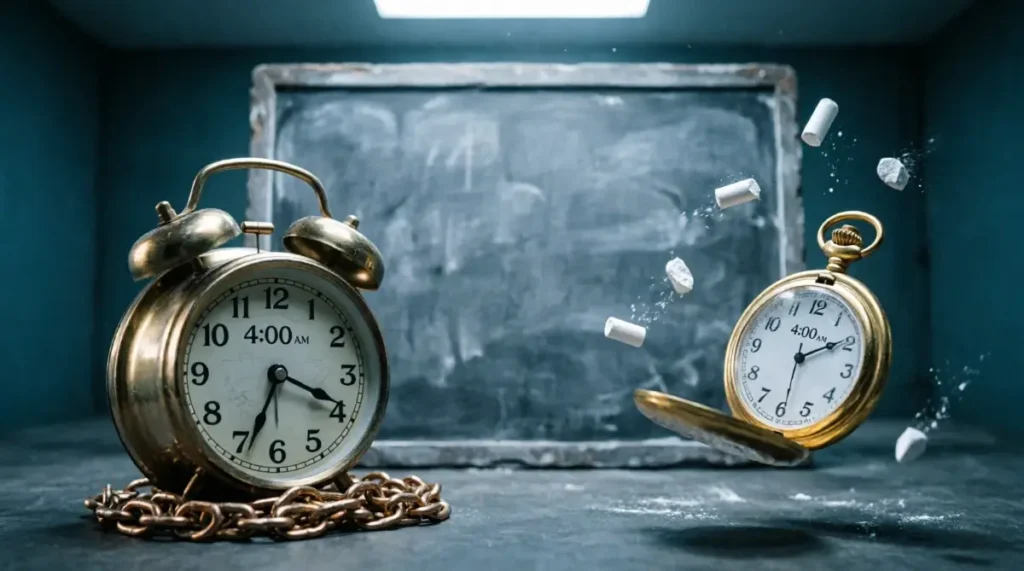
Illustration:AI-generated visual representing”belief beats barrier”
That journey did not begin with a curriculum it began with a decision to stop waiting for permission and start constructing my own classroom out of the hours the world forgot.
The University of 4 AM has no admissions office, no application fee, and no graduation ceremony. It has only one requirement: show up before the world wakes and do the work nobody is watching and that is the education that nobody can ever take from you. This is not a method reserved for language learners or those who lack formal schooling. It is an architecture and framework for mastering anything, coding, writing, design, business, music, mathematics, or any other skill you have ever wanted to claim as your own.
How to Build a Self Directed Education for Any Subject
You can master any subject without a degree, a teacher, or expensive resources I built my own “University of 4 AM” by waking before dawn, filling notebooks with evidence, and treating curiosity as the only admission requirement. You choose the skill; you set the pace; you create the curriculum from free materials the credential is not a piece of paper it is the stack of evidence you produce, day after day, that proves your willingness to learn. That stack, in time, becomes undeniable, whether you are learning a language, programming, art, or anything else that calls you.
When the Barrier Is a Belief, Not a Lock (Stepping Past the Fence)
I was born in a place where the written word belonged to other families. The alphabet was not something that sat on a shelf in our home; it lived inside a building I could see from the dust road a school but it might as well have been on the far side of a river with no bridge. The distance between me and that building was not measured in steps; it was measured in assumptions about who deserved to learn. I walked past that school many times, always on the outside, always believing the gate was locked against people like me.
Years later, after leaving my country and arriving in a new place, I finally entered a classroom I was older than the other students. I carried a hunger they did not share a hunger to understand, to catch up with a world that seemed to have started the race long before I even knew there was a race. The teacher spoke; the others wrote; my hand could barely form the letters. Someone laughed when I stumbled. I felt the heat rise in my chest, but I kept my head down and continued.
I asked the teacher once how long it would take to reach basic literacy. She gave me a timeline that felt as heavy as a sentence handed down. The number sat inside me like a weight. I thought about the years stretching ahead, measured by someone else’s clock, and I felt something in me begin to shrink. The pace was not mine. The sequence was not mine. I realized the gate was not a lock it was the belief that I had to follow someone else’s path before I could call myself educated.

Illustration:AI-generated visual representing”witness beats attempt”
I did not leave because I was angry I stepped away because I understood that my learning could not be confined to a room where I was always catching up. I needed a different kind of classroom one that opened when I opened my eyes, that required no tuition beyond attention, and that measured progress not in grades but in pages filled, problems solved, skills demonstrated.
The obstacle that keeps many capable people from building a self‑directed education is not the absence of a degree. It is the story they have been told about what learning requires: a building, a teacher, a timetable, a piece of paper at the end. When you release that story, the resources become visible everywhere. Libraries, the internet, conversations with strangers, the back of a receipt and a borrowed pen these are the materials of a self‑built education. Whether you want to learn a new language, how to code, how to write, or how to start a business, the path opens the moment you stop waiting for an institution to validate you.
I later came to understand that this entire framework of building without permission is in the broader architecture of a self sustaining education system that foundation taught me that when you stop waiting for institutions to open doors, you discover that the world itself is a classroom, and the hours before dawn are its quietest, most powerful lecture hall.
How do I start learning a new skill when I have no formal background in it?
Start exactly where you are, with whatever you have. I began with no alphabet and a borrowed pen. You might begin with a free online resource, a library book, or a single question typed into a search bar. The key is to make the first move small enough that you cannot talk yourself out of it. One sentence, one line of code, one sketch, one practice problem. The act of starting, no matter how imperfectly, is what transforms you from someone who wants to learn into someone who is learning.
What became clear only much later is that the gate I had stood outside for so long was not a wall. It was a mirror, reflecting my own hesitation back at me. The moment I stepped past it, the entire landscape of learning opened up and the classroom I entered was not a room it was a rhythm.
Think of one skill you have been wanting to learn but felt unqualified to start write down one reason you have been waiting. Ask yourself: Is this barrier real, or is it a story I have accepted? If it is a story, what is one tiny action you can take today to rewrite it? Take that action.
The First Move You Ever Make at Dawn (Enrollment Without Permission)
The morning air was cool, the way it often is before the rest of the world stirs. I sat at a small table with a single notebook and a pen I had borrowed. There was no curriculum waiting for me, no assignment due, no voice telling me what to learn or how to learn it there was only the empty page and the quiet hum of my own attention.
I wrote one sentence not a paragraph, not a page. One sentence. It was not profound. It was probably full of mistakes but it was mine.
That sentence was my first deliberate act of self‑education. And it carried more weight than any certificate I would later see. Because it was proof to myself that I could begin.
That single morning became the foundation upon which I would later stack years of sentences, years of pages, years of showing up in the dark. The act of doing something anything at dawn did more than teach me a subject; it taught me that I could be both the learner and the witness. Nobody was grading me. Nobody was watching and yet the evidence accumulated, and with it, something far more important than a grade self‑trust.

Illustration:AI-generated visual representing”investment is the only cures of regret”
When you sit down at the same hour each day, without external validation, something shifts beneath the surface. You begin to trust that you will keep the appointment. You begin to see yourself as someone who can rely on yourself. That identity the one who shows up is far more valuable than any credential, because it travels with you everywhere, into every new skill you decide to learn.
This process of becoming your own teacher is how I found that the principle and the system I built with nothing but a notebook and an alarm clock where I learned that the simple, repeated act of showing up rewires not only the mind but the entire architecture of self belief. Whether you are practicing a musical instrument, learning to draw, or studying a new programming language, the mechanism is identical: small, consistent inputs, performed without fanfare, create a compound effect that eventually becomes mastery.
Why the First Minute Matters More Than the First Month
Most people who abandon a skill do not quit in the middle of a year; they quit in the first few weeks because the initial discomfort feels like failure. The solution is not to “push through” with willpower but to shrink the entry point so small that resistance cannot form one sentence one line of code one scale on an instrument.
The habit formation shows that the brain’s basal ganglia encodes repeated behaviors as automatic routines, but only after a threshold of repetition is crossed. The size of the action is irrelevant; what matters is the consistency of the cue and the completion of the routine so if you want to learn anything cooking, carpentry, calculus define the smallest possible unit of practice and perform it at the same time each day. The commitment is not to mastery it is to the appointment.
How do you stay motivated when learning something completely new on your own?
Motivation is not the engine I rely on; it comes and goes like weather. Instead, I make the practice so small that I cannot justify skipping it five minutes. One sentence. One scale. One line of code. The goal is not to feel inspired; the goal is to keep the appointment. Over time, the appointments add up to something substantial you do not need to feel ready. You only need to show up.
The quiet shift I almost missed was that the blank page was never empty; it was a space waiting for a first plank. And every morning I filled it with words, with practice, with effort I was building a bridge I could not yet see.
Before you move on, open a notebook or a blank document. Write one small action you can take today toward a skill you want to learn that action is your enrollment it is your first plank. Keep it.
Why You Trade Immediate Comfort for a Blank Notebook (The Investment That Compounds)
There was a period in my life when I had almost nothing. No permanent roof, no steady source of income, and many days of profound emptiness. But I carried a hunger not for physical comfort, but for knowledge, for the acquisition of something that could never be taken from me.

Illustration:AI-generated visual representing”permission beats doubt”
I remember a particular morning during that time. I had a small amount of money in my pocket enough for something that would provide momentary relief. Across the street, however, was a small shop that sold paper and notebooks. I stood for a long time, caught between two choices. One would satisfy a passing need; the other would feed something deeper, something that could keep growing long after the moment had passed.
I chose the notebook.
That choice was not dramatic there was no applause. But it was one of the most significant decisions of my life. I was investing in my own mind the only asset that no one could repossess, that no misfortune could destroy. That notebook became my first ledger of learning, a physical record of the hours I would later pour into it. It held my first words, my first sentences, my first attempts at understanding.
I later came to understand that this choice, made in a moment of great scarcity, was an example of how self investment creates a foundation that cannot be taken away the principle is simple but often forgotten: what you put into your mind becomes permanent capital. Whether you fill a notebook with code, with sketches, with business ideas, or with vocabulary, you are constructing an asset that no one can ever remove from you this is the true currency of self education.
The notebook is still with me its pages are yellowed, its cover worn. But it holds within it the first evidence that I was serious about building something from nothing. Every subsequent accomplishment traces back to that single decision: to choose learning over ease.
How can you invest in your own education when you have very little money?
A: You invest with time and attention, which are currencies that nobody can take from you libraries, the internet, conversations, observation these are free resources what matters is the commitment to use them. I had almost no money, but I had hours before dawn that belonged to me. I traded those hours for knowledge. The most valuable investment you can make is the decision to spend a portion of your day, every day, on building a skill that no one can repossess.
The choice I made that morning was not about a notebook. It was about where I placed my trust. I chose to trust that the pages I filled would lead somewhere, even if I could not see the destination from where I stood.
Think of one small comfort you could set aside today thirty minutes of entertainment, a fleeting distraction and instead invest that time into a skill you want to learn. Make the trade. Write down what you did with that time. That is your investment.
A Reminder When the World Says You Are Not Capable
The world may tell you that you need a certificate, a title, or a formal acceptance letter before you can call yourself a learner. That is the voice of institutions, not the voice of truth. The only permission you need is the one you give yourself: the decision to sit down, open the page, and begin.
The University of 4 AM does not ask for credentials it only asks that you show up. And every morning you do, you become the living proof that education is not a place you enter it is a bridge you build, plank by plank, in the quiet hours before the world wakes up.
What Physical Weight Taught Me About Building Mental Strength (The Days That Forged Discipline)
For many years I worked with my body I carried cement bags on construction sites. I collected discarded materials. I labored in greenhouses through the cold season. My hands bled. My back ached my muscles burned with exhaustion that sleep could barely touch.
Those days were not Wasted They were real, and they were difficult. But buried inside them was a lesson that would later define my entire approach to learning anything new: the weight you carry today becomes the strength you walk with tomorrow.
When you labor for hours, you learn something that a classroom rarely teaches. You learn that effort and reward are not always immediate. You plant in the morning and you may not harvest until the season turns. The cement I lifted one day did not become a wall until many days later. The words I wrote at dawn did not become fluency until years had passed. The same principle applies to every skill: the practice you put in today may not show results for a long time, but it is never wasted. It is accumulating, like bricks being laid.
This understanding reminded me of myself why beginning with nothing can be your greatest advantage when you start from zero, you are not burdened by the pressure of maintaining a reputation or fulfilling external expectations. You have the freedom to build slowly, deliberately, and exactly according to your own design every hour you invest becomes a brick in a foundation that owes nothing to anyone except your own effort.
The discipline I developed on those work sites showing up regardless of weather, doing the task even when it hurt transferred directly to the discipline of learning I did not need a motivational speech to open a book I had already learned that you do the work because it is the work, not because you feel like it.

Illustration:AI-generated visual representing”the weight today becomes strength tomorrow”
In the quiet hours before dawn, when my body ached from the day before and my mind whispered that I had done enough, I returned to the desk anyway. I learned then that the truest test of discipline is not performance but presence. Showing up on the hardest mornings builds a foundation that nothing can shake.
How do you build discipline for self education when you have no external pressure?
You build it the same way you build any other strength: through small, repeated acts that you refuse to skip. I did not wake at 4 AM because I felt inspired; I woke because I had made a commitment to myself. The more you keep that commitment, the stronger it becomes discipline is not a personality trait. It is a practice, and it is available to anyone who is willing to show up, especially on the days when showing up is the last thing you want to do.
The weight I carried on those job sites left marks on my body. But they also left marks on my character they taught me that nothing valuable comes without effort, and that the effort itself the act of carrying is what makes the arrival meaningful.
make a commitment for tomorrow morning
Tonight, before you sleep, write down one small action you will take at dawn tomorrow to advance a skill you care about. Set your alarm. When it rings, do that action. Do not ask yourself if you feel ready just do it that kept promise is your first plank.
Why Others Call You Gifted When They Haven’t Seen the Dawn (The Invisible Years Nobody Witnessed)
Years passed I accumulated thousands of hours of practice, thousands of pages filled, thousands of mornings spent alone before the sun. People began to notice the results they heard me speak in languages I had taught myself they saw me write. They saw me solve problems and teach others.
And they said: “You are gifted.”
I smiled, but I knew they were wrong gifted is a word people use when they have not seen the early mornings, the failed attempts, the pages torn out and rewritten, the countless hours of invisible labor.
The truth about mastery any kind of mastery is that it is built in the dark. It is built in the hours before anyone else wakes up, in the moments when no one is applauding, in the quiet repetition that looks like nothing from the outside. When I first discovered the power of tracking the invisible with simple marks I realized that the only honest measure of progress is the tally of hours you have invested that tally does not lie. It does not care about talent. It only cares about time.

Illustration:AI-generated visual representing”consistency beats talent”
Every skill you see someone perform effortlessly whether it is a musician playing a complex piece, a programmer writing elegant code, or a writer crafting a powerful sentence rests on a foundation of unseen hours. The person who seems “gifted” simply made a choice, long before you noticed them, to do the work when nobody was watching and they kept making that choice, day after day, long after the initial excitement faded.
How to Design Your Own Curriculum When There Is No Syllabus
One of the greatest challenges of self education is the absence of a pre‑designed path. In a formal setting, someone else decides what you learn and in what order. Without that structure, many people drift the solution is to create your own syllabus using reverse engineering: identify someone who already has the skill you want, deconstruct what they know, and map it into a sequence of small, learnable units. Then allocate time to each unit in your dawn sessions.
This approach framework from the way I learned multiple languages without a teacher works across disciplines. A coder might break down a full‑stack web application into HTML, CSS, JavaScript, and backend frameworks, tackling each for a set number of mornings. A musician might divide a piece into measures, practicing each measure until it flows the key is to always work on something just beyond your current ability, the “edge” that stretches you without breaking your confidence.
How can I measure my progress when I can’t see any changes day to day?
You stop measuring by how you feel and start measuring by the evidence you have produced the stack of pages the completed projects. The exercises you can now do that once felt impossible. Feelings lie. Evidence does not keep a tally of your hours, and when doubt visits, let the tally speak the numbers will tell you the truth when your emotions tell you stories.
After many accumulated sessions, I felt a shift inside me. The words came with less resistance. I noticed the change before anyone else could. After twice that time, others noticed. People around me asked what had happened. After five times that initial shift, someone called me a natural gift I nearly laughed. They saw the result they did not see the hours.
The hours became a witness that did not require belief only addition and that is the only mirror a self‑learner ever needs.
Take a blank page write the date at the top. Each day, record the number of minutes you spent deliberately practicing your chosen skill. Do not judge the number. Just record it. At the end of several weeks, look at the total that is your bridge being measured in time.
The Morning You Almost Let Go and the Deal That Saves You (Showing Up Without a Plan)
There was a morning during the darkest stretch of my life when the silence felt unbearable I had filled countless notebooks. I had risen before the sun more times than I could remember. And still, I could not see the bridge. I could not feel the progress. I sat at my small table, the notebook open, and I thought: what is the point of all this?
I almost let go that morning not dramatically just quietly, the way so many people let go of their dreams. I thought about the friend who had laughed when I told him I wanted to invest my time and resources into learning. He said I was wasting my effort. I did not argue then and now, in that moment of doubt, I wondered if he had been right.
But something inside me knew that if I stopped today, this day would be lost forever. It would never return. I could not recover it I had a choice: let it disappear, or let it become another morning I showed up.
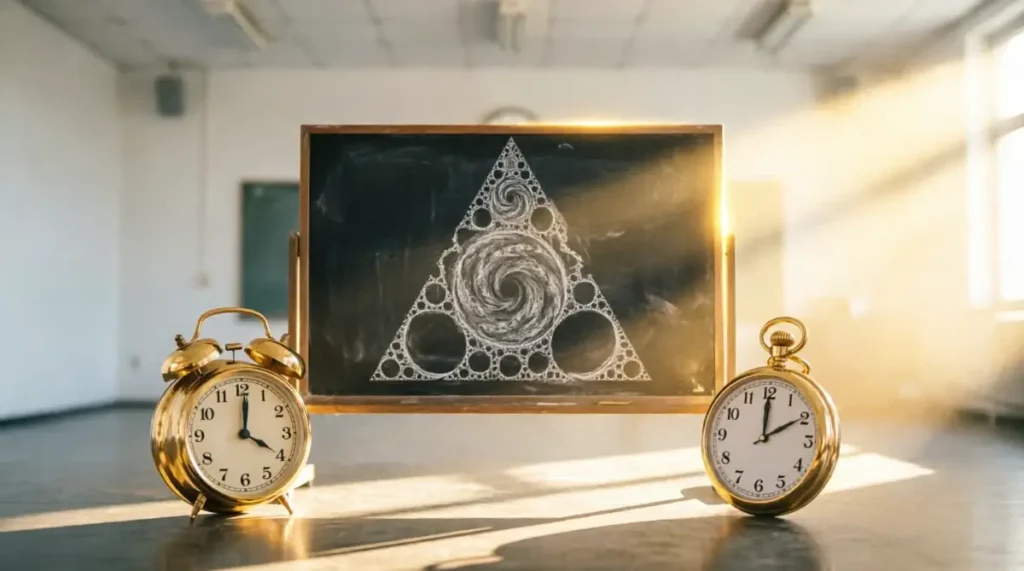
Illustration:AI-generated visual representing”evidence makes easy the process”
I made a deal with myself. I did not have to learn anything. I did not have to make progress. I only had to sit with the book for five minutes. The simple act of keeping the appointment without any demand on performance became my rescue. And almost every time, those five minutes became thirty the connection stayed alive.
I used this principle in the quiet art of staying consistent with what matters most where I learned that the habits that survive are not the grand ones they are the small, protected ones that you refuse to drop, no matter what.
What should I do on mornings when I want to give up?
Make a deal with yourself: show up for five minutes. Do not demand progress do not expect inspiration just sit with the work. Open the book, the code editor, the sketchpad, the instrument. If after five minutes you still cannot continue, you have permission to stop. But almost always, the simple act of showing up breaks the inertia. The only way to fail is to break the appointment entirely five minutes of presence keeps the bridge intact until the next morning.
I chose the stack that morning not because I felt strong, but because I had learned that feelings are passengers, not pilots. The evidence of my previous hours the notebooks, the tally told me that the work was real, even when it felt pointless. And that evidence was enough to carry me through.
Write down, in your own words, a deal you will make with yourself on the next hard morning: “I will show up for five minutes. I do not need to accomplish anything. I just need to be present.” Sign it. When the hard morning comes, honor that deal.
What You Find When You Stop Asking for Approval (The Credential You Give Yourself)
For years, I carried a question in the back of my mind: Who am I to learn this? Who gave me permission? The question came from a voice that believed I needed someone else an institution, a teacher, an authority to validate my pursuit of knowledge.
Over time, the question changed.
Who am I to learn without a degree? I am someone who learns anyway.
Who am I to build expertise from nothing? I am someone who built it anyway.
Who am I to call myself educated? I am someone who did the work, and the work is the proof.

Illustration:AI-generated visual representing”credential beats approval”
This transformation from seeking permission to claiming ownership did not happen in a single moment. It happened in thousands of small moments: in the mornings I showed up, in the pages I filled, in the problems I solved, in the skills I demonstrated the proof was never on paper the proof was in me.
Looking back, I can see this entire journey was an example of the lessons that only reveal themselves after years of stubborn persistence the credential I wanted as a man was a piece of paper that would tell the world I was qualified. The credential I eventually earned was something far more durable a deep, unshakeable trust in my own capacity to learn anything I set my mind to.
How do you build self trust when you have no external validation?
You build it one kept promise at a time you say, “I will write one sentence,” and you write it. You say, “I will practice for fifteen minutes,” and you practice. Each kept promise is a brick in the foundation of self trust. Over time, the bricks become a wall that doubt cannot breach self trust is not given; it is constructed through the repeated refusal to abandon yourself.
The credential I gave myself was not printed on paper it was etched into the thousands of hours I spent in the dark, building a bridge that no one could see. And when the time came to cross it, I walked across with the quiet confidence of someone who knew exactly how every plank was laid.
Take a piece of paper write down one thing you have already learned, despite lacking formal permission. Now write: “I am the kind of person who learns regardless of permission.” Keep this statement where you can see it. It is your credential.
How You Open Your Own Gate, Starting This Morning (The University That Never Closes)
The sun rises every morning it does not ask who you are. It does not check your credentials. It simply arrives, offering another day, another empty classroom, another chance to build.
I started with no alphabet, no teacher, no proof that someone like me could ever master anything. But I had mornings, and I had a will to show up. That willingness became a habit. The habit became a bridge.

Illustration:AI-generated visual representing”courage and consistency beat anything”
The University of 4 AM has no admissions deadline, no prerequisite courses, no final exams. It has only one curriculum: the skill you choose to learn, practiced in the hours you carve out for yourself. Whether you want to speak another language, write a novel, build a business, or master a craft, the door is open. It has always been open.
For the full picture of how I began with nothing and assembled a method from silence and scraps, you will find and how eventually became a system anyone can follow.
The crossing never ends, and that is the gift there is always another skill to learn, another horizon to chase, another version of yourself waiting on the other side of the bridge you are building right now.
The Gate You Have Already Opened
You arrived at this framework carrying your own collection of invisible hours you may not have called them that. You may have called them failures, wasted mornings, or reasons to quit. But if you are still standing, still curious, still willing to learn something new, then you have already stepped past the gate. The University of 4 AM has no walls that can keep you out the only thing that can stop your education now is the decision to stop showing up.
I once believed that speed was the measure of strength I know now that the slow builder the one who rises before the sun, who adds one page to the stack, who refuses to quit when the silence deepens is the one who crosses every river worth crossing.
I would love to know what your 4 AM is. Not the literal hour not everyone needs to wake at dawn but what is the version of showing up that works for you? What is the quiet space where you can build, uninterrupted by the noise of the world? What is the small choice you can make, day after day, that will stack into something unshakeable?
If your education were a structure you were building with your own hands not a degree, not a certificate, but a physical thing that would outlast you what would it look like? What materials would you use? What room would you build first? I ask because the picture you hold in your mind is the blueprint you will follow, whether you realize it or not.