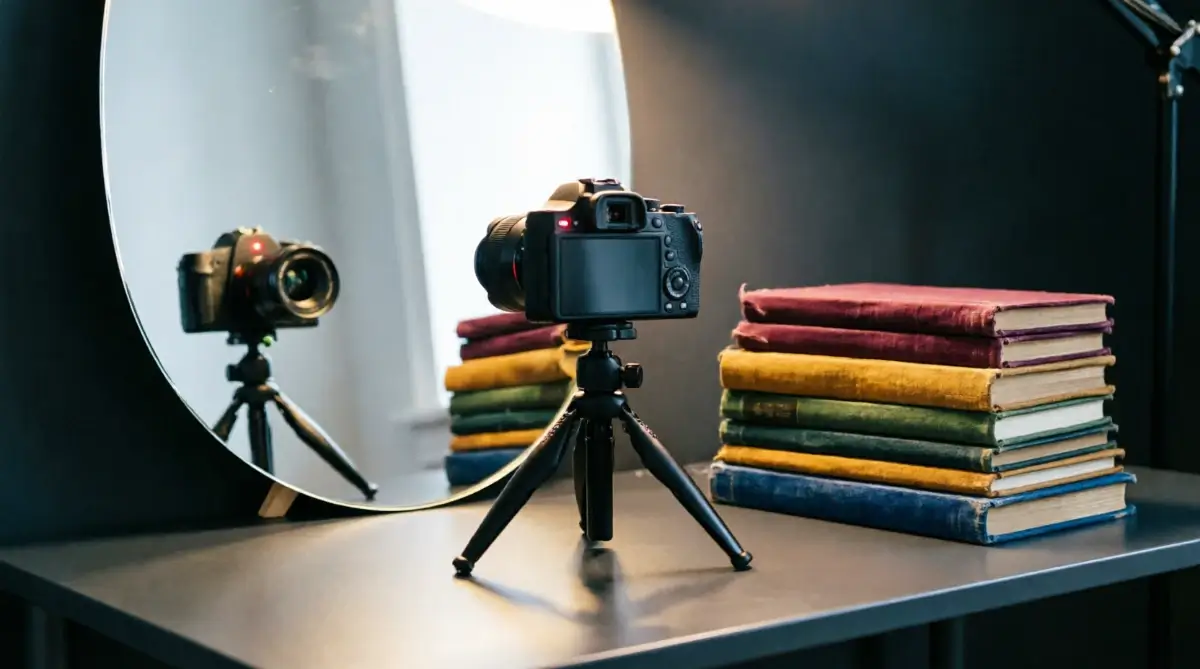
I keep two mirrors in my home. One in the living room, where the light is good and I can stand back and see my whole body. Another in the bathroom, where the walls are close and the sound bounces back to me quickly. I did not buy them for decoration. I bought them because I needed a teacher who would never get tired, never judge me, and never lie. The mirror became that teacher.
When I first started learning languages, I focused all my attention on my ears. I listened to native speakers, I repeated after them, and I thought that if I could hear the difference, I could make the difference. But something was wrong. The sounds that came out of my mouth did not match the sounds I heard in my head. They were close, but not close enough. There was a gap I could not close by listening alone.
One day, by accident, I caught my reflection while I was practicing. I saw my mouth moving, and I noticed something I had never noticed before. The shape of my lips was not the same as the shape I had seen native speakers make. My tongue was in the wrong place. My jaw was too tight. I was making a sound that was almost right, but the almost was written all over my face.
The mirror showed me what my ears could not
The physical shape of a sound, and whether mine matched the original.
That first accidental glance turned into a deliberate practice. I started standing in front of the mirror every time I practiced pronunciation. I would play a short clip of a native speaker a single word, a single phrase and I would watch their mouth. Then I would watch my own mouth as I tried to make the same sound. The difference was often obvious. My lips were too relaxed. My tongue was too far back. My jaw was not dropping enough for the open vowels. The mirror showed me everything.
I became a detective of my own mouth I studied the way native speakers shaped their sounds, and I compared it to my own reflection. When there was a mismatch, I adjusted. I moved my lips forward. I opened my jaw wider. I flattened my tongue. And then I tried again. The mirror gave me instant feedback that no audio recording ever could. It was like having a pronunciation coach who never left my side.
This kind of deliberate practice watching, comparing, adjusting is something I later understood the art of self correction a method that turns the learner into their own best teacher.
I began to understand that the mirror was not just showing me my mistakes. It was showing me a path to improvement that I could walk at my own pace. No teacher could stand beside me for every hour of practice. No pronunciation coach could watch my mouth move a thousand times until the sound came out right. But the mirror could. It was always there, always patient, always ready to give me honest feedback.
The first weeks of mirror practice were humbling. I saw flaws I had never noticed before. My mouth was lazy. It wanted to make the sounds it already knew, the sounds of my first language, and it resisted the new shapes. Watching myself struggle was not comfortable. But that discomfort was the feeling of growth. Every time I saw a mistake and corrected it, I was building a new pathway in my mind. The mirror made the invisible process of language acquisition visible.
I started to notice details that most learners miss. The way a native speaker’s lips barely move for certain consonants. The way their jaw drops open for a long vowel. The slight tension in their throat for a guttural sound. These were not things I could learn from a textbook. They were things I had to see and feel and imitate until my body understood them as deeply as my mind.
The mirror also taught me patience there were sounds that took weeks to master. I would stand in front of the glass, repeat the same word fifty times, and still see a gap between my reflection and the native speaker’s. But I learned not to be discouraged by the gap. The gap was not a failure. It was a direction. It showed me exactly where I needed to go. And every day, the gap got a little smaller.
The mirror also helped me understand something about learning itself. When you see your own reflection making mistakes, you have a choice. You can feel embarrassed and give up. Or you can feel curious and keep going. I chose curiosity. I wanted to understand why my mouth moved the way it did. I wanted to understand the mechanics of speech. The mirror turned me into a student of my own body.
This curiosity spread to other areas of my learning I started paying attention to how native speakers used their entire bodies to communicate. I noticed the way they nodded, the way they used their eyebrows, the way they leaned forward or back depending on the context. These were not things I had learned from textbooks. They were things I learned by watching and imitating in front of the mirror.
The mirror became my research tool it let me study human communication from the inside out. I was not just learning a language. I was learning how people connect with each other. And that understanding deepened my appreciation for the languages I was learning.
Learning to Listen with My Eyes
After a while I stopped needing to think about the adjustments. My body started to learn the shapes directly. When I heard a new sound, I could feel in my mouth where it should be made. The mirror had trained my muscles as much as my ears. But that training did not happen overnight. It took hours of standing in front of the glass, repeating the same words until my reflection finally looked right.
Slowing Down to Speed Up
There were sounds that felt impossible the kind of sounds that live in a language but not in your own, and your mouth simply does not know how to make them. When I hit one of those sounds, I did not push harder. I slowed down.
I would take the audio of a native speaker and play it at half speed. I would watch their mouth move in slow motion, seeing exactly how their lips rounded, exactly where their tongue touched their teeth, exactly when their jaw dropped. Then I would try to copy that motion, slowly, in front of the mirror. At first, my reflection looked like a clumsy imitation. But I kept at it, speeding up little by little, until I could match the native speaker at full speed.
And then I went further. I practiced until I could say the word or phrase faster than the original, and more clearly. Not because I wanted to show off. Because I wanted to own the sound. To make it so familiar that I could produce it without thinking, even in the middle of a fast conversation.
I learned that if I could not pronounce something exactly like a native speaker, I could slow it down, watch my reflection, and try again until my mouth learned the shape.
The slow‑motion practice became my secret weapon. Most learners try to speak at full speed from the beginning, and they end up reinforcing bad habits. The mirror, combined with slowed‑down audio, let me build the correct habits from the start. I was not just learning to make sounds. I was learning to make them correctly, and then to make them automatically.
I remember one particular sound that gave me months of trouble. It was a consonant that did not exist in my first language. My tongue simply did not know where to go. I watched native speakers make the sound, and I could see the position of their tongue, but my own tongue refused to cooperate. I spent weeks in front of the mirror, slowly placing my tongue in the right position, trying to produce the sound, failing, and trying again.
One morning, it worked. The sound came out clear and correct. I saw it happen in the mirror my tongue moved to the right place, my lips shaped themselves correctly, and the sound emerged. I was so surprised that I laughed out loud. The mirror reflected my joy back at me, and in that moment I understood something important: the mirror was not just a tool for correction. It was a witness to my victories.
That experience taught me that the most difficult sounds are often the ones that become the most satisfying to master. They are the trophies of your effort. And the mirror lets you watch yourself earn them, one attempt at a time.
The slow‑motion technique also taught me to listen more carefully. When you slow down audio, you hear details that are invisible at full speed. The slight breath before a consonant. The way a vowel bends in the middle. The tiny pause between words. These details are the secret to sounding natural. And once you have heard them in slow motion, you can start to reproduce them in your own speech.
The mirror and the slowed audio became a partnership the audio taught my ears. The mirror taught my eyes. Together, they taught my mouth. And my mouth, once trained, could produce sounds that had once seemed impossible.
The bathroom mirror became my other practice space the small room had a natural echo that let me hear myself more clearly. I would stand in front of that mirror and speak, listening to the sound bounce back from the tiles. The echo revealed things that a dry room hid the slight buzz of a mispronounced consonant, the waver of an uncertain vowel. In that small, reflective room, I could both see and hear my progress.
The bathroom mirror taught me something else too it taught me that small spaces can be powerful. The echo in that small room forced me to hear my own voice clearly. I could not hide from my mistakes. The sound bounced back at me immediately, and I had to confront it.
That immediate feedback speak, hear, adjust is one of the most effective learning mechanisms I have ever used. It compressed the learning cycle. Instead of waiting for a teacher to correct me, I could correct myself in real time. The mirror and the echo together created a self‑contained learning environment that I could access at any hour.
I came to think of that bathroom as my language laboratory. It was small and simple, but it contained everything I needed to improve my speaking. A reflective surface. Four walls that bounced sound back at me. And my own willingness to keep trying until I got it right.
This method of watching myself and correcting in real time reminded me of the long invisible hours that eventually look like natural talent to anyone watching from the outside the mirror was simply the tool that made those hours count.
The Body Behind the Words
Language is not just sounds. It is also presence. When you speak to someone, they are not just listening to your words. They are watching your face, your hands, your posture. They are reading your confidence or your nervousness in the way you hold yourself. I knew that if I wanted to speak a language well, I needed to learn the body language that goes with it.
The Living Room Stage
The living room mirror was for bigger practice there, I could stand back and see my whole body. I started using it not just for pronunciation, but for presence. I would deliver entire talks to that mirror, watching my gestures, my posture, my facial expressions. I wanted to see what an audience would see. And I wanted to make sure that what they saw was confidence.
Acting Before Speaking
I started practicing public speaking in front of the mirror I would imagine an audience a room full of people, or a single important person and I would speak to them through the glass. I watched my hands. Were they moving naturally, or were they stiff? I watched my shoulders. Were they back and open, or hunched forward? I watched my eyes. Was I making eye contact with the imaginary audience, or was I looking down?
The mirror let me rehearse not just words, but the entire performance of speaking. I could try a gesture, see how it looked, and adjust it. I could practice the same opening line ten times until it felt natural. I could see the difference between a confident stance and a nervous one, and choose the confident one every time.
Before I ever stepped in front of a real audience, I had already performed for the most honest one: my own reflection.
After enough practice, something shifted the confident body language that I had rehearsed in front of the mirror started to appear automatically. When I stood up to speak in a real situation, my shoulders went back without me thinking about it. My hands moved naturally. My face stayed calm. I was not performing confidence anymore; I had become confident. The mirror had taken what was once forced and made it natural.
The Automatic Confidence
The body language work also taught me to be more observant of others. I started noticing how confident speakers carried themselves. I noticed that they did not rush. They paused. They breathed. They used silence as a tool. These were things I could practice in front of the mirror, and then apply in real conversations.
I also learned to match my body language to the culture of the language I was speaking. Different cultures have different norms for eye contact, for gestures, for personal space. The mirror let me practice these cultural differences before I had to navigate them in real life. It gave me a way to prepare for the social aspects of language, not just the linguistic ones.
The most rewarding part of mirror practice was watching myself improve over time. I could see the difference between a recording of my first attempt and a recording of my hundredth attempt. The mirror had captured that journey. It had been there for every step. And looking back at that progress gave me the motivation to keep going.
I encourage anyone who tries mirror practice to keep a record of their progress. Not for anyone else. For yourself. So that when you feel like you are not improving, you can look back and see how far you have come. The mirror will show you the truth, and the truth is almost always more encouraging than you expect.
This private rehearsal builds the foundation for public success is something I saw again and again the principle that what you practice alone eventually walks out into the world with you.
The Lesson That Spread Beyond Language
The mirror taught me something that applies far beyond pronunciation. It taught me that private rehearsal is the foundation of public success. Whatever you want to do well in front of others, you must first do it in front of yourself. The mirror is the connection between the private practice and the public performance.
For the Teacher and the Student
A teacher can use a mirror to practice a lesson before the class arrives. Standing in front of the glass, they can rehearse the difficult explanations, the transitions between topics, the questions they will ask. They can see their own enthusiasm or fatigue, and adjust before the students ever see them.
A university student who must speak in front of hundreds can use the mirror to prepare. They can practice their speech, watch their timing, see where they stumble, and smooth those places out. By the time they stand on the stage, they have already given the speech a dozen times. The real one is just another repetition.
For the Interview and the Conference
A person preparing for a job interview can use the mirror to practice their answers. They can see if they look uncertain, if they fidget, if their eyes wander. They can train themselves to sit still, to listen, to respond with calm. The interview becomes less frightening because it is no longer the first time.
Someone who must speak at a conference perhaps for the first time can use the mirror to learn how to stand at a podium, how to use a microphone, how to move on a stage. These things feel awkward until they are practiced. The mirror removes the awkwardness by letting you see it and fix it before anyone else does.
The mirror does not care what profession you are in. It only cares that you show up, watch, and adjust.
I began to see the mirror as a universal tool for anyone who needs to communicate clearly and confidently. The same method I used for language pronunciation could be used for any form of speaking the reflection was always honest, always available, and always free.
The Private Stage
I made a rule for myself that I still follow today. Before I show up in public, I must show up in private. I must stand in front of the mirror and do the thing say the words, make the gestures, hold the posture until it feels like second nature. Only then am I ready to do it in front of others.
This rule has served me in every area of my life. It has made me a calmer speaker, a clearer communicator, and a more confident person. The mirror gave me a space to fail without consequences, to experiment without embarrassment, and to grow without an audience. That space is available to anyone who is willing to stand in front of the glass and begin.
The applications of mirror practice are endless. A doctor can use it to practice delivering difficult news with compassion. A salesperson can use it to refine their pitch until it feels natural and persuasive. A parent can use it to rehearse a difficult conversation with their child. Anyone who needs to speak and be understood can benefit from spending time in front of the glass.
What makes the mirror so effective is that it removes the fear of judgment. When you practice alone, you can make mistakes without embarrassment. You can try different approaches and see which one works best. You can be completely honest with yourself about what needs improvement. The mirror creates a safe space for growth.
And when you finally step in front of a real audience, you carry that safe space with you. You have already seen yourself succeed. You have already watched yourself speak with clarity and confidence. The real performance is just a repetition of what you have already done. The nerves do not disappear, but they become manageable. They become a source of energy rather than a source of fear.
The Reflection You Can Trust
The mirror does not flatter. It does not criticize. It simply shows you what is there. If your mouth is making the wrong shape, you will see it. If your posture is weak, you will see it. But you will also see the progress. The small improvements that add up over time. The moment when a sound that once felt impossible suddenly comes out right. The mirror witnesses it all, and it never forgets to show you how far you have come.
I learned to trust the reflection. To see it not as a judge, but as a source of truth. The mirror could not tell me I was good enough, but it could show me when I was getting better. And that evidence, seen with my own eyes, was more powerful than any external praise.
The mirror has no ego. It does not care if you are a beginner or an expert. It does not care if you have struggled for years or just started yesterday. It gives the same honest feedback to everyone. That equality is part of what makes it so powerful. The mirror is a teacher that never plays favorites, never gets tired, and never gives up on you.
I have recommended mirror practice to many people over the years. Some have embraced it and seen remarkable results. Others have been skeptical. They thought it seemed silly to talk to themselves in front of a mirror. But those who tried it, even for a week, often came back and told me they were surprised by how much it helped. The mirror shows you things you cannot learn any other way.
The truth is that the mirror never gets the credit it deserves. People see the fluent speaker and think it came from a classroom or a textbook. They do not see the hours spent in front of the glass, watching and adjusting. But that is fine. The mirror does not need credit. It only needs you to show up.
The mirror is always there. It never leaves. It never judges. It only shows you the truth, and the truth is the first step toward mastery.
The Mirror Is Waiting
The two mirrors are still in my home the bathroom mirror still catches my morning practice. The living room mirror still watches my full‑body rehearsals. They are the most patient teachers I have ever had.
The Habit That Stuck
Over time, the mirror practice became a natural part of my daily routine. I no longer had to schedule it or force myself to do it. I just did it. When I had a new word to learn, I took it to the mirror. When I had a presentation to prepare, I rehearsed it in front of the glass. The mirror had become my training ground, and the habit had become automatic.
This is the gift of any practice that you stick with long enough it stops being something you do and becomes part of who you are. The mirror was no longer a tool; it was a companion a silent partner in my growth.
The Public You Are Ready For
The confidence I found in front of the mirror eventually walked out into the world with me. When I spoke to people, I no longer worried about how I looked or sounded, because I had already seen myself. I had already practiced. The public performance was simply the final step of a process that had begun long before in my own home.
The mirror taught me that the person you are in private is the person you will become in public. If you rehearse confidence, you will become confident. If you practice clarity, you will become clear. The reflection is not just a picture of who you are; it is a preview of who you are becoming.
The mirror became the one audience I never feared, because it never demanded perfection only honesty.
If you are learning a language, or preparing to speak in any setting, I invite you to try the mirror. Stand in front of it. Watch your mouth. Watch your body. Speak. Adjust. Speak again. Do it until the person in the glass looks like the speaker you want to be.
The mirror will not do the work for you. It will not teach you the words or the grammar. But it will show you the truth of your own performance, and that truth is the first step toward mastery. What you see in the glass is what the world will see. Make sure it is the person you intend to show them.
I have spent countless hours in front of those two mirrors, and I will spend countless more. Because every time I stand there, I am not just practicing a language. I am practicing being the person I want to become and the mirror, silent and steady, is always ready to help me get there.
I still sometimes catch myself in the mirror when I am not practicing. A glance as I walk past. A moment in the bathroom. And I see the speaker I have become. Not perfect, but confident. Not flawless, but clear. The mirror reminds me, every time, that the work was worth it.
And that is what I want for anyone who reads this I want you to look in the mirror and see not just your reflection, but your potential. Your future self is waiting in that glass. Go meet them.
The mirror practice has been one of the most consistent habits of my language‑learning life. It has outlasted other methods, other techniques, other tools. I have changed how I study vocabulary. I have changed how I practice grammar. But I have never stopped using the mirror. It remains the foundation of my speaking practice.
I encourage everyone to try it you do not need a special mirror. Any reflective surface will do. A window at night, when the light inside turns it into a mirror. A phone screen when it is dark. The surface does not matter. What matters is the willingness to look at yourself honestly and to keep adjusting until the reflection matches the speaker you want to be.
The mirror is patient it will wait as long as you need. It will show you the same mistake a hundred times without complaint, and it will show you the hundred‑and‑first attempt when you finally get it right. It is the most honest teacher you will ever have, and it asks for nothing in return except your willingness to show up.