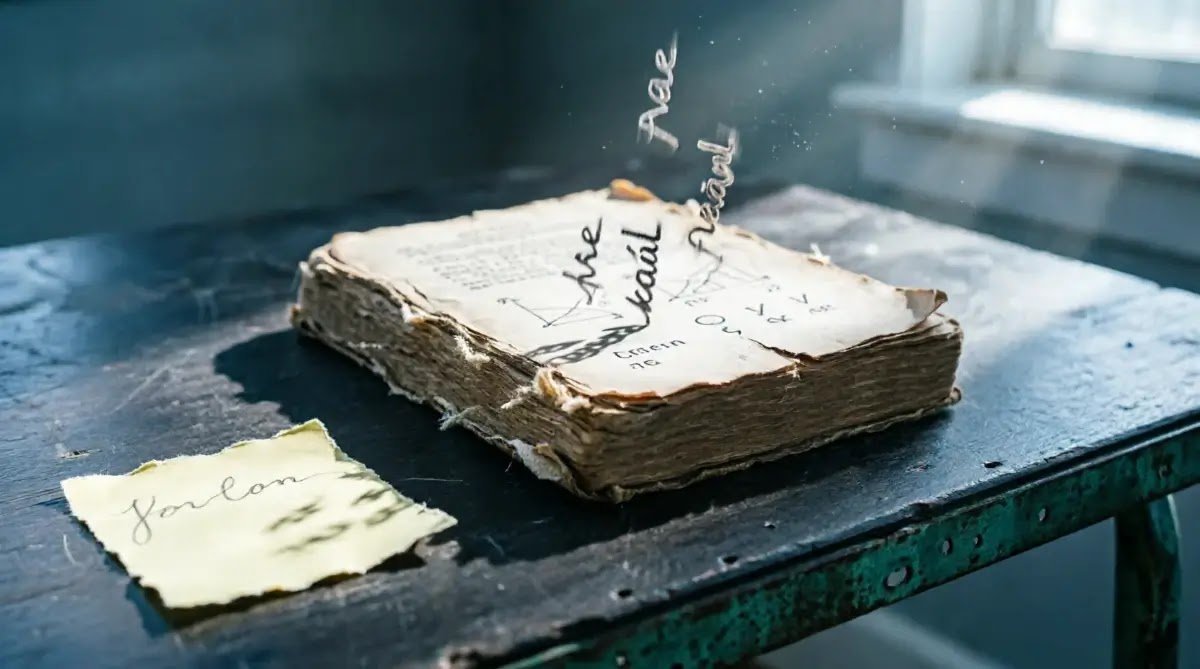
I remember the test clearly. Forty questions in English, and I had prepared for them one month ahead. The teacher had told us what to do: memorize the lessons, focus on the questions that were likely to appear, and do not worry about understanding just remember. So I did exactly that. I memorized every lesson that had been taught. I repeated the answers until they stuck in my mind like stickers on a wall. When the day of the test came, I sat down, wrote the answers, and passed.
One week later, I met a classmate. We talked about the test. He said it had gone well for him too. Then I asked him something simple. Can you speak any English now? Can you remember any of the lessons? He laughed and said the test was last week he had already forgotten everything.
I understood him completely I had forgotten everything too.
The test was a performance a short show that we put on for a single day, and then the curtain fell, and the stage was empty. The words we had memorized had no roots. They were cut flowers placed in a vase, looking good for a moment, but already dying. We had learned nothing real. We had only learned how to pass.
I passed the test, and one week later I remembered nothing. My classmate had already forgotten everything too. That was the moment I understood that memorization without purpose is like writing on water.
This experience stayed with me for years. It was not the failure of a system. It was a simple, human truth: if you learn something only to pass a test, your mind will let it go the moment the test is over. The mind is practical. It holds onto what matters and releases what does not. And a grade on a paper, once it has served its purpose, does not matter anymore.
I am grateful for that moment it taught me something essential about learning that I have carried into every language, every skill, every new thing I have attempted since. It taught me that the purpose behind the learning is more important than the learning itself. Without purpose, even the most diligent effort fades. With purpose, even the smallest effort grows.
The memory of that test, and the forgetting that followed, is something I carry with me not as a wound but as a compass. It points me toward what matters. Whenever I am learning something new, I ask myself: am I learning this to pass a test, or am I learning this to use it? If the answer is the first, I reconsider. If the answer is the second, I commit fully.
That simple question has saved me from wasting countless hours on things that would not last. It has kept me focused on skills that have real value, that can be applied, that can make a difference in my life and in the lives of others. It is a question I recommend to everyone. Before you invest your time in learning something, ask yourself why. The answer will determine whether the learning sticks or fades.
The Overload That Made Deep Learning Impossible
We had many subjects that year I cannot remember the exact number now, but it felt like a different world every hour. In the morning, we studied one thing. By mid-morning, something else. By afternoon, yet another. The day was a constant shifting of gears, and my mind never had time to settle into any one topic before it was pulled away to the next.
No one can focus deeply when the focus is constantly broken. The mind needs time to sink into something, to explore it, to ask questions about it, to connect it to other things you already know. But when you are moved from subject to subject like a traveler changing trains, you never arrive anywhere. You are always in transit, never at a destination.
I remember sitting in those classes and feeling my attention scatter. One moment I was trying to understand a mathematical concept. The next, I was supposed to be analyzing a poem. The next, I was supposed to be learning about the geography of a country I had never seen. My brain could not keep up. It was not that the subjects were too hard. It was that they came too fast, one after another, with no space between them to breathe.
The Pretending That Drained My Energy
The hardest part was not the difficulty of the material. It was the pretending. I had to pretend I was interested when I was exhausted. I had to pretend I was paying attention when my mind was floating somewhere else entirely. I had to pretend I cared about grades that measured only my ability to temporarily store information.
I remember sitting in one class, looking toward the front of the room, hearing the voice of the teacher, and realizing that I had not absorbed a single thing in the last ten minutes. I was present in body. But my mind had checked out. It had reached its limit and closed the door. No more information could enter.
This is not because I was a bad student. It is because the mind, like the body, has limits. You cannot run forever without rest. You cannot lift weights forever without recovery. And you cannot absorb new information forever without time to process what you have already received. The mind needs silence. It needs reflection. It needs the chance to let new ideas settle and find their place. Without that, everything stays on the surface, and nothing becomes part of you.
I later built that the foundation of any real education is not a classroom but a decision made alone. The decision to learn because you want to, not because you have to that shift from obligation to desire is what separates the person who forgets a week later from the person who builds skills that last a lifetime.
The experience of being overloaded with subjects taught me something valuable about focus. When you are trying to learn many things at once, you end up learning none of them well. The mind is not designed for that kind of scattered attention. It is designed for depth, not breadth. It is designed to focus on one thing, to explore it thoroughly, to understand it from multiple angles, and then to move on to the next thing.
When I later designed my own learning path, I made focus a priority. I did not try to learn three languages at the same time when I was starting out. I gave my full attention to one language until I reached a level of comfort with it. Then I added the next. The focus allowed me to go deep, and the depth made the learning stick.
This principle applies to any skill. If you are trying to learn to code, to write, to design, to speak give yourself the gift of focus. Do not scatter your attention across a dozen different things. Choose one, and give it your full presence. The results will be far greater than if you try to do everything at once.
The Silence That Allows Learning
I also learned that the mind needs silence not just the absence of noise, but the absence of constant input. When you are always receiving new information, you never give your mind the chance to process what it has already received silence the space between learning sessions is where the real integration happens. It is in the silence that the mind sorts through what it has learned, connects it to existing knowledge, and makes it part of you.
Now I build silence into my learning process. After a focused session, I step away. I let my mind rest. I trust that the work I have done is being processed beneath the surface. And when I return, I often find that something has shifted. A concept that was confusing now makes sense. A word that I struggled to remember now comes easily. The silence did the work that effort alone could not do.
The Question That Changed Everything
After that conversation with my classmate, I could not stop thinking about what we had done. We had spent an entire month preparing for a test, and one week later, it was as if the preparation had never happened. The hours we had invested were gone. The effort we had made was wasted. We had nothing to show for it except a mark on a paper that no one would ever look at again.
I asked myself a question that I had never asked before. What is the point of learning something if you forget it immediately? What is the value of all those hours if they leave no trace in your mind?
The answer was uncomfortable but clear. The learning I had experienced was not designed to make me knowledgeable. It was designed to make me pass. The goal was the paper, not the person. The goal was the certificate, not the skill. And once the paper was obtained, the knowledge could safely disappear, because no one was ever going to check if it had stayed.
I realized that I needed something different. I needed a reason to learn that was bigger than a test. I needed a purpose that would make the knowledge stick not for a week, but for a lifetime.
No one can transfer information into your brain if you are not interested. The door of the mind opens only from the inside.
The Classmate Who Showed Me the Truth
That classmate who forgot everything he was not a failure. He was a mirror. He showed me what I had also done. He showed me the emptiness that comes from learning without wanting to learn. And I am grateful to him, because without that conversation, I might have continued on the same path, collecting papers and forgetting facts, never asking myself if there was a better way.
The truth he revealed was this: the mind is not a storage room where you can pile facts like boxes. The mind is a garden. If you plant seeds you do not care about, you will not water them. And if you do not water them, they will die. The only seeds that grow are the ones you choose to plant, the ones you want to see bloom.
That was the beginning of my search for a different way to learn. A way that started with purpose. A way that valued skills over papers. A way that treated the mind not as a container to be filled, but as a fire to be lit. I found that the method which worked when the standard classroom wasn’t the right fit was built on a different kind of structure one where I was both the architect and the builder of my own learning.
The Shift from Mandatory to Meaningful
When I finally got access to learning resources that I could choose myself, everything changed. I was no longer a student following a preset path. I was a person with interests, with questions, with a desire to understand things that mattered to me. And the difference was immediate.
I chose to learn languages not because someone told me to. Because I wanted to. I wanted to connect with people across borders. I wanted to read books that had never been translated into my first language. I wanted to understand the world from perspectives that were different from my own. That want that deep, personal, burning desire became the fuel that made learning possible.
When I sat down to study a language I had chosen, I was not forcing myself to focus. I was eager to focus. The hours passed without me noticing. The words stayed because I wanted them to stay. I was not memorizing for a test. I was building a skill that I intended to use for the rest of my life.
The Purpose That Made the Difference
Purpose changes everything about learning when you have a reason to learn that is connected to who you want to become, the work stops feeling like work. It feels like building. It feels like growing. It feels like investing in your own future.
I had spent years where the only purpose was to pass. And I had forgotten almost everything I had learned. But the languages I chose to learn those stayed. They are still with me today. They are part of who I am.
This is not because languages are easier to remember than other subjects. It is because I cared about them. I had a reason to learn them that went beyond a grade. I wanted to speak to people. I wanted to understand their stories. I wanted to be a person who could move between cultures and connect. That purpose turned information into knowledge, and knowledge into skill.
I began to find ways to practice that were connected to real life I realized that listening to the language in real situations not just textbook exercises was the missing piece that turned memorized words into actual understanding. When I focused on listening first, the words found a natural home in my mind instead of being forced in and quickly forgotten.
Choosing Based on Who You Want to Serve
The most important question I asked myself was not what skill would bring the most immediate reward. It was who I wanted to serve. What problems did I want to solve? What people did I want to help? When you choose a skill based on service, the motivation takes care of itself. You are not grinding through boredom. You are preparing to be useful. And that sense of purpose makes every hour of practice meaningful.
I learned that the combination of a valuable skill and a genuine desire to serve others is powerful. It gives you direction when the work is hard. It gives you resilience when progress is slow. It gives you a reason to keep showing up, day after day, even when no one is watching.
This was the opposite of what I had experienced before. There, the goal was a grade, and the grade was for me alone. It served no one else. It connected to nothing larger. But when I learned with the intention of serving others, the learning became part of something bigger than myself. And that made all the difference.
I remember the first time I chose a learning resource for myself. It was a free online course in English. No one told me to take it. No one was grading me. No one was checking if I completed it. I was completely on my own. And yet, I finished it. I finished it because I wanted to. Because the content was interesting to me. Because I could see how it would help me become the person I wanted to be. That experience was liberating. It showed me that I did not need external pressure to learn. I only needed internal motivation. And that internal motivation was far more powerful than any external pressure had ever been.
The freedom to choose what to learn is a gift that was not always available. For much of history, knowledge was locked behind walls. You had to be in a certain place, at a certain time, with certain resources, to access it. That is no longer true. The walls have come down. The knowledge is available to anyone with a connection and a willingness to learn.
But with that freedom comes responsibility you are now the one who must decide. You are the one who must choose what to learn, how to learn it, and how long to stay with it. No one will do that for you. And that can be intimidating. But it is also empowering. Because when you take responsibility for your own learning, you take ownership of your own growth. And that ownership is the foundation of everything that follows.
The Skills That Matter More Than Paper we live in a different world now the internet has changed everything about how knowledge is accessed and shared. In the twenty‑first century, information is everywhere. It is free. It is abundant. What is rare is not information it is skill. The ability to do something useful. The ability to solve problems. The ability to create value.
A certificate can open a door, but only a skill can keep you in the room. And skills are not built by memorizing facts for a test. They are built by practicing, failing, adjusting, and practicing again. They are built by showing up every day, not because someone is checking attendance, but because you have decided to become someone who can do something valuable.
I started researching what skills were in demand. Not just for today, but skills that would still be valuable in ten years, twenty years, thirty years. Skills that could be done from anywhere in the world. Skills that could give me freedom and flexibility and the ability to serve others in meaningful ways.
Then I found the resources. Online courses. Free materials. Communities of people who were learning the same things. I committed to a path, and I showed up every day. Not for a paper. Not for anyone else. For me. For my future. For the person I wanted to become.
The Digital Library That Never Closes
The resources available today are unlike anything that existed before. Anyone with an internet connection can access courses from the best teachers in the world. You can learn a language from native speakers, study programming from experienced engineers, understand design from working artists. The knowledge is not locked behind walls anymore. It is open.
But the abundance of resources creates a new challenge. It is easy to get lost in the choices. To jump from one course to another without ever finishing. To collect certificates without building skills. The key is not access it is commitment. Choosing a path and staying on it, day after day, even when the initial excitement fades.
I learned to commit. When I chose a language, I gave it my full attention. I did not chase every new method or every new resource. I found what worked for me and I stuck with it. The commitment itself became a skill. The ability to stay focused on one thing, over a long period, is a kind of mastery that most people never develop.
How you can learn a language from zero with almost no money using only the free resources that are available to anyone with determination and a willingness to search for them the financial barrier that once kept people from learning has almost completely disappeared. What remains is the barrier of commitment and that is a barrier only you can break.
Setting goals that actually work, rather than vague wishes, became another piece of the puzzle. I learned to define exactly what I wanted to be able to do and then work backward from that goal one small step at a time.
The Process You Can Trust
Learning for yourself requires trust. Not blind trust. Not wishful thinking. The kind of trust that comes from understanding how growth actually works.
Growth is not a single event. It is not a test you pass and then you are done. Growth is a process. It is slow. It is invisible most of the time. You put in the hours, and for weeks or months, you may see no change. The words still feel strange. The sentences still come out wrong. The skill still feels beyond your reach.
But then, one day, something shifts. A word comes to you without thinking. A sentence flows naturally. A conversation happens where you understand almost everything. And you realize that the hours you invested were never wasted. They were accumulating. They were building something beneath the surface that you could not see until it was ready to emerge.
The hours you invest in learning for yourself never disappear. They compound in the dark, and one day they break through the surface as skill.
This is the process I have learned to trust. Not because I read about it in a book. Because I have lived it. I have felt the frustration of invisible progress. I have sat with the boredom of repetition. I have wondered if anything was happening at all. And then I have experienced the breakthrough. The moment when the skill becomes part of me, and I know that the work was worth it.
The Daily Commitment That Builds Everything
The only secret to this process is showing up. Every day. Not when you feel motivated. Not when the conditions are perfect. Every day, regardless of how you feel. Because the days when you do not feel like showing up are the days that matter most. Those are the days when your commitment is tested. Those are the days when your identity is being shaped.
When you show up on a hard day, you prove to yourself that you are not a slave to your feelings. You are a person who does what they said they would do. And that self‑trust, built over time, is more valuable than any skill you could learn. It is the foundation of everything else.
I learned to make the practice so small that I could not justify skipping it. Even five minutes. Even one sentence. The size of the effort did not matter. What mattered was keeping the chain unbroken. One day of practice is nothing. A thousand days of practice is everything.
Trusting the process is not easy. It requires patience, and patience is not something that comes naturally to most people. We want to see results immediately. We want to know that our effort is paying off. And when we do not see results, we doubt. We wonder if we are doing something wrong. We consider giving up.
I have been in that place many times. I have sat with the frustration of feeling stuck. I have wondered if the hours I was putting in were a waste. But I kept going anyway. Not because I was certain of the outcome. Because I had made a commitment to myself, and I was not willing to break it.
And every time, the breakthrough came. Not on my schedule. Not when I wanted it. But it came. And when it did, it was sweeter because of the waiting. The struggle had not been a waste. It had been the preparation. The soil had to be turned and watered before the seed could grow. The invisible work was the foundation of the visible success.
I found that even in the hardest moments, there was a way to keep hope alive and keep moving forward the small reasons a single word learned, a single sentence understood were enough to carry me through the dark stretches when the destination felt impossibly far away.
The Real Measure of Progress
I stopped measuring my progress by grades. I started measuring it by what I could actually do. Could I hold a conversation for five minutes without freezing? Could I read a page and understand the main idea? Could I write a paragraph that someone else could understand?
These were real measures. They were not numbers on a paper. They were evidence of a growing capacity. And they were far more motivating than any grade had ever been. Because they showed me that I was changing. That the work was producing results. That I was becoming the person I wanted to be.
I also learned to keep a record of my practice. Not for anyone else. For myself. A simple log of the hours I had spent, the pages I had filled, the conversations I had attempted. When I felt stuck, I could look back at that log and see how far I had come. The evidence did not lie. Even when my feelings told me I was making no progress, the log showed a different story.
The mirror of evidence is more honest than the mirror of emotion. Emotions lie. They tell you that you are not improving, that you are wasting your time, that you should give up. But the evidence the stack of pages, the hours logged, the conversations had tells the truth. And the truth is almost always more encouraging than the emotions want you to believe.
I encourage everyone who is learning something new to keep a record. It does not have to be complicated. A notebook with the date and what you practiced. A note on your phone. The format does not matter. What matters is that you have something to look back at when the doubt comes. And the doubt will come. It always does. But the record will be there, waiting, to remind you that you are still walking, still growing, still becoming.
The art of watching my own progress and adjusting based on what I saw not based on what I felt became one of the most reliable tools in my learning practice I stopped relying on external validation and started trusting the evidence that was right in front of me.
I am still learning. Every day. The languages I speak now are not a final achievement. They are a ongoing process. There is always more to learn, more to improve, more to discover. And that is not a burden. It is a gift. The path never ends because the growth never ends.
The difference between who I was and who I am is not talent. It is not luck. It is the decision I made to learn for myself, with purpose, and to keep showing up, day after day, even when the progress was invisible. That decision is available to anyone. It does not require special resources or special circumstances. It only requires a reason that matters to you, and the willingness to begin.
I think about the boy who memorized forty questions for a test and forgot them a week later. I am grateful for him. He showed me what does not work. And that lesson learned early, learned clearly set me on a different path. A path where learning is not a performance. It is a transformation.
The test is temporary the skill you build with purpose is permanent.
I am grateful for the journey. Not just for the skills I have built, but for the person I have become along the way. The discipline, the patience, the trust in the process these are qualities that extend far beyond language learning. They are part of who I am now.
I am also grateful for the early experiences that showed me what does not work. The memorization that faded. The tests that measured nothing lasting. These were not failures. They were lessons. They taught me what I did not want, and they pointed me toward what I did want. Without them, I might never have discovered the joy of learning for myself.
I want everyone who reads this to know that you can learn anything you want to learn. You do not need a special background. You do not need permission. You only need a reason that matters to you, and the willingness to begin. Start small. Show up every day. Trust the process. And watch what happens.
I still remember the boy who memorized forty questions and forgot them a week later. I am not ashamed of him. I am grateful for him. He was not a failure. He was a beginning. He was the starting point of a journey that has taken me further than I ever imagined possible.
And if you are standing where he stood overwhelmed by information that does not feel relevant, tired of performing for tests that measure nothing lasting, wondering if there is a better way I want you to know that there is. The better way is learning for yourself, with purpose, with patience, with trust in the process. It is not always easy, but it is always worth it.
The path is open the only thing you need to do is take the first step.