There was a time when I believed grammar was the foundation of everything. I filled notebooks with verb tables, colour‑coded my textbook margins, and checked every sentence I wrote against the rules. I was sure that if I could just master the grammar, the speaking would follow. It didn’t. I’d sit across from a real person, my mind racing through conjugations and word order, and by the time I had the sentence ready, the conversation had already moved on. I was slow. Frustrated. Beginning to wonder if I was simply not made for languages.
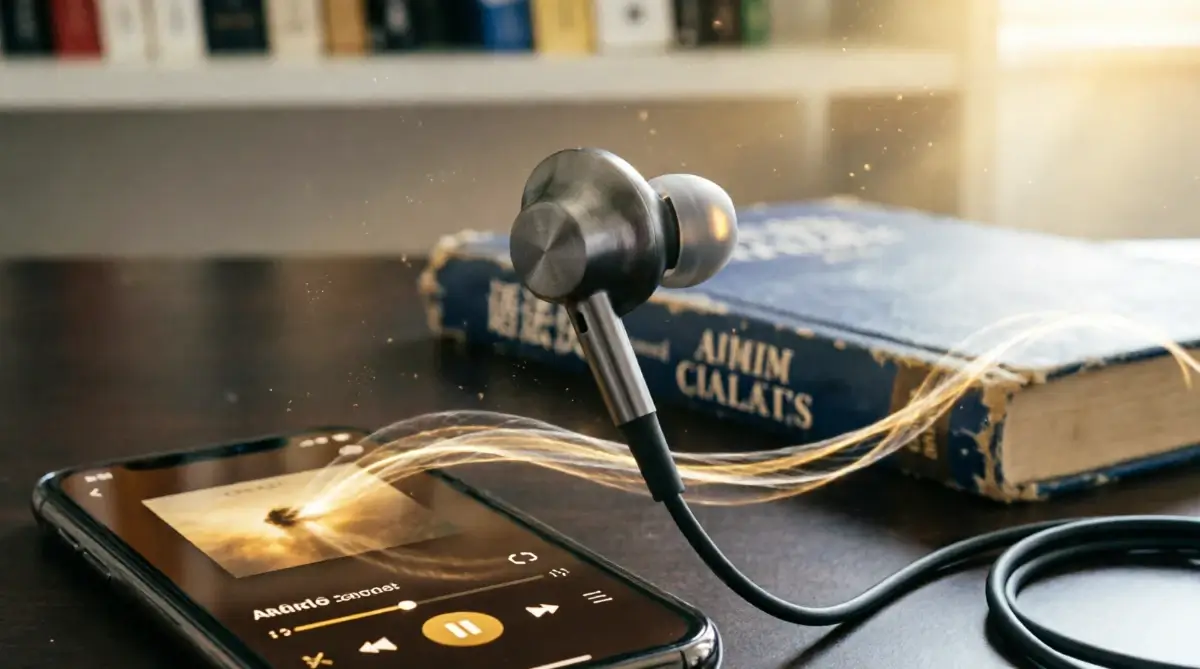
Then I made a change not a big one I put the grammar book on the shelf. I stopped doing the exercises. And instead, I started walking. Every day, I put a single earbud in my ear, pressed play on an audiobook in the language I was learning, and walked. I did not try to understand every word. I did not pause to look things up. I just let the voice fill my head while my feet moved along the pavement I did this for a month.
And at the end of that month, something had shifted. I could not explain it with rules, but the language felt different. It felt closer. I was discovering, slowly and quietly, that listening is more important than grammar early on and that my ear could learn what my textbooks had never been able to teach.
The change was not just In my routine it was in how I felt about the language. Before, every time I opened my mouth, I was afraid of making a mistake. The grammar rules were like a panel of judges in my head, and they were always frowning. But when I was walking and listening, there were no judges. There was only the voice of the narrator, telling a story I could follow without pressure.
I began to trust the sounds I noticed that certain words kept appearing together. I noticed that the voice rose at the end of questions and fell at the end of statements. I noticed that the past tense had a particular shape, even if I did not know its name. The language was becoming familiar not through study, but through exposure. My ear was learning, and it was learning faster than my conscious mind ever had.
That month changed everything I did not become fluent. But I became comfortable. And that comfort was worth more than a hundred grammar exercises. Because once the language felt familiar, the fear began to fade. And when the fear faded, I could finally start to speak.
When you listen, you let the language enter your mind in its natural form. You hear the patterns, the flows, the way words connect. Your brain starts to build an internal sense of what sounds right. Grammar rules, when you meet them later, simply describe something your ear already knows.
In my own journey, I found that a month of daily listening audiobooks, podcasts, whatever I could find did more for my speaking than a year of grammar drills. Listening comes first. The rules can wait. That insight didn’t come from a book; it came from the pavement, the earbud, and the quiet repetition of voices I didn’t yet understand but was beginning to feel.
Later, when I began to build my own path for learning any foreign language by myself I realized that everything I would later systematize began in that one decision: to stop trying to control every rule and let my ears do the work. The self‑built system I eventually created was simply a way to protect and repeat that original act of listening. Without that foundation, no amount of discipline or clever method could have carried me forward.
The freeze that grammar alone could never fix
I can still remember the moment clearly I was sitting with a friend who spoke the language I was learning. He asked me a simple question. Something about what I had done the day before. And I froze. I knew the verb. I knew the past tense. I knew the word order. But all that knowledge sat in my head like a blocked pipe. Nothing came out I smiled, shrugged, and changed the subject. My friend was kind about it, but I felt the weight of all those grammar exercises pressing down on me, mocking me. All that work, and I could not answer a simple question.
That freeze happened many times. And every time, I told myself the same thing. “I need to study more grammar.” But more grammar did not help. The freeze stayed. Because the freeze was not a lack of knowledge. It was a lack of connection. My brain had stored the rules as facts, but it had never heard them enough times in real speech to trust them.
The breakthrough came when I was listening to a podcast and heard a sentence in the past tense. The speaker used a verb form I had studied many times. But this time, I did not think about the rule. I just understood the meaning. The sound of the past tense had become familiar. It had become something I could recognize without effort. That was the moment I understood that knowing a rule and feeling a sound are two different things. Knowing a rule is like reading about how to swim. Feeling a sound is like getting into the water. The water teaches you things the book never can.
Later, when I learned how to practice speaking alone without freezing I realized that the freeze had never been about not knowing enough. It had been about not trusting my own voice enough to let it move. The listening had been building that trust all along, quietly, in the background, while I was busy worrying about my mistakes. The voice I used to dread hearing was actually the one that would eventually set me free.
There were nights when I sat alone in my room, replaying the same short clip over and over until my mouth could shape the sounds without effort. Those repetitions felt tedious at the time, but they were the bridge between hearing and speaking. Each repetition was a small deposit in a bank I couldn’t yet access. I didn’t know it then, but the withdrawals would come later, in real conversations, when the words would simply be there, waiting for me.
I started to notice that on days when I had listened more, my speaking felt looser, more natural the grammar was still there in the back of my mind, but it wasn’t blocking the flow anymore. It had stepped aside. And in its place was a quiet confidence that the sounds I needed were already inside me, just waiting for the right moment to surface.
The question often came up shouldn’t I learn grammar so I can speak correctly? Grammar has its place, I came to understand, but if you start with grammar, you may end up knowing the rules without ever feeling them. When you start with listening, you absorb the patterns naturally. Later, when you study the rules, they will feel like names for something you already understand. That order listening first, grammar later saved me years of frustration. I made a quiet pact with myself: for the next thirty days, I would not open a grammar book.
Instead, I would listen to something in the language every single day. A podcast. An audiobook a video of someone talking. I would not pause to look up words. I would just listen. At the end of the month, I would notice whether the language felt more familiar. The freeze was never about grammar. It was about trust. And trust cannot be built from rules. It can only be built from hearing the same sounds, over and over, until they feel like your own.
The hidden classroom I carried in my pocket
My daily commute used to be filled with music songs I had heard a hundred times. They passed the time, but they did not teach me anything. Then one day, I decided to try something different. Instead of music, I opened a podcast in the language I was learning. I did not know if I would understand much. But I thought, even if I catch only a few words, that is more than nothing.
The first few trips were hard the speakers were fast. The words blurred together. But I kept the podcast playing. Day after day, trip after trip. I did not try to understand everything. I just let the voices fill the background of my journey. After a week, I noticed that I could pick out a few more words. After two weeks, I could follow the general topic of the conversation. After a month, I was understanding whole segments. The commute had not changed. The time had not increased. I had simply turned the dead minutes into a living classroom.
The earbuds were small, but they were powerful. They gave me access to the sounds of the language whenever I wanted. While I was walking to the station. While I was waiting on the platform. While I was sitting on the train. Every spare minute became a chance to listen. I did not need to open a book or load an app. I just needed to press play.
This habit taught me that listening does not require extra time. It only requires a decision. The decision to fill the empty spaces with the language instead of with noise. Once I made that decision, the progress came naturally. I came to understand, in a way I could feel, that active language learning beats passive input because when I listened with attention, the words began to live in me.
What surprised me most was how the language began to follow me into my quiet moments. I’d catch myself humming a phrase I’d heard on the podcast, or repeating a word under my breath while I made tea. The listening had become part of my inner soundtrack, and I was richer for it my day felt incomplete without that voice in my ear, and I found myself looking forward to the next episode not as a lesson, but as a small ritual of comfort.
And if I didn’t understand much at first? That was fine. I did not understand much at first either. But my brain was still hearing the sounds. It was still recording the patterns. Understanding comes slowly, but it comes. Think of a baby. They listen for months before they speak. Your brain works the same way. Just keep the audio playing.
There were days when I was tired and did not want to listen. I wanted to sit in silence or play my old songs. But I made a small deal with myself. Just five minutes. That was all I had to do. Most days, five minutes turned into ten, then twenty. The habit held. And now, looking back, I see that those tired days were just as important as the easy ones. They kept the chain alive.
The commute did not get longer. The day did not get more hours. But I found time I did not know I had, and I filled it with the sounds of the language. Those minutes, which used to be empty, became the foundation of everything I now understand.
When fast speech stopped being a wall and became a window
When I first started listening to real conversations and podcasts, the speed scared me. The speakers talked so fast that the words seemed to tumble over each other like water over rocks. I would try to catch every single word, and when I missed one, I would panic and lose the next ten. It felt hopeless. I thought I needed to study harder, learn more vocabulary, drill more grammar. But that approach only made me more anxious.
Then, during one of my walks, I made a small but important decision. I told myself, I am not going to try to understand everything. I am just going to let the sounds come. I let go of the need to be perfect. I stopped pausing. I stopped rewinding. I just let the stream of speech wash over me, and I paid attention to what I could catch a familiar word, a phrase, the rise and fall of a question. To my surprise, I understood more than I expected. Not everything, but enough to follow the thread. And what I missed did not bother me as much. I had given myself permission to be imperfect, and that permission freed my ears.
Over the following weeks, something remarkable happened the blur began to clear. Words that had once sounded like a single long noise started to separate. I could hear where one word ended and the next began. I could hear the small, connecting words that native speakers often swallow. My ear was learning to find the boundaries, all on its own, without a single grammar explanation. I was not studying connected speech. I was absorbing it.
This taught me that starting from zero with no special talent or head start is actually a gift when you come to the language with empty hands, your ears are hungry, and they take in whatever you give them. The fast speech that once felt like a wall became a window, and all I had to do was stop pushing and start listening.
I remember a particular afternoon when I listened to a news report at full speed and realized I hadn’t tensed up once. The words flowed past, and I caught the main story without effort. It felt like I’d been running against the wind for months and had finally turned to run with it. That afternoon, I knew something fundamental had changed. The language was no longer a puzzle to solve; it was a landscape I could navigate.
I began to seek out faster content deliberately talk shows with multiple speakers, debates, street interviews. Each new challenge stretched my ear a little further. And each time I felt lost, I reminded myself that the feeling of being lost was the feeling of growing. The ear grows strongest when it’s slightly beyond its comfort zone.
And if you’re wondering how to get used to fast speech when you can barely understand slow speech, start by letting go of the need to understand every word. Pick content where you can follow the general idea, even if the details are fuzzy. Listen to the same short clip many times. The first time, just feel the rhythm. The second time, listen for one or two words you know. The third time, try to follow the topic. Your brain will begin to fill in the gaps naturally. Speed is not the enemy anxiety is. Let go, and your ears will do the work.
The fast speech never slowed down. I did. And in that slowing, I found that my ears were far more capable than I had ever believed. They just needed permission to stop straining and start receiving.
Repeating aloud when I was alone, and silently when I wasn’t listening was only half of the practice. The other half was repeating what I heard. When I was alone in my room, in the kitchen, on a quiet street I would speak the phrases back to the podcast or audiobook. I did not care if I sounded clumsy. I did not care if my accent was wrong. I just wanted my mouth to get used to shaping the sounds. I would pause the audio after a short sentence and say it out loud. Sometimes I would say it several times, trying to match the speaker’s tone and speed. It felt like singing along to a song I was just learning. Messy, but joyful.
The habit of repeating aloud built a direct connection
Before I would hear a word and then translate it in my head before speaking. But when I repeated immediately, without stopping to think, the translation step slowly disappeared. My mouth was learning to respond directly to the sound. I was building the same kind of reflex that children build when they mimic their parents.
I could not always speak out loud on a crowded bus or a quiet train carriage, talking to myself would have drawn stares. So I learned to repeat the phrases silently, in my mind. I would hear the speaker say a sentence, and I would imagine myself saying it. I would feel the words on my tongue without ever opening my mouth. It was a secret practice, invisible to everyone around me, but just as powerful as speaking aloud.
This silent repetition kept the language alive during moments that would otherwise have been empty. Waiting in line. Sitting in a waiting room. Walking through a busy street. I was always practicing, even when no one could tell. and that constant, quiet repetition strengthened the patterns in my mind until they became automatic.
I remember standing on a train platform, surrounded by people, silently repeating a phrase I had heard on a podcast that morning. A stranger glanced at me, and I must have looked deep in thought, but they had no idea I was learning. That small, hidden practice stayed with me all day, and when I finally spoke the phrase aloud that evening, it came out smooth and certain.
I had started to learn any foreign language by myself with a self‑built system, and the system was simple: listen, repeat, listen, repeat everywhere, all the time, with whatever I had. Speaking out loud trains your mouth and builds confidence. Silent practice trains your mind and can be done anywhere. I used both. When I was alone, I spoke out loud. When I was in public, I practiced silently. Together, they kept the language with me all day.
The voice I speak with now was shaped in those quiet moments the loud repetitions in my empty room, and the silent echoes I carried with me through crowded streets. My mouth learned to move long before my mind understood why.
The patterns that emerged without a single grammar lesson
After weeks of listening and repeating, something strange began to happen. I would be about to say a sentence, and I would pause because a certain word felt wrong. I did not know the rule. I could not explain why it was wrong. But my ear told me it was. When I changed the word to the one that “sounded right,” I later discovered I had chosen the correct form. My brain had absorbed the pattern without ever being taught the rule.
This was the moment I truly understood that grammar is not the starting point. Grammar is the label you give to patterns you have already internalized. The patterns come first, through exposure. The rules can come later, to tidy things up. But if you try to learn the rules before you have heard the patterns enough times, the rules float in empty space, with nothing to attach to.
The voices I listened to every day the podcast hosts, the audiobook narrators, the people chatting in the background of a video were teaching me grammar without ever opening a textbook. I was absorbing the structure of the language the way a child does: through repetition, context, and meaning. I could not recite the rule for adjective placement, but I knew where the adjective went because I had heard it there a thousand times.
This natural absorption is far more durable than memorized rules. When I later sat down with a grammar guide, I was not learning new information. I was giving names to feelings I already had. The rules made sense because my ear had already walked the terrain to stop mental translation and let my mouth speak required me to trust this internal sense the feeling of what sounds right over the slow machinery of grammar analysis.
Why Listening Is More Important Than Perfect Grammar Early On
There was a time when I believed grammar was the foundation of everything. I filled notebooks with verb tables, colour‑coded my textbook margins, and checked every sentence I wrote against the rules. I was sure that if I could just master the grammar, the speaking would follow. It didn’t. I’d sit across from a real person, my mind racing through conjugations and word order, and by the time I had the sentence ready, the conversation had already moved on. I was slow. Frustrated. Beginning to wonder if I was simply not made for languages.
Then I made a change not a big one. I put the grammar book on the shelf. I stopped doing the exercises. And instead, I started walking. Every day, I put a single earbud in my ear, pressed play on an audiobook in the language I was learning, and walked. I did not try to understand every word. I did not pause to look things up. I just let the voice fill my head while my feet moved along the pavement. I did this for a month. And at the end of that month, something had shifted.
I could not explain it with rules, but the language felt different. It felt closer. I was discovering, slowly and quietly, that listening is more important than grammar early on and that my ear could learn what my textbooks had never been able to teach.
The change was not just in my routine it was in how I felt about the language. Before, every time I opened my mouth, I was afraid of making a mistake. The grammar rules were like a panel of judges in my head, and they were always frowning. But when I was walking and listening, there were no judges. There was only the voice of the narrator, telling a story I could follow without pressure.
I began to trust the sounds I noticed that certain words kept appearing together. I noticed that the voice rose at the end of questions and fell at the end of statements. I noticed that the past tense had a particular shape, even if I did not know its name. The language was becoming familiar not through study, but through exposure. My ear was learning, and it was learning faster than my conscious mind ever had.
That month changed everything I did not become fluent. But I became comfortable. And that comfort was worth more than a hundred grammar exercises. Because once the language felt familiar, the fear began to fade. And when the fear faded, I could finally start to speak.
When you listen, you let the language enter your mind in its natural form. You hear the patterns, the flows, the way words connect. Your brain starts to build an internal sense of what sounds right. Grammar rules, when you meet them later, simply describe something your ear already knows.
In my own journey, I found that a month of daily listening audiobooks, podcasts, whatever I could find did more for my speaking than a year of grammar drills. Listening comes first. The rules can wait. That insight didn’t come from a book; it came from the pavement, the earbud, and the quiet repetition of voices I didn’t yet understand but was beginning to feel.
Later, when I built my own path for learning any foreign language by myself I realized that everything I would later systematize began in that one decision: to stop trying to control every rule and let my ears do the work. The self‑built system I eventually created was simply a way to protect and repeat that original act of listening without that foundation, no amount of discipline or clever method could have carried me forward.
The freeze that grammar alone could never fix
I can still remember the moment clearly I was sitting with a friend who spoke the language I was learning. He asked me a simple question. Something about what I had done the day before. And I froze. I knew the verb. I knew the past tense. I knew the word order. But all that knowledge sat in my head like a blocked pipe. Nothing came out. I smiled, shrugged, and changed the subject my friend was kind about it, but I felt the weight of all those grammar exercises pressing down on me, mocking me. All that work, and I could not answer a simple question.
That freeze happened many times. And every time, I told myself the same thing. “I need to study more grammar.” But more grammar did not help. The freeze stayed. Because the freeze was not a lack of knowledge. It was a lack of connection. My brain had stored the rules as facts, but it had never heard them enough times in real speech to trust them.
The breakthrough came when I was listening to a podcast
I heard a sentence in the past tense. The speaker used a verb form I had studied many times. But this time, I did not think about the rule. I just understood the meaning. The sound of the past tense had become familiar. It had become something I could recognize without effort. That was the moment I understood that knowing a rule and feeling a sound are two different things. Knowing a rule is like reading about how to swim. Feeling a sound is like getting into the water. The water teaches you things the book never can.
Later, when I learned how to practice speaking alone without freezing I realized that the freeze had never been about not knowing enough. It had been about not trusting my own voice enough to let it move. The listening had been building that trust all along, quietly, in the background, while I was busy worrying about my mistakes the voice I used to dread hearing was actually the one that would eventually set me free.
There were nights when I sat alone in my room, replaying the same short clip over and over until my mouth could shape the sounds without effort. Those repetitions felt tedious at the time, but they were the bridge between hearing and speaking. Each repetition was a small deposit in a bank I couldn’t yet access. I didn’t know it then, but the withdrawals would come later, in real conversations, when the words would simply be there, waiting for me.
I started to notice that on days when I had listened more, my speaking felt looser, more natural. The grammar was still there in the back of my mind, but it wasn’t blocking the flow anymore. It had stepped aside. And in its place was a quiet confidence that the sounds I needed were already inside me, just waiting for the right moment to surface.
The question often came up: shouldn’t I learn grammar so I can speak correctly? Grammar has its place, I came to understand, but if you start with grammar, you may end up knowing the rules without ever feeling them. When you start with listening, you absorb the patterns naturally. Later, when you study the rules, they will feel like names for something you already understand. That order listening first, grammar later saved me years of frustration. I made a quiet pact with myself: for the next thirty days, I would not open a grammar book.
Instead, I would listen to something in the language every single day. A podcast. An audiobook. A video of someone talking. I would not pause to look up words. I would just listen. At the end of the month, I would notice whether the language felt more familiar. The freeze was never about grammar. It was about trust. And trust cannot be built from rules. It can only be built from hearing the same sounds, over and over, until they feel like your own.
The hidden classroom I carried in my pocket
My daily commute used to be filled with music songs I had heard a hundred times. They passed the time, but they did not teach me anything. Then one day, I decided to try something different. Instead of music, I opened a podcast in the language I was learning. I did not know if I would understand much. But I thought, even if I catch only a few words, that is more than nothing.
The first few trips were hard The speakers were fast the words blurred together. But I kept the podcast playing. Day after day, trip after trip. I did not try to understand everything. I just let the voices fill the background of my journey after a week, I noticed that I could pick out a few more words.
After two weeks, I could follow the general topic of the conversation. After a month, I was understanding whole segments. The commute had not changed. The time had not increased. I had simply turned the dead minutes into a living classroom.
The earbuds were small, but they were powerful. They gave me access to the sounds of the language whenever I wanted. While I was walking to the station. While I was waiting on the platform. While I was sitting on the train. Every spare minute became a chance to listen. I did not need to open a book or load an app. I just needed to press play.
This habit taught me that listening does not require extra time. It only requires a decision. The decision to fill the empty spaces with the language instead of with noise. Once I made that decision, the progress came naturally. I came to understand, in a way I could feel, that active language learning beats passive input because when I listened with attention, the words began to live in me.
What surprised me most was how the language began to follow me into my quiet moments. I’d catch myself humming a phrase I’d heard on the podcast, or repeating a word under my breath while I made tea. The listening had become part of my inner soundtrack, and I was richer for it. My day felt incomplete without that voice in my ear, and I found myself looking forward to the next episode not as a lesson, but as a small ritual of comfort.
And if I didn’t understand much at first? That was fine. I did not understand much at first either. But my brain was still hearing the sounds. It was still recording the patterns. Understanding comes slowly, but it comes. Think of a baby. They listen for months before they speak. Your brain works the same way. Just keep the audio playing.
There were days when I was tired and did not want to listen. I wanted to sit in silence or play my old songs. But I made a small deal with myself. Just five minutes. That was all I had to do. Most days, five minutes turned into ten, then twenty. The habit held. And now, looking back, I see that those tired days were just as important as the easy ones. They kept the chain alive.
The commute did not get longer. The day did not get more hours. But I found time I did not know I had, and I filled it with the sounds of the language. Those minutes, which used to be empty, became the foundation of everything I now understand.
When fast speech stopped being a wall and became a window
When I first started listening to real conversations and podcasts, the speed scared me. The speakers talked so fast that the words seemed to tumble over each other like water over rocks. I would try to catch every single word, and when I missed one, I would panic and lose the next ten. It felt hopeless. I thought I needed to study harder, learn more vocabulary, drill more grammar but that approach only made me more anxious.
Then, during one of my walks, I made a small but important decision. I told myself, I am not going to try to understand everything. I am just going to let the sounds come. I let go of the need to be perfect. I stopped pausing. I stopped rewinding. I just let the stream of speech wash over me, and I paid attention to what I could catch a familiar word, a phrase, the rise and fall of a question. To my surprise, I understood more than I expected. Not everything, but enough to follow the thread. And what I missed did not bother me as much. I had given myself permission to be imperfect, and that permission freed my ears.
Over the following weeks, something remarkable happened. The blur began to clear. Words that had once sounded like a single long noise started to separate. I could hear where one word ended and the next began. I could hear the small, connecting words that native speakers often swallow. My ear was learning to find the boundaries, all on its own, without a single grammar explanation. I was not studying connected speech. I was absorbing it.
This taught me that starting from zero with no special talent or head start is actually a gift when you come to the language with empty hands, your ears are hungry, and they take in whatever you give them. The fast speech that once felt like a wall became a window, and all I had to do was stop pushing and start listening.
I remember a particular afternoon when I listened to a news report at full speed and realized I hadn’t tensed up once. The words flowed past, and I caught the main story without effort. It felt like I’d been running against the wind for months and had finally turned to run with it. That afternoon, I knew something fundamental had changed. The language was no longer a puzzle to solve; it was a landscape I could navigate.
I began to seek out faster content deliberately talk shows with multiple speakers, debates, street interviews. Each new challenge stretched my ear a little further. And each time I felt lost, I reminded myself that the feeling of being lost was the feeling of growing. The ear grows strongest when it’s slightly beyond its comfort zone.
And if you’re wondering how to get used to fast speech when you can barely understand slow speech, start by letting go of the need to understand every word. Pick content where you can follow the general idea, even if the details are fuzzy.
Listen to the same short clip many times. The first time, just feel the rhythm. The second time, listen for one or two words you know. The third time, try to follow the topic. Your brain will begin to fill in the gaps naturally. Speed is not the enemy. Anxiety is. Let go, and your ears will do the work.
The fast speech never slowed down I did. And in that slowing, I found that my ears were far more capable than I had ever believed. They just needed permission to stop straining and start receiving.
Repeating aloud when I was alone, and silently when I wasn’t
Listening was only half of the practice. The other half was repeating what I heard. When I was alone in my room, in the kitchen, on a quiet street I would speak the phrases back to the podcast or audiobook. I did not care if I sounded clumsy. I did not care if my accent was wrong. I just wanted my mouth to get used to shaping the sounds. I would pause the audio after a short sentence and say it out loud. Sometimes I would say it several times, trying to match the speaker’s tone and speed. It felt like singing along to a song I was just learning. Messy, but joyful.
This habit of repeating aloud built a direct connection between my ears and my voice. Before, I would hear a word and then translate it in my head before speaking. But when I repeated immediately, without stopping to think, the translation step slowly disappeared. My mouth was learning to respond directly to the sound. I was building the same kind of reflex that children build when they mimic their parents.
I could not always speak out loud. On a crowded bus or a quiet train carriage, talking to myself would have drawn stares. So I learned to repeat the phrases silently, in my mind. I would hear the speaker say a sentence, and I would imagine myself saying it. I would feel the words on my tongue without ever opening my mouth. It was a secret practice, invisible to everyone around me, but just as powerful as speaking aloud.
This silent repetition kept the language alive during moments that would otherwise have been empty. Waiting in line. Sitting in a waiting room. Walking through a busy street. I was always practicing, even when no one could tell and that constant, quiet repetition strengthened the patterns in my mind until they became automatic.
I remember standing on a train platform, surrounded by people, silently repeating a phrase I had heard on a podcast that morning. A stranger glanced at me, and I must have looked deep in thought, but they had no idea I was learning. That small, hidden practice stayed with me all day, and when I finally spoke the phrase aloud that evening, it came out smooth and certain.
I had started to learn any foreign language by myself with a self‑built system, and the system was simple: listen, repeat, listen, repeat everywhere, all the time, with whatever I had. Speaking out loud trains your mouth and builds confidence. Silent practice trains your mind and can be done anywhere. I used both. When I was alone, I spoke out loud. When I was in public, I practiced silently. Together, they kept the language with me all day.
The voice I speak with now was shaped in those quiet moments the loud repetitions in my empty room, and the silent echoes I carried with me through crowded streets. My mouth learned to move long before my mind understood why.
The patterns that emerged without a single grammar lesson
After weeks of listening and repeating, something strange began to happen. I would be about to say a sentence, and I would pause because a certain word felt wrong. I did not know the rule. I could not explain why it was wrong. But my ear told me it was. When I changed the word to the one that “sounded right,” I later discovered I had chosen the correct form. My brain had absorbed the pattern without ever being taught the rule.
This was the moment I truly understood that grammar is not the starting point. Grammar is the label you give to patterns you have already internalized. The patterns come first, through exposure. The rules can come later, to tidy things up. But if you try to learn the rules before you have heard the patterns enough times, the rules float in empty space, with nothing to attach to.
The voices I listened to every day the podcast hosts, the audiobook narrators, the people chatting in the background of a video were teaching me grammar without ever opening a textbook. I was absorbing the structure of the language the way a child does: through repetition, context, and meaning. I could not recite the rule for adjective placement, but I knew where the adjective went because I had heard it there a thousand times.
This natural absorption is far more durable than memorized rules. When I later sat down with a grammar guide, I was not learning new information. I was giving names to feelings I already had. The rules made sense because my ear had already walked the terrain to stop mental translation and let my mouth speak required me to trust this internal sense the feeling of what sounds right over the slow machinery of grammar analysis.
What I hadn’t expected was how much joy would come from this trust. When I stopped treating every sentence as a test, the language became a playground. I’d try out a new phrase just to hear how it sounded, not caring if it came out slightly wrong. And the more I played, the more accurate my speech became. It was a circle of trust and improvement that fed itself. The correction didn’t come from a rule; it came from the memory of the voice I’d heard a hundred times, gently nudging me back toward the right shape.
I began to notice patterns everywhere in the way questions were formed, in the way stories were told, in the way people expressed surprise or gratitude. The language was not a code to crack. It was a living thing, and I was learning to live inside it. You do not need to study the forest tree by tree. Walk through it enough times, and your mind will map the paths on its own. The same is true for language. Listen enough, and the patterns will build themselves inside you, silently, without effort, while you are simply paying attention to the story.
And how long does it take before the patterns start to feel natural? It depends on how much you listen. For me, it took about a month of daily listening before I started to notice the patterns. The more you listen, the faster they emerge. The key is to listen to content you enjoy, so you stay engaged. Your brain does the work in the background. You do not need to force it.
The grammar I now know was never studied. It was absorbed. The voices I let into my ears carried the structure of the language with them, and my brain quietly built the framework while I was busy enjoying the stories.
What happened when I finally returned to a grammar exercise
I still remember the afternoon I decided to test myself. I had spent weeks doing almost nothing but listening. Podcasts while I walked. Audiobooks while I rested. Conversations overheard on videos. I had not opened a grammar book or looked at a single exercise. Part of me worried that I had wasted my time, that I would have forgotten everything I had once studied.
I found an old workbook in a drawer the pages were crisp and clean, the exercises untouched. I sat down with a pen and began to fill in the blanks. To my surprise, the answers came to me without struggle. I did not need to pause and think about the rules. I just wrote what sounded right. When I checked my answers at the back of the book, most of them were correct. A few were wrong, but even those were close my ear had guided me to the right place more often than not.
That moment confirmed something I had been feeling for a while. The listening had been teaching me all along. I had not been wasting time. I had been building a deep, intuitive understanding that no grammar explanation could ever give me.
The grammar rules that had once seemed like heavy chains now felt light. They were simply names for patterns I had already absorbed. When I read about the past tense, I did not need to memories the forms. I had heard them hundreds of times. When I read about word order, I already knew where the verb belonged because I had heard it there so often. The rules were no longer instructions. They were descriptions of a landscape I had already walked through.
I had spent a long time trying to find the best order to learn language skills and what I discovered was that the natural order listening first, speaking second, reading and writing later was the one my brain had been waiting for all along. When you follow that order, the grammar stops being a wall and becomes a signpost.
Listening alone can take you very far, but grammar has its place later. Once you have heard the language enough to feel what sounds right, a grammar book can help you tidy up the edges and understand why certain things work the way they do. The difference is that after listening, grammar feels like a helpful guide, not a prison. Use it when you are ready, and not before. I didn’t throw my grammar books away. I just put them in their proper place after the listening, not before it.
I think about the old days when I used to spend evenings hunched over conjugation tables, my eyes tired and my mind blank. If someone had told me then that the answer was to close the books and go for a walk with an audiobook, I might not have believed them. But now I know. The ears are the fastest teachers, and they ask for nothing but time and attention. And the most remarkable part is that the time they ask for is often time you already have, just waiting to be filled.
The grammar book did not become my enemy it became a map that I no longer needed to clutch with both hands. I had walked the ground already, and now the map simply confirmed what my feet already knew.
The deep joy that turned the language into a friend
One of the best decisions I made was to listen to stories I already loved. I found audiobooks of familiar tales stories I had read as a child, novels I had enjoyed in my own language. Because I already knew the plot, I did not need to understand every word. I could simply follow along, letting the voice carry me through the familiar turns of the story.
This turned listening from a study task into a genuine pleasure. I was no longer practicing a language. I was revisiting old friends in a new voice. The words I did not understand were no longer obstacles. They were just parts of the music, notes I had not yet learned to name. And over time, as I heard the same words again and again in different stories, they began to make sense on their own.
When I stopped trying to understand every single word, something magical happened. The words I did understand became brighter, clearer. They stood out against the background of sound, and they stayed with me longer. I remembered phrases from the stories not because I had drilled them, but because I had felt them. I had laughed at a joke. I had felt sad at a parting. The emotions had glued the words into my memory far better than any flashcard ever could.
This was the point where the language stopped being a subject and became a part of my life. I was no longer learning a language. I was simply living inside stories that happened to be told in a different tongue. And that shift, from learner to listener, from student to audience, was the moment I truly began to find purpose in the journey itself.
Start with stories you already know and love. Fairy tales, famous novels, movies you have seen many times. When you know the plot, you are free to enjoy the language without pressure. Later, you can move on to new stories the key is to choose content that makes you forget you are learning.
I discovered that I could learn a foreign language through audio even when reading slowed me down and that discovery reshaped everything. The stories I listened to on my walks became the foundation of my fluency. They gave me the rhythm, the melody, the feeling of the language in its natural state. And the best part was that it never felt like work. I was simply doing something I loved following a story and the language crept in through the back door of my attention, quietly making itself at home.
There was a week when I listened to the same short story every single day. By the end of the week, I knew the rhythm of every sentence. I did not understand every word, but I felt the shape of the language in a way I had never felt before. That story became a friend, and its voice stayed with me long after the week was over.
The stories did not just teach me words they taught me that language, at its heart, is not a code to crack. It is a voice telling a tale, and when you let yourself be carried by the telling, the understanding comes on its own. You do not need a textbook to learn a language. You need a story that matters to you. When you find that story, and you let its voice into your ears every day, the language will grow inside you like a seed in good soil. The words will take root without effort, because they are attached to something you already care about.
Grammar and listening what I now believe
I do not hate grammar. I have simply learned where it belongs. Grammar is the map. Listening is the walking. You cannot understand a map if you have never seen the land it describes. But once you have walked the streets, once you know the feel of the stones under your feet, the map becomes clear. It helps you name the places you have already been.
For a long time, I tried to learn the map without ever leaving my room I memorized street names and distances and directions, and I wondered why I still got lost. The day I put the map down and stepped outside, everything changed. The streets were no longer abstract lines on a page. They were real, and I could walk them.
If I could give one piece of advice to anyone struggling with a language, it would be this: stop studying for a while. Put away the grammar exercises. Close the textbook. And just listen. Let the language come into your ears in its natural form through stories, through conversations, through songs and podcasts and the voices of people you will never meet let it wash over you without trying to control it.
After a month of listening, you will notice something. The language will feel less foreign. The sounds will feel less strange. And when you return to the grammar, you will find that the rules have become easier, lighter, almost obvious. Because your ear has already learned what your mind is only now beginning to understand.
I still remember the feeling of staying motivated when the journey felt impossible the secret was not pushing harder. It was putting down the heavy weight of grammar and letting the sounds carry me instead. That is what I now believe, and that is what I have lived.
If you have spent years studying grammar and still cannot understand native speakers, start by letting go. Stop doing grammar exercises for a month. Spend that time listening every day, as much as you can. Choose content you enjoy. Do not test yourself. Just absorb. At the end of the month, notice how much more natural the language feels. The grammar you studied is still inside you it just needs to be awakened by the sound of real speech.
The path I walked from silence to fluency was not straight, and it was not fast. But it was steady. I built my own way of learning, starting from that first decision to listen rather than analyze. And if you are standing at the beginning, wondering whether you can really learn a language by yourself, know that you can. All you need is a voice in your ear and the patience to let it work.
I began with grammar books piled high and a mind full of rules. I could not speak. I could barely understand. I was lost in a map with no land to walk on. Then I put the books away and let my ears take over. I filled my days with the sounds of the language podcasts, audiobooks, stories, voices. I listened while I walked, while I travelled, while I rested. I repeated what I heard, out loud when I was alone, silently when I was not.
Slowly, the language began to feel familiar the sounds that once seemed alien became old friends. The patterns emerged without being named. And when I finally returned to the grammar books, I discovered that the rules had become simple. They were not commands they were descriptions of something I already understood.
Listening is not a supplement to learning a language it is the foundation. It is the ground on which everything else is built. Grammar can wait. The ears come first. And if you trust them, they will lead you further than any textbook ever could.
The voice I have now was not given to me. I built it, one repeated phrase at a time, by letting the language in through my ears until it became my own. That quiet, daily act of listening while I walked, while I waited, while I lived became the engine of everything I now know. And it can become yours too.
If you could only listen to one voice for the rest of your language journey a narrator, a friend, a stranger on a podcast whose voice would you choose, and what story would you want them to tell you?