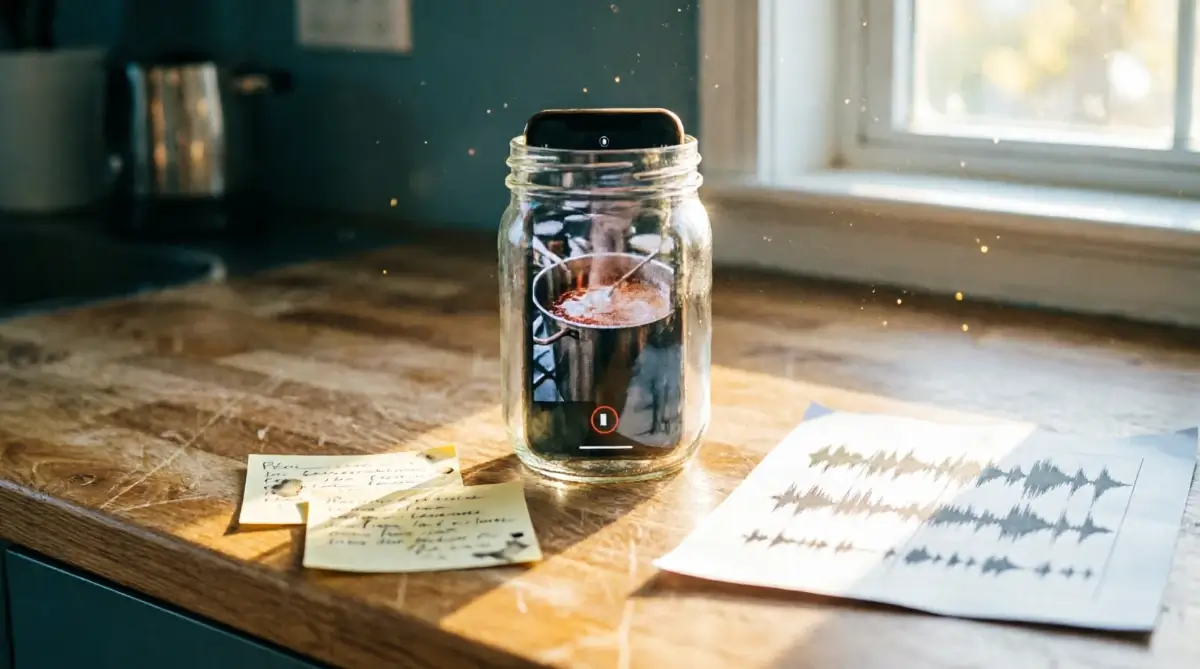
The kitchen smelled of garlic and tomato. My phone was propped against a jar on the counter, playing a video of a native speaker making a dish I had wanted to learn for months. She moved through the steps with ease chopping, stirring, explaining. And then she said a word I did not recognize. I tried to repeat it under my breath, but the sound came out wrong. My tongue felt thick. The vowels did not sit where I expected them to.
I paused the video. I said the word again. Still wrong. I rewound, listened, and tried once more. This time, the sound was closer. My mouth was learning the shape of it, the way a hand learns the weight of a new tool. I was not studying a textbook. I was not repeating a list of isolated words. I was in my kitchen, following a recipe, and I was learning to pronounce something real. I was discovering that I could learn pronunciation without a teacher just a video, a pause button, and the willingness to repeat until it felt right. Each repetition was like sending my voice out into the room and waiting for the echo to return, clearer each time.
That small moment pausing the video, repeating the word, and hearing the difference became my new method. Before, I had tried pronunciation drills. I had listened to audio clips and repeated them in empty rooms. But the words never stuck because they were not connected to anything. They were sounds without a story. The cooking video gave them a story. The word was not just a word. It was the name of an ingredient I needed to find, a step I needed to follow, a dish I wanted to eat. The meaning and the sound were tied together, and that tie made the sound memorable. The echo of the cook’s voice stayed in my mind long after the video ended, and I found myself chasing that echo, trying to match it with my own voice.
The kitchen became my classroom not because it was quiet or well‑equipped, but because it was where I wanted to be. The videos were not lessons. They were just people cooking. But every time I paused to repeat a word, I was learning. And the more I learned, the more my mouth began to move with confidence instead of fear.
Why drilling alone never worked
I had tried the traditional way. I had listened to a native speaker pronounce a word, and I had repeated it. Alone, in a quiet room, the word sounded fine. But the next day, when I needed it in a real sentence, it vanished. My mouth forgot the shape. The sound came out flat or forced or just wrong. The echo of the practice session had faded before it could settle into something permanent.
The problem, I later understood, was that the word had been alone. It had no context. No sentence around it. No emotion. No need. A word learned in isolation is like a shout into an empty canyon you hear the sound, but it doesn’t come back to you. The cooking videos changed that. The words were not alone. They were part of instructions, stories, explanations. They had neighbours other words that gave them meaning. And when I repeated them, I was not just repeating a sound. I was repeating a piece of a real moment. That context was the canyon wall that sent the echo back, fuller and more resonant each time.
The missing piece was context the sound inside a real situation
When I watched a native speaker say “simmer for ten minutes,” I was not just learning how to pronounce “simmer.” I was learning how the word sat inside a sentence. I heard the way her voice dropped at the end of the instruction. I heard the slight pause before “for ten minutes.” These were not things I could learn from a list. They were things I could only absorb by listening to real speech, in real situations, over and over.
I began to understand that training my ear was just as important as training my mouth. The two were connected. When my ear could hear the small details the rise, the fall, the way a vowel stretched in a certain phrase my mouth could follow I was training my ear to understand fast native speech without even realizing it. The cooking videos were not just teaching me words. They were teaching me the music of the language, and my voice was learning to sing along with that music, finding the right notes through endless repetition.
If I could improve pronunciation just by watching videos and pausing, the answer was yes if you do it with attention and repetition. The key is not to watch passively. Pause when you hear a word that sounds unfamiliar. Repeat it out loud several times. Compare your sound to the speaker’s sound. Do not move on until your mouth feels comfortable. This active repetition, tied to a real context, is far more effective than repeating words from a list. The drills had their place. But they were never meant to be the whole journey. When I put the words back into real moments into the steam of the kitchen and the voice of the cook they finally began to sound like language, not like practice. The echo I was chasing had become my teacher.
How I turned cooking videos into a pronunciation classroom
The first video I used this way was a simple recipe for lentil soup. The cook was a woman from a small town, and her accent was thick and warm. She spoke quickly, and within the first minute, I had missed three words. My old habit would have been to feel frustrated and give up but I had promised myself to try a different way.
I paused the video. I rewound. I listened to the phrase again. “Add the onions and stir.” The word “stir” did not sound the way I expected. I said it aloud. Wrong. I said it again. Closer. I kept repeating until the sound felt natural in my mouth not forced, not copied, but comfortable. Then I pressed play and continued. Each time my voice faltered, I imagined the sound bouncing off the kitchen walls and returning to me slightly altered, until finally it came back in the shape I wanted.
This became my pattern. Watch. Hear a difficult word. Pause. Repeat. Rewind. Repeat again. Only when my mouth felt comfortable did I move on. Some days I would spend ten minutes on a single sentence. The progress felt slow, but it was real. Every repetition was carving a small groove in my brain, and those grooves were getting deeper. I was learning to stop mental translation and let my mouth speak trusting the echo of the cook’s voice to guide me rather than the slow machinery of grammar analysis.
The cooking videos were perfect for this because they were practical. The words were things I could use in my own life ingredients, measurements, actions. When I later stood in my own kitchen and said “stir” out loud while I cooked, the word came out naturally. It had been planted in a real context, and it had grown there. The pause button was never my enemy. It was my patient teacher. It let me stay with a sound as long as I needed, and in that staying, my mouth learned what no textbook could teach.
I also noticed something else. The more I listened to the cook’s voice, the more I absorbed the natural flow of the language. I was not just learning pronunciation. I was absorbing the way the language moved I had been told that listening mattered more than grammar early on and now I could feel why. The sounds were becoming part of me before I ever studied a rule. Every time I repeated a phrase, the echo inside me grew stronger, until eventually it felt like the voice was my own.
How long should I spend on a single word before moving on? I spent as long as it took for the word to feel comfortable in my mouth. Sometimes that was three repetitions. Sometimes it was twenty. The number does not matter. The feeling matters. When the word stops feeling foreign and starts feeling familiar, you are ready to move on. The cooking video did not grade me. It did not correct me. But it gave me something better a real voice, saying real words, in a real moment. And when I repeated those words enough times, they became my own. The echo I had been pursuing had finally settled into my voice.
I remember the first time I said “stir” correctly without thinking. I was cooking for a friend, talking through the steps, and the word came out before I could even remember that it used to be hard. The kitchen had become my classroom, and the lesson had stayed. The pause button had been my teacher, and the echo had been my guide.
The small cards that made the words stick
After I paused the video and repeated the word enough times, I did something that felt old‑fashioned. I took a small piece of paper and wrote the phrase down. Not the translation. Just the phrase, in the language I was learning, exactly as the cook had said it. I put that piece of paper on the shelf above my kitchen sink. Every time I washed my hands or filled a pot with water, the phrase was there. I would see it and say it aloud. Sometimes I said it wrong. Sometimes I said it right. But the paper kept the word alive between the video sessions.
The simple act of seeing the phrase every day did more than I expected. The word was no longer something I visited once and forgot. It became part of my kitchen, part of my daily view, part of the small rhythm of my morning. And because I saw it often, I practised it often. Not because I forced myself. Because it was just there. Each time my eyes fell on the handwritten card, it was like hearing a faint echo of the cook’s voice, reminding me to try the sound again.
How a simple note turned into daily practice without effort
The notes multiplied. Soon I had small cards stuck to the fridge, tucked into the corner of the mirror, propped against the coffee jar. Each one held a phrase I had pulled from a video, paused, and repeated until it felt close. The cards were not pretty. The handwriting was messy. But they worked. They turned my home into a soft classroom, where every room held a small reminder of the language I was learning. The cards were like echoes of the original lessons, scattered through my day, calling me back to the sounds I was trying to master.
I kept no more than five cards at once. Any more, and I stopped noticing them. When a phrase became easy when I could say it without thinking I took the card down and replaced it with a new one. The goal was not to cover every surface. The goal was to keep a few words alive in the background of my day. The cards did not teach me pronunciation. They reminded me to practise it. And that reminder, placed where I could not ignore it, was often all I needed to keep the words from fading. The echo they carried was the memory of the video, the voice, the moment in the kitchen.
From the kitchen to the newsroom hearing more voices
The cooking videos were wonderful the cook spoke clearly. Her accent was familiar. I grew comfortable with the way she shaped her words. But I knew that real life was not one voice. Real life was many voices fast ones, slow ones, young ones, old ones, voices from different cities and different backgrounds. If I only listened to one person, I would only learn one way of speaking. I would only chase one echo.
So I added something new I started watching the news in the language I was learning. Then I found a talk show. Then a travel programm. The voices were different. The speeds were different. Some speakers were easy to follow. Others felt like a wall of sound. But each new voice stretched my ear a little further, and each stretch made the previous ones feel easier. Each new speaker was a new echo, bouncing off the walls of my mind from a different angle, revealing something I hadn’t heard before.
The different speeds and sounds that stretched my ear
The news anchors spoke fast and clean the talk show guests interrupted each other. The travel host spoke while walking, sometimes with wind in the microphone. These were not perfect recordings. They were messy and real, and that messiness was exactly what I needed. It taught me that pronunciation was not just about making the right sound. It was about making the right sound in the middle of noise, distraction, and speed. The echo of a word spoken in chaos is different from the echo of a word spoken in silence and I needed to learn both.
The small habit of saving words from the cooking videos had taught me how to keep vocabulary alive. Now I was applying that same habit to the new voices I was hearing. Every time a news anchor said a word I could not catch, I paused and repeated it. Every time a talk show guest used a phrase I wanted to remember, I wrote it down. I had found the simplest way to keep words fresh each repetition was another echo added to the growing chorus in my mind.
Should I start with slow content or jump straight into fast native speech? I started with content that was slightly slower cooking videos, travel shows, simple interviews. When those felt comfortable, I added faster material like news and talk shows. The key was to always have something that felt just a little bit too fast. That edge is where the growth happens. The cooking video was my first teacher. But the news, the talk shows, and the travel programmes became my school. Each new voice was a new room, and the more rooms I entered, the more at home I felt in the language. The echoes were beginning to harmonize.
The patience that built my confidence
I gave myself one rule I would not press play again until the word felt right. Not perfect. Not like a native speaker. Just right enough that my mouth did not stumble. This rule slowed me down. A two‑minute video might take me twenty minutes to finish. But the slowness was the point. Every repetition was a small act of patience, and patience was what my mouth needed. I was learning to stay disciplined without anyone checking on me trusting that the sounds would eventually settle.
There were words that took ten tries there were words that took thirty. I did not count. I just stayed with the sound until it stopped feeling foreign. And when it finally came out smooth when my tongue found the right place and my lips made the right shape I felt a small burst of pride. Not because the word was perfect. Because I had earned it. The echo I had been chasing had finally arrived.
The patience I learned that I now apply to every new word
The habit of staying with a sound until it felt right changed more than my pronunciation. It changed the way I learned everything. I stopped rushing. I stopped expecting instant results. I started trusting that the repetition itself was the progress. The word I could not say today would be easier tomorrow, and easier still the day after, if I just kept returning to it.
This patience carried over into real conversations. When I spoke to someone and a word came out wrong, I did not panic. I just remembered the kitchen, the video paused, the word repeated until it felt right. I had done this before. I could do it again. The confidence I was building before my next real conversation was not about being perfect. It was about knowing that I could work through the mistakes. Each mistake was just a misaligned echo, and I could always adjust and try again.
How do I stay patient when a word just will not come out right? I reminded myself that my mouth was learning a new movement. The muscles needed time, just like learning to throw a ball or play a note on an instrument. Some movements take longer than others. If a word was really hard, I left it for the day and came back tomorrow. Often, the rest made the difference. The pause button was never my enemy. It was my patient teacher. It let me stay with a sound as long as I needed, and in that staying, my mouth learned what no textbook could teach. The echo always returned, sometimes clearer, sometimes fainter, but always there.
There was a word I practised for three weeks before it came out right. Every day, I would say it, fail, and put the card back on the shelf. On the twenty‑second day, I said it without thinking while talking to a friend. I almost did not notice. But my friend did. He said my pronunciation had improved. The card stayed on the shelf for one more week, and then I took it down. The echo had finally found its home.
The words that finally came out right in real conversations
It happened on an ordinary day, in a small shop I had walked past a hundred times. I needed vegetables. The man behind the counter asked me something a simple question about how much I wanted. And I answered. The words came out just as I had practised them in the kitchen, with no pause, no stumble. He nodded, weighed the tomatoes, and handed me the bag. He didn’t know that I had spent weeks with that phrase. He didn’t know about the cooking video, the paused screen, the card on the shelf. He just heard a person speaking, and he understood. The echo I had been nurturing in private had finally been heard by someone else.
I walked out of that shop holding more than vegetables I was holding a small, private victory. The work I had done alone, with no one watching, had reached into the real world. The pronunciation I had built word by word had carried me across a bridge I had been afraid to cross. And the feeling was not pride. It was something simpler. It was the quiet knowledge that I could be understood.
How the kitchen practice became real world speaking
After that first success, I began to notice a pattern. The words I had practised in the kitchen the ones I had paused, repeated, written down, and seen every day were the words that came out most easily in real conversations. The words I had only studied from a list, without the full‑body practice of speaking them aloud in context, were still slow and uncertain.
The kitchen had given me more than pronunciation. It had given me a method I could trust. I knew that if I followed the same steps watch, pause, repeat, write, review I could learn any word, any phrase, any sound. The method was portable. It didn’t depend on a teacher or a classroom. It depended only on my willingness to stay with a word until it felt right. The echoes of my practice sessions were now following me out into the world, and they were no longer faint they were clear and strong.
The real conversation was not the final exam. It was the reward. The work had been done in the kitchen, alone, with the video paused and the word repeated. The conversation just proved what the practice had already built. Every time I stepped out of my home and into the world, the practice I did alone went with me. The words I shaped in the quiet of my kitchen were there when I needed them. I trusted the work I had already done. It did not leave me. The echoes had become my voice.
The slow progress that felt like nothing until it wasn’t
There were long stretches when I felt like I was not improving at all. I would say a word, and it would sound the same as it did the week before. I would listen to the video, repeat, listen again, and hear no difference. The progress I had been hoping for seemed to have stopped completely. The echo I was chasing seemed to be fading, not growing.
But I kept going. Not because I felt encouraged I did not. But because the routine had become a part of my day, as natural as making coffee or washing the dishes. The phone was still propped against the jar. The videos were still playing. The cards were still on the shelf. And even on the days when I felt stuck, I still paused, repeated, and wrote. The actions themselves had become automatic, even when the results were invisible.
The moment I looked back and saw the distance I had travelled
One afternoon, I found an old card tucked behind the coffee jar. It had a phrase I had written months earlier, when I first started the cooking videos. I read it aloud. The words came out smoothly, without hesitation. I remembered how hard that phrase had once been how many times I had paused, repeated, and failed. Now it felt easy. The change had been so gradual that I had not noticed it happening. But it was real. The echo had returned, and it was stronger than ever.
That moment gave me more motivation than any praise from a teacher ever could. It was proof that the slow, invisible work had been working all along. The cards on the shelf, the videos in the kitchen, the endless repetitions they had been building something, one small layer at a time. And now the structure was strong enough to stand on. I had found purpose in my language journey and that purpose was the fuel that kept me going through the slow weeks.
How do I keep going when I cannot hear any improvement? I stopped listening for improvement every day. The daily view is too small. Instead, I looked back over a month. I compared how I said a word then to how I said it now. The difference was always there, even when I couldn’t feel it in the moment. Trust the repetition. The change is happening beneath the surface. The progress was invisible day by day, but it was undeniable when I looked back. The kitchen had not changed. The videos had not changed. But I had. Slowly, quietly, without fanfare, my mouth had learned to speak. The echoes had become my voice.
The phone stays in the kitchen and the videos still play
Years have passed since that first cooking video the phone is newer now, but it still sits propped against the same jar on the kitchen counter. The videos are different new recipes, new cooks, new accents but the method has not changed. I still pause when a word feels hard. I still repeat until my mouth feels right. I still write the phrase on a small card and put it somewhere I will see it.
The habit has become so natural that I no longer think of it as studying. It is just something I do while I cook, while I drink my coffee, while I wait for the water to boil. The language has woven itself into the fabric of my day, and the sounds that once felt foreign now feel like old friends. The echoes that I once had to chase now arrive unbidden, settling into my speech as naturally as the rising steam from a pot.
Start with something you love and the sounds will follow
If someone asked me how to learn pronunciation without a teacher, I would tell them this. Find something you love cooking, sports, travel, music and find a video of a native speaker talking about it. Watch it. When a word feels strange in your mouth, pause the video. Say the word aloud. Say it again. Say it until it feels comfortable. Write it down. Put the paper where you will see it every day. Then do it all again with the next word.
You do not need a classroom you do not need a teacher. You need a video, a pause button, and the patience to stay with a sound until it becomes yours. The kitchen taught me that. And the kitchen is still teaching me, every single day. The weekly rhythm of watching, pausing, writing, and reviewing became the backbone of my learning. If you want to build a routine that holds everything together start with one small consistent session that you protect every single week the kitchen will be waiting for you.
Can this method work for any language? Yes. The sounds are different, but the process is the same. Watch a native speaker. Pause when a word feels hard. Repeat until it feels right. Write it down. See it every day. The method does not depend on the language. It depends on your willingness to stay with the sound until it becomes yours. The echo will come if you keep calling.
I began with a phone propped against a jar, a cooking video playing, and a word I could not say. My mouth felt clumsy, my ears uncertain. But I stayed with the sound. I paused, repeated, wrote, and reviewed. The kitchen became my classroom, the video my teacher, the small cards my daily reminders.
There were weeks when I heard no change there were days when the words felt as foreign as they had at the start. But the method held. The repetitions accumulated. And one day, in a small shop, I opened my mouth and the right sounds came out. The seller understood me. The bridge between practice and real life had been crossed.
Pronunciation does not require a teacher it requires a voice to imitate, a pause button, and the patience to stay with a sound until it feels like home. The kitchen gave me all of that. And it can give it to anyone who is willing to start. The echoes I chased in that small kitchen are now the voice I carry with me everywhere. And that voice is my own.
If you could cook one meal in the language you are learning using only the words you have practised in your kitchen what would you make, and who would you invite to share it?