The silence arrived without warning. I had worked for months to reach the intermediate level. Hours of listening, pages of notes, conversations that left me exhausted but proud. And when I finally got there, I felt like I had climbed a mountain and could finally rest. The language was not perfect, but it was mine. I could hold a conversation. I could understand the news. I could read a book without a dictionary glued to my hand.
But then the silence began. Not the silence of not knowing. The silence of not using. My life got busy. The people around me did not speak the language. The need that had once driven me to practised every day was no longer there. And slowly, quietly, the words began to fade.
I would reach for a phrase and find only a shadow. I would hear a sentence and miss a word I used to know. The mountain I had climbed was eroding beneath my feet, and I did not know how to stop it. I needed to understand how to keep a language from fading, and the answer was not what I expected.
My first instinct was to return to the books. I opened my old textbook. I downloaded a flashcard app. I tried to drill the words back into my memory. But it felt wrong. The words were there, somewhere, but they would not come when I called them. The drills felt like trying to fill a bucket with a hole in the bottom. I was working hard, but the water kept leaking out.
Then I noticed something the few words I had used recently in a real conversation, in a message to a friend, in a search I had made online those words were still sharp. They had not faded. The words I had only reviewed had slipped. The words I had used had stayed. That was the clue I needed. The problem was not a lack of study. The problem was a lack of living. I had stopped being an active user and had gone back to being a student. And the language, which had once been a living thing, was turning into a museum piece.
The decision came to me not as a grand plan, but as a simple shift. I would stop trying to maintain the language. I would start using it. Every day. For real reasons. With real people. And that shift changed everything. The fading was never a sign that I had failed. It was a sign that I had stopped walking the path. And the moment I started walking again not as a student, but as a person who simply lived the language the path began to clear.
Why my language skills began to slip just when I thought I was safe
The intermediate level is a strange place you know enough to feel confident, but not enough to be fluent. You can survive, but you cannot yet thrive. And in that space, it is easy to stop pushing. I had passed the tests. I had proved to myself that I could learn. So I slowed down. I stopped seeking out conversations. I stopped watching videos in the language. I stopped reading. And the language, which had once been a fire I fed every day, began to cool.
The fading was so gradual that I did not notice it at first
A word I could not recall. A sentence I had to replay twice a conversation where I nodded along but missed the details. The signs were there, but I explained them away. I was tired. I was busy. I would get back to it soon. But soon never came, and the fading continued. I had learned earlier that confidence in speaking comes from real practice, not from study alone and the same was true for keeping the language alive the confidence to speak was not enough. I needed the habit of speaking, every day, to keep the words from slipping away.
Why do language skills fade even when you have reached a good level? I came to see that language is not a trophy you put on a shelf. It is more like a garden. If you stop watering it, the plants do not die immediately. But they start to wilt. The same is true for vocabulary, listening, speaking they need regular contact to stay strong a small amount of contact a short conversation, a video, a few messages can be enough to keep the garden alive.
The friend who changed everything
The first real change came when I made a friend not a language partner. Not a tutor. A friend. Someone who shared an interest of mine, who happened to speak the language I was learning. We started chatting online. At first, the messages were slow. I had to look up words. I made mistakes. But my friend was patient. He corrected me gently, laughed with me when I said something funny by accident, and kept the conversation going.
How a real conversation did more than a hundred review sessions
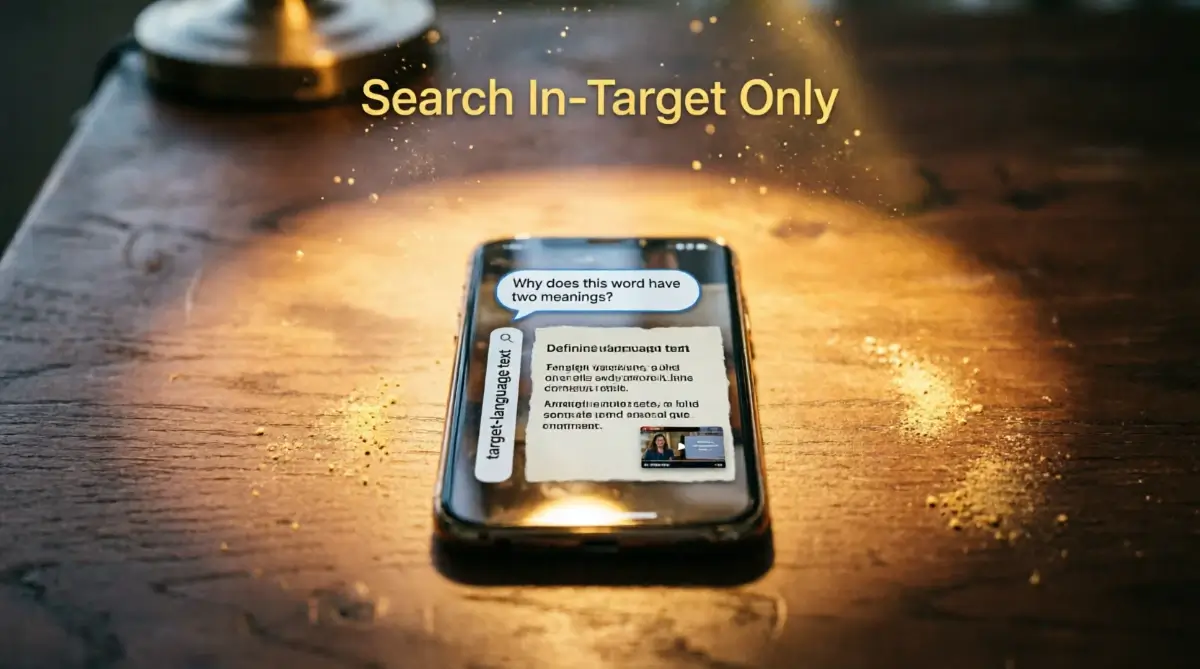
Every conversation with my friend was a review session disguised as a chat. When I did not know a word, I looked it up but I did it differently now. Instead of searching for the translation in my own language, I searched for the meaning in the target language. If I wanted to know a word, I typed it into the search bar and read the definition in the language itself. I saw the word used in sentences. I saw other words I knew around it. I learned more than the single word I had looked for.
This habit of searching in the target language was like opening a door into a new room every time I had a question. I was no longer leaving the language to get help. I was staying inside it. And the more I stayed inside, the more natural it felt. I had started building a weekly routine of using the language, not studying it the routine was not rigid. It was just the natural flow of a life that now included the language in its daily rhythm.
If I didn’t know anyone who spoke the language I would start with shared interests. Join online communities, forums, or groups that focus on something I loved cooking, sports, music, travel and look for people who speak the language. The connection does not have to be about language learning. It just has to be about something I care about. The language will follow naturally.
The friend did not teach me grammar he did not drill me on vocabulary. He simply talked to me, and I talked back. And in that simple exchange, the language came alive again. I remember the first time I made my friend laugh with a joke I told in his language. It was a small joke, and my grammar was not perfect. But he laughed, and I felt a warmth that no test score had ever given me. That was the moment I knew the language was no longer fading it was growing.
How I started searching in the target language instead of my own
Before the shift, my search habit was simple I heard a word I did not know. I opened a translation app. I typed the word. I read the meaning in my own language. I closed the app. The whole process took ten seconds, and I learned almost nothing. The word was a visitor that stayed for a moment and left.
Then I changed one thing. Instead of translating the word into my own language, I searched for it in the target language. If I wanted to know what a word meant, I typed it into the search bar and read the explanation in the language itself. The definition was not always easy. Sometimes there were other words I did not know inside the explanation. But that was the gift. Each search became a small lesson. I would read the definition and find three other words I recognized. I would see the word used in example sentences. I would learn not just the meaning, but how the word lived among other words.
The hidden lessons I found inside every search result
Every search became a doorway I would look up a word and end up reading about something completely different a news article, a blog post, a forum discussion. The search results were not just definitions. They were real content, written by real people, using the language I was trying to keep alive. And because the content was connected to my own curiosity, I remembered it.
This habit also kept my vocabulary fresh without feeling like review. I was not drilling flashcards. I was just following my questions wherever they led. And each question kept the language moving through my mind. I had discovered that the simplest way to keep words from fading was not to review them in isolation, but to meet them again and again in real contexts. I was learning any foreign language by myself with a self built system and that system now ran on curiosity, not discipline. The search bar became my teacher. Every question I asked in the language opened a door, and behind every door was another room full of words I already knew, waiting to be found again.
From student to active user the shift that saved my fluency
The biggest change was not a new app or a better schedule. It was a decision. I decided that I was no longer a student of the language. I was a person who used it. That decision changed everything. A student reviews. A user lives. A student prepares for a future conversation a user has the conversation now.
I started talking to my friend every day, even if it was just a few messages. I started watching videos not to study, but because I wanted to know what happened next. I started reading articles not to find new words, but because the topic interested me. The language became the medium, not the lesson. And when the language became the medium, it stopped fading.
The day I realized I had not opened a textbook in weeks
I remember the moment clearly. I was sitting on my sofa, watching a show in the language without subtitles. I was laughing at the jokes, following the plot, not thinking about the fact that it was in another language. And then it hit me. I had not opened a textbook in weeks. I had not reviewed a flashcard. I had not done a single grammar exercise. And yet, the language felt stronger than ever.
That was the proof I needed maintenance was not about study. It was about use. The words I needed were staying because I was using them. The structures were holding because I was hearing them every day. The language had become part of my life, and as long as I kept living it, it would not leave and how the simplest way that keep words alive use them in real contexts as often as possible.
Using the language is the most powerful form of maintenance. But a small amount of focused study looking up a grammar point, reviewing a tricky word can still help. The difference is balance. When I was a student, study was the main meal and use was the snack. Now, use is the main meal, and study is a small side dish. That shift keeps the language alive without making it feel like work. The textbook had its time. But that time was over. The language was no longer something I studied. It was something I lived and living it was the only maintenance it ever needed.
The daily habits that keep the language alive
The habits were not complicated every morning, I sent a message to my friend. During the day, if I needed to look something up, I did it in the language. In the evening, I watched a show or read a few pages of a book. None of this felt like practice. It felt like my normal life, just in a different tongue.
The key was that the habits were tied to things I already did. I already sent messages. I already searched for things online. I already watched videos. I just changed the language. And because the actions were already part of my day, the language slipped into my life without resistance.
How my phone became a portal to a world without translation
My phone had always been a tool for learning flashcards, apps, exercises. But now it became something else. It became a window into the world where the language lived. The messages I sent were real conversations. The videos I watched were made for native speakers. The searches I made were for things I genuinely wanted to know. The phone was no longer a classroom it was a doorway, and I walked through it every day.
The listening I did during those daily moments also kept my ear sharp. I was no longer studying grammar rules. I was hearing the language in its natural form, over and over, and that constant exposure was doing more for my fluency than any exercise ever could. I had learned that listening mattered more than perfect grammar early on and now that lesson was keeping my skills alive at the intermediate level.
What daily habits make the biggest difference? The ones you actually do, every day, without fail. For me, it was messaging a friend, searching in the language, and watching something I enjoyed. The specific habits matter less than the consistency. Pick two or three small actions that fit naturally into your day, and protect them. The language will stay because you are using it. The daily habits were not grand. They were small, ordinary, almost invisible. But they were constant and constancy, more than intensity, is what keeps a language alive.
There was a week when I was travelling and could not keep my usual habits. I sent only a few messages. I watched nothing. By the end of the week, the words felt a little further away. But the moment I returned to my small daily actions the message, the video, the search they came back the language had not left. It had just been waiting for me to return.
How mainstream content kept my ear sharp without a single grammar lesson
When I shifted from student to active user, I made a simple rule. Every day, I would watch or listen to something that was made for native speakers. Not lessons. Not simplified content. Real shows, real news, real people talking about real things. At first, it was hard. The speech was fast. The accents were unfamiliar. I missed words and lost the thread. But I kept going. I did not test myself. I did not pause to look things up. I just let the sounds fill the room while I did other things cooking, cleaning, sitting on the sofa.
After a few weeks, I noticed a change the fast speech that had once felt like a wall was starting to feel like a stream I could step into. I caught more words. I followed more conversations. I understood jokes without needing them explained. The content had not changed. My ear had. And it had changed not because I studied harder, but because I listened more. I was giving my ear what it needed real language, in real time, every single day.
Understanding without translating the quiet milestone I almost missed
One evening, I was watching a talk show the host was interviewing a guest, and they were laughing about something that had happened backstage. I laughed too. Not because I read a translation. Because I understood. The words had travelled from the screen to my mind without passing through my own language. There was no pause. No mental search. Just understanding.
That moment was quiet. It did not announce itself. But it was one of the most important milestones I ever reached. It meant the language had become direct. It was no longer a code I had to decode. It was a voice I could hear. The listening I had been doing every day the news, the shows, the videos had been working all along I had been training my ear to understand fast native speech without even realizing it. The maintenance was not a chore. It was just living.
What kind of mainstream content should I watch? Watch what you love. If you like cooking, watch cooking shows. If you like sports, watch sports commentary. If you like talk shows, watch talk shows. The content must pull you in. When you are interested in the topic, you forget you are listening to another language.
You are just following the story that natural engagement is what keeps your ear sharp. The news did not teach me grammar. The shows did not drill me on vocabulary. But they gave my ear what it needed real voices, real speed, real life. And that was enough to keep the language awake.
The people I met and the conversations that replaced my flashcard drills
The friend I mentioned earlier was only the beginning through him, I met others. People who shared my interests, who spoke the language, who were willing to talk to me even when my sentences were clumsy. They became more than practice partners. They became real friends. We talked about our days, our problems, our dreams. The language was not the point of our conversations it was just the tool we used to reach each other.
The friends who corrected me laughed with me and kept me going
These friends did something no flashcard ever could they made me care. When I did not know a word, I wanted to learn it not for a test, but because I wanted to tell my friend something that mattered. When I made a mistake, they corrected me gently, and I remembered the correction because it was attached to a real moment. The words I learned from them did not fade. They were tied to laughter, to arguments, to shared stories they had roots.
The conversations were not always easy sometimes I struggled to express myself. Sometimes I had to describe something in a roundabout way because I did not know the exact word. But the struggle was part of the learning. It forced me to use the language I had, to stretch it, to bend it. And every time I found a way to make myself understood, I grew a little more confident.
The flashcard drills I used to do were lonely. It was just me and a screen. But the conversations were alive. They had warmth and humour and surprise. They taught me not just words, but how people actually speak the pauses, the interruptions, the way a voice softens when someone is being kind. These were things no app could teach me. I was learning not just the language, but the culture that lived inside it. My ear was being trained through the voices of people I genuinely cared about.
If I cannot find a friend who speaks the language, I start where I am. Join online communities, forums, or groups that focus on something I love. Comment on posts. Send messages. The connection does not have to be deep at first. Even small exchanges a comment, a reply, a shared laugh keep the language alive the friendships will grow over time.
The key is to start. The flashcards were useful, but they were never the destination. The destination was the people on the other side of the words. And when I finally reached them, the language stopped being something I maintained and became something I lived.
I once went a full month without opening a single study app. No flashcards. No grammar exercises. Just conversations with friends, videos in the language, and searches made in the language itself. At the end of that month, I spoke to a stranger and realized I had not lost a thing. The language had not faded. It had grown stronger, because I had finally stopped studying it and started living it.
The language is still here because I use it every day
The fear of fading is gone not because I have a perfect memory, but because I have built a life that holds the language inside it. The friends I talk to. The shows I watch. The searches I make. The news I read. The language is not something I visit. It is something I live in. And as long as I keep living in it, it will not leave.
The shift from student to active user was the most important decision I ever made. It changed not just how I learned, but how I saw myself. I was no longer someone trying to keep a language alive. I was someone who simply used it, every day, as naturally as I used my own.
What I tell anyone who feels their skills slipping become a user not a student
If someone came to me today and said, “I think I am losing my language,” I would tell them this. The problem is not your memory. The problem is that you have stopped living the language. You have put it on a shelf, and shelves are for things you want to keep but never touch. The language does not belong on a shelf. It belongs in your hands, in your mouth, in your messages and your searches and your laughter with friends.
Start small. Send one message watch one video. Search for one thing. Do it today, and do it again tomorrow. The language will not fade because you are using it. And the more you use it, the more it will grow. Purpose is what turns maintenance into meaning. When the language is tied to something you care about friends, culture, connection it stops being a task and becomes a part of who you are. That sense of purpose is the thread that holds everything together.
How much daily contact do I really need? Less than you think a short conversation, a video, a few messages these small acts, done consistently, are enough. The key is not the length of the contact. It is the fact that the contact happens every day. The language needs to feel wanted, not studied. Give it a little attention each day, and it will stay. The language did not stay because I studied it. It stayed because I used it, loved it, and let it become part of my daily life. And that, more than any method or tool, is what keeps a language from fading.
I thought at my language was slipping away I had reached the intermediate level and stopped pushing. The words were fading, and I did not know how to stop them. What I discovered was that the answer was not more study it was more living.
I made a friend. I started searching in the language instead of translating. I let mainstream content fill my days. I stopped being a student and became an active user. And the language, which had been fading, came back to life. Not because I worked harder, but because I finally gave it what it needed: a real place in my real life.
The bridge between knowing a language and keeping it alive is not built with flashcards. It is built with conversations, with curiosity, with the small daily acts that turn a subject into a companion. Walk that bridge every day, and it will never crumble. And if you need to build the discipline to keep going without anyone checking on you, remember that the most powerful motivation is the connection you create by using the language every single day.