I stay motivated during long language learning journeys not by chasing motivation, but by anchoring myself to a precise promise that makes quitting feel more expensive than continuing. Motivation is a wave that rises and falls without warning. A promise is a decision that can be renewed every morning. When I started learning English, I did not begin with a vague desire to “learn a language.” I began with a specific purpose: to build proof for my mind that I was capable of doing hard things, to access opportunities that were closed to me, and to become a person I could trust and respect. That promise did not disappear when I felt tired. It did not waver when progress slowed. It stood firm, waiting for me to return to it, and every time I did, the journey continued.
The long language learning journey is not a sprint with a finish line you can see from the starting blocks. It is a path that stretches over years, through plateaus and valleys, through seasons of visible growth and seasons of invisible work. The people who reach fluency are not the ones who never wanted to quit.
They are the ones who learned how to continue despite the desire to quit. This article is about what I learned during my own long journeys the practices, the mindset shifts, and the deliberate experiments that kept me moving forward when everything in me wanted to stop.
Motivation asks you to feel like practicing. A promise asks you to practice regardless of how you feel. The promise lasts longer.
The Promise That Must Come Before the First Lesson
Before I opened a textbook or downloaded an app, I wrote down why I was learning the language. I did not write “to be fluent.” That is a result, not a reason. I wrote: “I am learning this language to access better career opportunities that will change the trajectory of my life.” I wrote: “I am learning this language to prove to myself that I am capable of finishing something difficult, so that I can trust myself when I set future goals.” Those statements were specific. They were personal. They carried emotional weight.
A promise that is vague will not survive the first plateau. “I want to learn Spanish” is a wish, not a promise. “I want to learn Spanish so I can communicate with my partner’s family in their native language and build a relationship that transcends words” is a promise. The difference is the emotional anchor. The promise connects the language to something larger than the language itself to identity, to relationships, to survival, to purpose.
For some learners, the promise is educational: graduating from a better university, earning a degree that opens doors. For others, it is professional: qualifying for a job that requires the language, accessing markets that were previously closed. For me, as a displaced person, the promise was survival and self‑respect. I needed to communicate to navigate a new world. I needed to achieve something difficult to rebuild the confidence that displacement had eroded. The promise was not optional. It was essential. That gravity kept me moving when lighter reasons would have failed.
A promise that is tied to your survival or your identity will outlast any feeling of discouragement. A promise that is tied to a vague desire will collapse under the weight of a hard day.
The Cost of Quitting: Regret Is Heavier Than Effort
I have thought deeply about the cost of quitting. Quitting feels like relief in the moment. You put down the burden. You stop the struggle. You reclaim your free time. The first few days after quitting feel like freedom. But that freedom is an illusion. Beneath it, regret is already growing. And regret, once it takes root, is far heavier than the effort you were trying to escape.
The effort of practicing when you are tired lasts for an hour. The regret of knowing you gave up on something that mattered to you lasts for years. I have experienced both. The memory of a difficult practice session fades within days. The memory of a goal abandoned still stings, years later, when I see someone else achieving what I once dreamed of. The asymmetry is stark. Temporary discomfort versus permanent disappointment. When I see that choice clearly, the decision to continue becomes almost automatic.
This is not about fear. It is about honesty. I do not practice because I am afraid of regret. I practice because I have been honest with myself about the alternative. The person who quits does not escape the struggle. They trade the struggle of practice for the struggle of watching their own potential fade. One struggle builds. The other destroys. I choose the one that builds.
Quitting feels like closing a heavy door. But the door you close on your language is the same door you close on the person you could have become.
How I Practice on the Days When Motivation Is Completely Absent
There are days when the promise feels distant and the motivation is zero. On those days, I do not try to produce my best work. I do the minimum. A single flashcard review. Five minutes of listening. One sentence spoken aloud. The minimum is not a failure. It is a victory over the voice that wants me to do nothing. It keeps the chain alive. It tells my brain that the practice continues, even if today is not a day for intensity.
The minimum works because it removes the pressure of performance. When I am tired, the thought of a full study session feels overwhelming. The thought of five minutes feels manageable. Once I start the five minutes, I often continue beyond them. But even if I do not, the minimum has done its job. The connection to the language has been maintained. Tomorrow, when I am less tired, I will do more.
This principle is supported by the larger truth that consistency over intensity is what compounds into lasting fluency and the learner who practices daily with modest effort will surpass the learner who practices intensely but irregularly the minimum is not a compromise. It is a strategy. It is the safety net that catches me on the hardest days and returns me gently to the path.
The 7‑Day Experiment That Taught Me the Value of Showing Up
I want to share an experiment I conducted on myself, not as a recommendation but as a personal experience that revealed something important. There was a period when I felt completely drained. The progress was invisible. The purpose felt distant. I was tempted to quit. Before making a final decision, I decided to stop practicing for seven days. I would do nothing related to the language. I would see how I felt at the end of that week.
The first few days felt comfortable. I had more free time. I did not have the weight of daily practice on my shoulders. By the fifth day, the comfort began to feel hollow. Regret started to creep in. I thought about the time I had already invested, the progress I had made, the person I was trying to become. By the seventh day, I knew I had made a mistake. The week of doing nothing had produced nothing. No progress. No satisfaction. Just the slow, creeping awareness that I was drifting away from something that mattered.
I measured my condition at the end of that week and compared it to the week before, when I had been practicing. The difference was stark. The week of practice had been hard, but I had felt energy, purpose, and a small but real sense of forward movement. The week of rest had felt easy at first, but it ended in emptiness. The experiment proved to me that the difficulty of practice is not a punishment. It is the source of something vital. It gives shape to the day. It builds evidence of my own persistence. Without it, I felt less like myself.
The following week, I returned to practice. I built a daily schedule around the time I could dedicate to language learning. After seven days of consistent work, I measured again. The difference was undeniable. I felt more energetic, more confident, more aligned with the person I wanted to be. My mood had shifted. The emptiness of the quitting week had been replaced by the satisfaction of showing up. I said to myself: the hard days will pass, but the results of showing up will accumulate. I will keep going.
The week of doing nothing taught me that comfort without purpose is emptiness. The week of practice taught me that effort with purpose is fulfillment.
Building Evidence for the Mind So Excuses Lose Their Power
The mind is an excuse factory. When I am tired, it tells me that one missed day will not matter. When I am frustrated, it tells me that I am not talented enough. When I see someone else progressing faster, it tells me that I should quit because I will never catch up. These excuses are not truths. They are automatic thoughts generated by a brain that wants to conserve energy and avoid discomfort.
I learned to counter these excuses not with willpower, but with evidence. I kept a record of every day I practiced. I kept a journal of my progress. I saved old recordings of my speaking and listened to them months later, hearing the undeniable improvement. When the excuse factory started producing reasons to quit, I opened my evidence folder and confronted the lies with facts. “One missed day will not matter” was met with a calendar of crossed‑off days that showed the chain I had built. “I am not talented enough” was met with recordings that proved I was better than I had been. “I will never catch up” was met with the realization that I was not racing anyone else. I was racing only the version of myself who almost quit.
The evidence stack is the foundation of self‑trust. Every time I practice, I add to it. Every time I want to quit, I consult it. The evidence does not argue with the excuses. It simply exists, undeniable and solid. Over time, the excuses have become less frequent. They have not disappeared, but they have lost their power. The evidence has spoken louder.
Your mind will always find reasons to stop. Give it a folder of reasons you kept going. The folder will win.
The Resilient Mind That Learns From Hard Days
A resilient mind is not a mind that never struggles. It is a mind that, when it struggles, asks a different set of questions. Instead of asking, “What is wrong with me?” it asks, “What can this hard day teach me?” Instead of asking, “Why is this happening to me?” it asks, “How can I use this experience to grow?” The shift from self‑pity to self‑inquiry is the shift from victimhood to agency.
I have trained my mind to see hard days as teachers. When I feel like quitting, I do not push the feeling away. I examine it. What caused the loss of motivation? Was I tired? Was I discouraged by slow progress? Was I comparing myself to someone else? The answer usually reveals a specific, fixable cause. Tiredness can be addressed with rest, not quitting. Slow progress can be addressed with patience, not abandonment. Comparison can be addressed by refocusing on my own journey, not someone else’s.
The hard days are not random punishments they are part of the process. Every long journey has them. The people who succeed are not the ones who avoided hard days. They are the ones who learned to walk through them, extracting the lesson and continuing forward. The resilient mind says: this is not permanent. This is a test I must pass. This is a lesson I am grateful for, because it will make me stronger for the next hard day that inevitably comes.
The hard day is not your enemy. It is your trainer. It asks you to prove that you want the destination more than you fear the climb.
The Role of Purpose in Outlasting the Desire to Quit
Purpose and promise are not the same thing, though they are closely related. The promise is the specific goal: to learn this language for this reason. The purpose is the deeper meaning behind the promise: to become a person who keeps their word, to build a life of agency rather than passivity, to honor the sacrifices of those who came before me. The promise can be completed. The purpose is never finished.
When the promise feels distant when the language still seems impossibly hard and the goal still seems impossibly far I reconnect with the purpose. I remind myself that I am not just learning vocabulary. I am building the identity of a person who does not quit. I am proving to myself that I am capable of long‑term commitment. I am creating evidence that will serve me in every future challenge. The language is the vehicle. The purpose is the destination. And the destination is a life where I trust myself completely.
The purpose also protects me from the trap of external validation. If my only reason for learning were to impress others or to achieve a certificate, I would be vulnerable to every negative comment and every slow month. But my purpose is internal. It does not depend on applause. It depends on my own honest assessment of whether I am moving toward the person I want to be. That assessment, unlike external feedback, is always available and always honest.
The promise gets you started. The purpose keeps you going long after the initial excitement has faded.
The Practice of Small Actions on the Hardest Days
I do not recommend this to everyone, but I want to share what I do on the days when even the minimum feels like too much. I do not abandon the language entirely, because I know from my 7‑day experiment that doing so leads to emptiness. Instead, I engage with the language in a way that requires almost no effort. I listen to a song I love in the target language without trying to understand every word. I watch a scene from a film without pausing to analyze the dialogue. I read a single page of a book without looking up unfamiliar vocabulary. The activity is not productive in the traditional sense, but it keeps the connection alive. It tells my brain that the language is still part of my life.
These small, effortless interactions are like embers in a dying fire. They are not enough to cook a meal, but they are enough to keep the fire from going out completely. When my energy returns and it always returns the fire is still there, ready to be fed. If I had let it die, restarting would be far more difficult. The embers make the return easier.
This practice is not laziness. It is strategic energy conservation. I have learned that forcing intense study when I am depleted leads to resentment and, often, to longer breaks. A gentle, effortless connection preserves the relationship with the language until I am ready to engage fully again.
Learning to use audio, even when I understand very little at first, trains the ear and keeps the language alive during periods when active study feels impossible.
The Comparison I Make Between My Weeks of Practice and My Weeks of Avoidance
I have kept journals during different phases of my language learning journey. Some entries are from weeks when I practiced daily. Others are from weeks when I avoided practice, telling myself I needed a break. The difference between those two sets of entries is the most powerful evidence I have for the value of showing up.
The practice‑week entries describe struggle, but they also describe small victories. A word I finally remembered. A sentence I constructed without hesitation. A podcast I understood a little better than the week before. The tone is tired but hopeful. The avoidance‑week entries describe comfort, but they also describe emptiness. A sense of drifting. A disappointing distance from the person I wanted to become. The tone is comfortable but hollow.
When I read those entries side by side, the choice becomes clear. The practice weeks were harder in the moment, but they produced something of value. The avoidance weeks were easier in the moment, but they produced nothing except regret. I no longer need to debate whether to practice. The evidence is in my own handwriting. Showing up, however imperfectly, produces growth. Avoiding produces only the slow erosion of my own self‑respect.
The journal does not lie. It tells you exactly what you gained and what you lost. Read it when you are tempted to quit.
How I Renew My Commitment After a Period of Drift
I am not perfect there have been periods when I drifted away from my practice not because I made a conscious decision to quit, but because life became chaotic and the language slipped down my list of priorities. When I realized what had happened, I felt guilty. The guilt made it harder to return. I felt like I had failed, and the feeling of failure made the language feel like a source of shame rather than a source of growth.
I learned to bypass guilt by focusing not on the time I had lost, but on the practice I could do today. I stopped asking, “How could I have let this happen?” and started asking, “What can I do right now to reconnect?” The question shifted my focus from the past, which I could not change, to the present, which I could. I would do a single, small practice session ten minutes of flashcards, a short podcast, a few sentences spoken aloud. The session did not make up for the lost weeks, but it broke the cycle of avoidance. It proved to me that the door was still open.
The return after a period of drift is a skill in itself. It requires humility to accept that you drifted, and courage to begin again. But every time I have returned, I have returned stronger. The drift taught me something about my triggers what causes me to disengage and that knowledge has helped me prevent future drifts. The return is not a sign of failure. It is a sign of resilience.
Drifting away is human. Returning is a choice make the choice before guilt convinces you that you cannot.
The Vision That Outlasts Every Plateau
There is a practice I return to when the journey feels endless: I close my eyes and imagine the person I will be when I have achieved what I set out to achieve. I do not imagine the certificate or the test score. I imagine the conversation. The moment when I am speaking with a native speaker and I realize, halfway through, that I am not translating. The moment when I read a book in the target language and forget that it is not my native tongue. The moment when I help someone else who is starting their journey and I can say, “I was once where you are. Keep going.”
That vision is not a fantasy. It is a preview. I have experienced versions of it with languages I have already learned, and the memory of those experiences fuels my commitment to the languages I am still learning. The vision makes the plateau bearable. It reminds me that the struggle is temporary and the reward is real.
The vision I held when I started learning English was simple: I wanted to understand the world beyond my immediate circumstances. As I grew, the vision expanded. I wanted to read literature in its original language. I wanted to speak with people from cultures I had only read about. I wanted to become someone who could move between worlds. The vision grew as I grew. That is the beauty of a long journey: the destination reveals itself in stages, each one more magnificent than the last.
I also use the vision to measure my progress in reverse. I ask: if I quit today, will I ever reach that vision? The answer is always no. The only path to the vision is through the plateau. Every day of practice is a step toward it. Every day of avoidance is a step away. The vision clarifies the choice.
The vision is the destination you cannot see from the valley. Keep walking. The view will reveal itself when you have climbed high enough.
The Evidence Stack That Silences the Voice of Doubt
I return to the evidence stack because it is the most practical tool I have for sustaining motivation. The stack contains everything I have accumulated over my years of learning: journals, recordings, screenshots of milestones, messages from native speakers who complimented my progress, old tests I took and later surpassed. When doubt arrives, I open the stack. I do not argue with the doubt. I let the evidence speak.
The evidence tells a story that my emotions, in a moment of discouragement, cannot tell. It says: you were once unable to form a single sentence, and now you can hold a conversation. You were once unable to understand a slow podcast, and now you can follow a film. You were once terrified to speak, and now you speak with confidence. The doubt says: you are not progressing. The evidence says: look at the distance you have traveled.
This practice is not a trick. It is an honest confrontation with the facts of my own history. The doubt is a feeling. The evidence is a fact. When I place them side by side, the fact wins. I return to the stack as often as I need to. It has never failed to remind me that the journey, however slow, is moving forward.
Measuring real language progress without tests means observing how comfortably you communicate, not relying on external certificates.
Doubt is a cloud. Evidence is a mountain that rises above it. Climb the mountain and look down. The cloud is thin, and the path is clear.
The Community That Refuels My Motivation
I do not learn alone I have sought out communities of language learners online groups, forums, language exchange partners who share my struggles and celebrate my victories. When my own motivation runs low, I draw on the collective energy of the community. I read posts from people who are further along the path and feel inspired. I read posts from people who are just starting and remember how far I have come. I share my own struggles and receive encouragement from people who understand exactly what I am feeling.
The community also provides accountability when I have told someone I will practice today, I am more likely to do it. The gentle social pressure of a shared commitment is often enough to push me past the resistance. I do not rely on the community as my sole source of motivation, but I value it as a resource I can draw on when my own reserves are low.
Creating a language learning environment inside my daily life which includes connecting with communities of fellow learners, has made the journey feel less solitary and more sustainable the language is not just a skill I am acquiring alone. It is a bridge to other people, and those people are there, waiting, ready to walk the bridge with me.
The Gratitude I Practice for the Hardest Parts of the Journey
I have learned to be grateful for the hard days. This did not come naturally. For years, I resented the struggle. I wanted the journey to be easier, faster, smoother. But the struggle is what built the resilience I now carry into every area of my life. The hard days taught me patience. The plateaus taught me consistency. The moments of wanting to quit taught me to examine my purpose and recommit to it with deeper conviction.
Gratitude transforms the experience of difficulty. When I am grateful for the hard day, the hard day loses its power to discourage me. It becomes a teacher rather than an enemy. I do not enjoy the hard day in the moment it is still hard but I recognize its value while it is happening. I know that on the other side of it, I will be stronger. That knowledge makes the hard day bearable.
This gratitude is not a denial of the difficulty. It is an acknowledgment that difficulty, faced and overcome, is the mechanism of growth. The muscle grows by being stressed. The mind grows by being challenged. The spirit grows by enduring what it once thought it could not endure. The language journey, with all its frustrations and plateaus, is a training ground for the soul.
The hard days are not obstacles on the path they are the path. Walk it with gratitude, and it will lead you somewhere worth arriving.
Measuring Progress Over Long Periods to See the Unseen Growth
One reason motivation fades is that daily progress is invisible. You practice today, and you feel the same as you did yesterday. The small improvements are too subtle to perceive. But over months and years, those small improvements accumulate into something dramatic. The problem is that the brain cannot see the accumulation. It only sees the present moment.
I solved this by creating periodic checkpoints. Every three months, I record a short video or audio of myself speaking freely in the target language. I do not prepare. I just speak for a few minutes about whatever comes to mind. Then I save the recording. A year later, I have four recordings. The difference between the first and the fourth is undeniable. The voice is smoother. The vocabulary is richer the hesitation is reduced. The confidence is higher.
These recordings are the antidote to the feeling of standing still. When I feel like I am not progressing, I compare my current recording to one from a year ago. The evidence is immediate and powerful. I can hear the progress. I can feel the distance I have traveled. That evidence refuels my motivation more effectively than any motivational speech or article ever could.
The eye cannot see the hour hand move, but the clock is running. The ear cannot hear the daily improvement, but the progress is real. Record it. Measure it. Believe it.
The Identity That Keeps Me Showing Up
At some point in my language learning journey, something shifted. I stopped being a person who was learning languages and became a person who speaks languages. The shift was not triggered by a specific event. It was the gradual accumulation of evidence that I had described to myself and to others: “I speak five languages.” The statement was true, but it also became an identity. And identity is a powerful motivator.
When I see myself as a polyglot, practicing is not a chore. It is an expression of who I am. A polyglot practices. A polyglot reviews flashcards. A polyglot listens to podcasts in foreign languages. The actions are not tasks I must force myself to do. They are behaviors consistent with my identity. I do them because that is what people like me do.
This identity did not appear fully formed. It was built, day by day, through the actions I took. Each practice session was a vote for the identity. Each completed lesson was a brick in the foundation. Over time, the identity became strong enough to carry me through the days when motivation was absent. I was not practicing because I felt motivated. I was practicing because I am a person who practices.
The journey of learning to think directly in a language, without translating in your head, is different for every learner and the identity you build along the way becomes the foundation that outlasts any temporary feeling of discouragement.
You do not need motivation when your identity demands action. Become the person who practices, and the practice will follow.
Celebrating the Small Wins That Keep the Journey Alive
I used to ignore small wins. A correctly pronounced word. A verb conjugation I remembered without checking. A sentence I understood on the first listen. I dismissed these as trivial. I was waiting for the big win the fluent conversation, the perfect test score, the certificate. But the big wins are rare. If I only celebrated the big wins, I would go months without celebration. And a journey without celebration becomes a grind.
I now celebrate small wins deliberately when I understand a joke in a podcast, I smile and acknowledge it. When I use a new word correctly in conversation, I make a mental note: progress. When I finish a chapter of a digital book without reaching for a dictionary, I feel a small surge of satisfaction. These celebrations are not grand. They are private, internal, and brief. But they matter. They tell my brain that the effort is producing results. They create a positive feedback cycle that sustains motivation.
The small wins are the interest payments on the investment of daily practice. They may be small individually, but they arrive frequently. And their cumulative effect, over months and years, is the difference between a journey that feels rewarding and a journey that feels like a punishment. Notice the small wins. Celebrate them. They are the fuel that keeps the engine running between the major milestones.
Learning a language naturally without depending on textbooks means replacing passive study with active, purposeful engagement and every small win is proof that the engagement is working.
The big wins are the destination the small wins are the scenery along the way. If you only look at the destination, you miss the beauty of the journey.
The Danger of Perfectionism in a Long Journey
Perfectionism is the enemy of long‑term motivation. When I demanded that every practice session be productive, every pronunciation be accurate, every grammar exercise be completed without error, I created a standard that was impossible to meet. The inevitable failure to meet that standard produced frustration. The frustration made me want to avoid practice. The avoidance produced guilt. The guilt made it harder to return. The cycle was destructive.
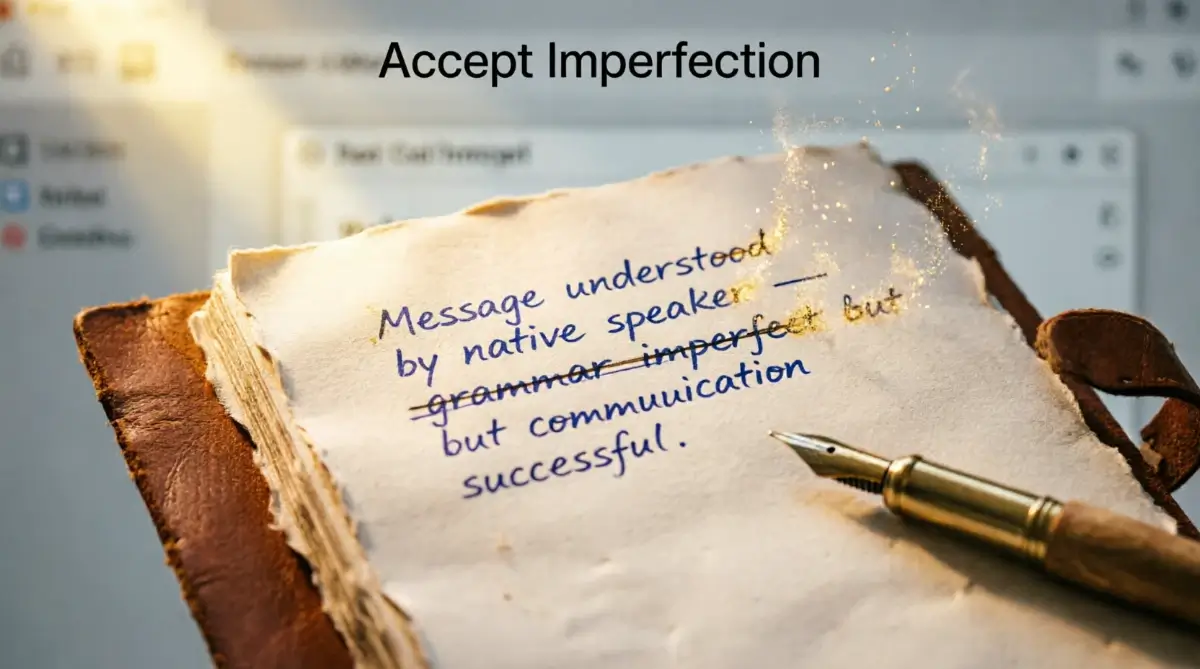
I broke the cycle by accepting imperfection as part of the process. I gave myself permission to have bad practice sessions. Sessions where I forgot words I knew yesterday. Sessions where my pronunciation was clumsy. Sessions where I ended early because I was tired. These sessions were not failures. They were part of the natural rhythm of learning. The only failure was refusing to practice because I could not practice perfectly.
Perfectionism also damages the ability to measure progress. If I only count the perfect sessions, I miss the growth that happens in the imperfect ones. The imperfect sessions are where the real learning occurs the struggle that strengthens memory, the mistake that teaches a new rule, the frustration that deepens commitment. The perfect session is a polished performance. The imperfect session is raw growth. Embrace it.
Perfection is the enemy of done. Done is the enemy of quit. Choose done. Choose progress. Choose imperfection as your companion on the long road.
The Long‑Term Perspective That Absorbs the Hard Days
A single hard day is a tragedy if your timeline is a week. It is a minor inconvenience if your timeline is a decade. I have learned to measure my language journey in years, not days. When I zoom out to the scale of a lifetime, the bad days shrink to insignificance. What remains visible is the trend, and the trend, for anyone who practices consistently, is upward.
This long‑term perspective does not make the hard days easy. It makes them meaningful. A hard day is a deposit into a future self who will look back with gratitude. A missed day is a withdrawal from that future self. The deposits compound. The withdrawals do not. When I see my daily practice as an investment in a person I have not yet met the person I will be in five years, in ten years the hard days become bearable. They are the price of a future I want to inhabit.
The long‑term perspective also reduces the pressure of immediate results. I do not need to be fluent tomorrow. I need to be closer to fluency than I was yesterday. The distance between those two points is often invisible, but the direction is clear. As long as the direction is forward, I am on the right path.
A decade from now, you will not remember the frustration of a single hard day. You will only know that you kept going. Keep going.
The Role of Rest in Sustaining Long‑Term Motivation
Rest is not the enemy of practice. It is the partner of practice. I have learned to distinguish between the fatigue that calls for a break and the resistance that calls for pushing through. When my body is tired, when my mind is fogged, when I have been pushing hard for weeks without a pause a day of rest is not quitting. It is maintenance. The machine cannot run forever without servicing.
I schedule rest deliberately. I do not wait until I am burned out. I take a day off every week or two, not because I need it in the moment, but because I know I will need it eventually. The scheduled rest prevents the unscheduled collapse. It keeps the journey sustainable over years, not weeks.
The key is that rest is intentional, not accidental an intentional rest day is part of the plan. An accidental rest day, caused by avoidance, feels like failure. The same action not practicing has a completely different emotional impact depending on whether it was chosen or whether it happened because I could not face the work. I choose my rest days. I do not let them choose me.
Rest is not a reward for quitting. It is a strategy for continuing. Use it wisely, and it will extend the life of your journey far beyond what relentless grinding could achieve.
The Daily Recommitment That Keeps the Promise Alive
Every morning, before I begin my practice, I take a moment to recommit to my promise. I do not assume that yesterday’s commitment carries over automatically. I renew it. I remind myself why I am learning this language. I visualize the person I am becoming. I acknowledge the difficulty of the path ahead and I choose, again, to walk it.
This daily recommitment is small it takes less than a minute but it is powerful. It transforms practice from a habit into a conscious act of will. I am not practicing because I practiced yesterday. I am practicing because I have chosen, today, to honor the promise I set for myself. The choice is mine. I make it anew every morning.
This practice also protects me from the slow drift of complacency. When I stop consciously recommitting, the practice can become mechanical. I go through the motions without connecting them to the purpose. The motions alone are not enough to sustain motivation over years. The connection to purpose must be renewed, regularly and deliberately. The daily recommitment is the ritual that keeps the connection alive.
Keeping a visible record of your progress a journal, a recording, a folder of completed lessons is a more accurate measure of growth than any external scale, and it fuels the daily decision to continue.
Every morning, the promise asks you: will you walk with me today? Answer yes. The answer, repeated over years, will carry you further than you ever imagined.
The Motivation That Comes From Helping Others
One of the most unexpected sources of motivation I have discovered is teaching others. When someone who is just starting their language journey asks me for advice, and I am able to help them, my own motivation is renewed. I see the journey through their eyes the excitement, the confusion, the hope. I remember why I started. I feel the weight of my own experience and the value of what I have learned.
Teaching also deepens my own understanding. When I explain a concept to someone else, I must organize my knowledge clearly. I must articulate what I have internalized. The act of teaching reinforces my own learning and reveals gaps I did not know existed. It is a form of practice that benefits both the student and the teacher.
I do not consider myself a formal teacher, but I have found that sharing my experience through conversation, through writing, through answering questions is one of the most fulfilling parts of the language learning journey. It transforms a solitary pursuit into a contribution to others. And the knowledge that my experience can help someone else gives my own struggles meaning. The hard days I endured are not just my own. They are lessons I can pass on.
When you help someone else take a step forward, you are reminded of how far you have come. That reminder is a powerful fuel for your own continued journey.
The Final Reflection on Staying Motivated
Staying motivated during a long language learning journey is not about finding a permanent source of energy. It is about building a structure that catches you when your energy falls. The promise is the foundation. The evidence stack is the wall. The small actions are the roof. The community is the door. The daily recommitment is the key. Together, they form a home for your practice a place you can return to even on the hardest days.
I have walked this path through multiple languages. I have wanted to quit more times than I can count. I have drifted and returned. I have doubted and persisted. The languages I speak today are not the result of a single, unbroken streak of motivation. They are the result of a structure that held me when motivation was absent and a promise that called me back when I had wandered away.
I remember the exact moment I decided I would never quit again. It was not a dramatic, cinematic moment. It was still. I was sitting at my desk, tired, staring at a flashcard I had reviewed a hundred times and still could not remember. The thought of quitting passed through my mind, and I let it pass. I did not argue with it. I did not fight it. I simply let it drift away and returned my eyes to the flashcard. That was the moment I became a person who finishes what they start. Not because I felt heroic, but because I had learned that the thought of quitting is just a thought. It has no power unless you give it power. I did not give it power. I kept going.
If you are in the middle of a long journey and you feel your motivation fading, do not despair. The fading is normal. The fading is part of the journey. What matters is not that you feel motivated. What matters is that you continue. Do something small today. Renew your promise tomorrow. Look at your evidence. Reach out to your community. Take a deliberate rest if you need it. Then return.
The languages I speak today are not a collection of facts I memorized. They are the accumulated evidence of thousands of small decisions to continue when stopping would have been easier. That evidence is now part of my identity. It is the foundation of my self‑trust. It is the proof I offer to myself whenever I face a new challenge: I did that. I can do this. The journey never truly ends, but the hardest part the part where you learn to keep going is behind me now. What lies ahead is not a test. It is an invitation.
The promise I chose was to become someone I could trust the languages I speak are proof that I kept that promise. Yours may be different. It may be connection, opportunity, identity, or love. Whatever it is, let it be specific. Let it be personal. Let it be strong enough to carry you through the days when motivation is absent. The promise will not practice for you. But it will be there, waiting, every morning, asking the same question: will you walk with me today? Your answer, repeated over years, will carry you further than you ever imagined. That answer is the only motivation you will ever need. It does not depend on how you feel. It depends on who you have decided to become. And that decision, once made, is the silent engine that powers every practice session, every flashcard, every sentence spoken aloud into the stillness.