Unshakable direction in independent learning is not a personality trait. It is not a gift reserved for the naturally disciplined. It is a structure you build, one day at a time, by grounding your learning in a purpose that holds weight on the hardest days and then showing up regardless of how you feel. This article is the complete framework I use to make sure that my self‑directed education never drifts and never collapses when motivation fades.
I have applied this method across multiple languages, the construction of this site, and every new skill I have chosen to pursue. What follows is the step‑by‑step internal architecture that keeps you moving forward when everything in you wants to stop. You can apply this structure to any subject you are learning, and by the end of this guide, you will have a repeatable approach for turning a fragile intention into an unbreakable direction.
Defining the Purpose That Grounds Independent Learning
A purpose that fails on a hard day is not a purpose it is a preference. I learned this distinction early in my language‑learning journey, when the first wave of enthusiasm faded and I was left with the silence of a room and the choice to continue or stop. What held me was not a vague desire to be fluent. It was a specific image of the person I was determined to become. That image became my fixed reference point, and every subsequent decision about my learning was measured against it. If you want to build unshakable direction, you must start by defining a purpose that can survive the worst conditions your life will throw at it. This section lays out the exact process I use to forge that purpose and keep it alive.
Naming the Person I Intend to Become Through Self‑Study
I write down a clear description of who I will be once the skill is mastered. That image becomes the guide. I do not write “someone who speaks another language.” I write “the person who can sit across from a native speaker and share a meal without hesitation, without translation, without the internal pause that signals I am still reaching for words.” The precision matters a vague identity produces vague commitment a sharp identity one that includes sensory details, the environment, the feeling acts as a permanent beacon. When the alarm rings at an early hour and the body wants to stay still, the image of that future self is what pulls me upright.
I recommend writing this description in the present tense, as if the identity already exists that shifts the mind from hoping to becoming. The person I described becomes a benchmark against which every decision is measured. If an action does not move me toward that person, it is a detour. If it does, it is a deposit into the identity I am building. You can do this right now. Take the skill you are learning and describe, in one paragraph, the version of you that has fully mastered it. Where are you? What are you doing? How do you feel? That paragraph is your guide. Keep it somewhere you will see it every day. The simple act of externalizing this identity moves it from a fleeting thought to a fixed point on your horizon.
The reason this works is that the brain responds to vivid, specific imagery far more powerfully than to abstract goals. When I say “I want to be fluent,” my brain does not know what to build. When I describe the scene the conversation, the laughter, the ease my brain has a blueprint this is not magic; it is targeted activation. Every time I revisit that scene, I strengthen the mental pathway that connects my daily practice to the outcome I desire. Over months and years, that pathway becomes so reinforced that the practice itself feels like a natural extension of the identity, not an external chore. The skill I learned long ago about why starting from zero is actually an advantage taught me that the blank slate is where the strongest identities are built because nothing from the past limits what you can become.
One more nuance about this practice that took me a long time to discover: the person I describe should not be a perfect, idealized version of myself with no flaws. That kind of fantasy is discouraging because it feels unattainable. Instead, I describe a realistic future self someone who still has struggles, still has off days, but has integrated the skill so deeply that it functions even on those off days. The realistic future self is the person who can still feel tired and still complete the session the person who can still feel awkward and still speak.
The person who can still doubt themselves and still publish. That image is achievable because it does not require me to become superhuman. It only requires me to become consistent. Write your purpose with this in mind. Describe the real person the tired, determined, resilient person who has earned the skill through sustained effort that person is far more compelling, and far more attainable, than any idealized image.
Connecting the Skill to a Future Worth Fighting For
I ask myself what life will look like after I own this ability and I let that answer become the fuel for every session. For language learning, I pictured the conversations I could have, the doors that would open, the independence I would gain. For building this site, I pictured a library of resources that would serve people long after the writing was done. The future I fight for is not abstract. It is a detailed scene I can replay when I need to remember why the effort matters.
If you are building a skill right now, close your eyes and walk through a day in the life of the person you intend to become. What do you see? What do you hear? What is different? That scene is your fuel. Keep it close. Write it down. Revisit it before every practice session until the neural pathway is so strong that the purpose arrives automatically the moment you sit down to work. I keep a short written version of this future scene taped to the wall above my workspace. When I sit down, before I open any materials, I read it aloud. That simple ritual, taking no more than a minute, resets my focus from the distractions of the day to the long‑term vision that makes the distractions irrelevant.
The key to making this connection durable is to tie the future scene to a value, not to a metric a metric “I want to earn a certain income from this skill” can be delayed, undermined, or become irrelevant a value “I want to be the kind of person who can connect deeply with people from another culture” is permanent. It does not expire. It does not depend on external validation. When I connect my learning to a value, the fuel is infinite. Every session is a step toward being that person, regardless of whether the external world has recognized it yet. You can identify your core value by asking: what will having this skill allow me to give to others? That question shifts the purpose from selfish to service‑oriented, and service is a far more powerful motivator than self‑interest alone.
Testing Whether the Purpose Is Strong Enough to Survive a Hard Day
I imagine the worst day of doubt and ask: will this reason still be enough to make me show up? If it cannot, I deepen it. A purpose that only works on easy days is not a purpose it is a preference. I test mine by simulating the hardest conditions: the morning after poor sleep, the session after a disappointment, the practice when no one has acknowledged the work in months. If the purpose still holds, I know it is genuine. If it wavers, I ask why.
Usually, when a purpose wavers, it is because it was tied to an external outcome “I will get a promotion,” “I will impress someone,” “I will prove the doubters wrong.” Those external outcomes are fragile because they depend on factors outside my control. The promotion may not come. The person may not be impressed the doubters may never change their minds. If my purpose depends on those, it will collapse when they fail to materialize.
The correction is to ground the purpose in an internal, identity‑based outcome: “I will become the kind of person who shows up,” “I will become someone who does not quit,” “I will become someone who can rely on myself.” Those are outcomes I control entirely. They cannot be taken away by a slow job market, an indifferent audience, an unsupportive environment they are forged in the furnace of daily action, and every session I complete is proof that I am already becoming that person.
You can stress‑test your own purpose right now. Write down your reason for learning the skill. Then imagine the scenario that would most likely make you quit a long plateau where progress feels invisible, a public failure, a month with no visible improvement. In that scenario, does your reason still hold? If it cracks, go deeper. Ask: “If I gave up this skill, what kind of person would I be?” The answer often reveals the real purpose the one rooted in identity rather than outcome that is the purpose that will survive the hard days I have written about how to keep yourself going when the initial excitement fades and the method I shared there securing your effort to a promise you make to yourself is exactly how I test every new purpose before I commit.
Writing the Purpose Where It Cannot Be Ignored
I keep that purpose visible on a note where I practice so it greets me the moment my mind wants to drift. I do not bury it in a journal I open once a month. I stick it to the wall, I set it as the background on my device, I write it on the top of my practice session . The purpose must be unavoidable. When the mind searches for an excuse, the first thing it encounters is the reason to stay.
This is environmental design for the will it does not rely on remembering; it relies on seeing and seeing the purpose every day reinforces it in ways that a buried intention never can. The visual cue serves as a trigger that activates the identity I am building. I have a small index card taped at eye level. On it is written, in my own handwriting: “You are the person who shows up. You are the person who finishes. You are the person who becomes what you practice.” When I sit down and feel the urge to check my messages instead of starting, my eyes land on that card. It is a gentle nudge that pulls me back to the path before the drift becomes a detour.
You can create your own visual reminder today take the purpose description you wrote the one‑paragraph future scene and condense it into a single sentence. Write that sentence on a piece of paper or a sticky note. Place it in the exact spot where you practice. Make it the first thing you see when you sit down. The simplicity of this action belies its power. It converts a mental intention into a physical presence, and a physical presence is far harder to ignore.
Refusing to Let the Purpose Become a Background Thought
I revisit the purpose aloud before each session I treat it as alive, not as a one‑time statement I wrote and forgot. I read it, I speak it, I let the words fill the space before the work begins. This ritual takes less than sixty seconds, but it shifts my entire mental state. It pulls me out of the day’s distractions and into the focused identity of the person I am becoming.
A purpose left unspoken fades a purpose spoken aloud daily stays sharp. The act of speaking engages different neural circuits than silent reading. It creates a multisensory imprint auditory, kinesthetic, visual that deepens the memory trace. I find that speaking the purpose aloud before a session creates a psychological boundary between “regular time” and “practice time.” It is a signal to my brain that the next hour is different, that the rules of the distracted, reactive day do not apply, that I am now in the space where I build the future. If you have never tried this, start tomorrow. Before you open your materials, speak your purpose sentence out loud. Listen to yourself say it the words will feel more real than they ever did on the page.
Building Daily Consistency as the Engine of Growth
Direction is useless without motion you can have the most clearly defined purpose in the world, but if you do not show up and move toward it, the purpose becomes a decoration, not a force. Consistency is the engine that converts purpose into identity. It is not glamorous. It is not exciting. But it is the only mechanism that reliably produces mastery. I have spent enough hours in the early‑morning darkness to know that the days I felt least like practicing were the days that built the most. This section is about building a consistency system that survives the real conditions of your life.
Showing Up Every Day as the Non‑Negotiable Minimum
I do not measure today by how much I achieve I measure it by whether I arrive at the practice and give what I have. Some days, “what I have” is ninety minutes of deep, focused effort. Other days, it is fifteen minutes of going through the motions that are deposits into the identity the moment I make the session conditional on feeling good or performing well I create an escape hatch that my mind will use whenever motivation dips.
The non‑negotiable minimum is a concept I Learned from the discipline architecture I built years ago, when I first learned that you cannot rely on motivation to sustain long‑term effort I decide, in advance, what the smallest acceptable version of a session looks like. For language learning, it might be reviewing ten flashcards aloud. For writing, it might be drafting one paragraph. The bar is so low that there is no valid excuse to skip it. And here is what happens almost every time: once I start the minimal session, the resistance fades, and I end up doing more than I planned. But even if I do not, I have still kept the chain alive the chain is more valuable than any single session’s quality.
You can set your own non‑negotiable minimum today pick one action that takes less than five minutes and defines it as the smallest version of your practice. That action is now your daily promise. On the days when everything in you wants to skip, you do that one action and declare the day won. Over time, this habit builds a track record of reliability that becomes the foundation of your identity.
Consider a learner who has committed to reviewing ten flashcards aloud as their daily minimum. On a particularly exhausting day after poor sleep, after a long shift, after a disappointing setback that person sits down at their desk. The mind offers every reason to skip. But the minimum is only ten cards. That is three minutes of work. They open the flashcard deck, speak the first word aloud, then the second. By the fifth card, the resistance has softened. By the tenth, they often continue to fifteen but even if they stop exactly at ten, they have kept the chain alive. The following day, the momentum is still there. The minimum protected the habit when the motivation was gone that is the function of the non‑negotiable minimum, and it works for any skill.
Letting Consistency Stack Into Capability Over Time
I trust that small, repeated actions compound into ability far more than occasional bursts of intensity ever could. I have seen this principle play out across every skill I have ever pursued. The language I now speak fluently was built on thousands of tiny sessions, not on a handful of marathon weekends. The site you are reading now was built on daily publishing, not on sporadic bursts of inspiration.
The challenge is that consistency feels slow a single session produces no visible improvement a week of sessions might still show nothing. But underneath the surface, the brain is rewiring. Neural pathways are strengthening. The skill is becoming automatic. I cannot see this happening, but I can trust that it is, because the evidence is overwhelming from every discipline where consistent practice has been studied. The learner who practices thirty minutes a day will outperform the learner who practices four hours once a week, every time. The gap is not in talent; it is in the architecture of daily reinforcement.
You do not need to trust this on faith run a simple experiment. Choose one small practice action a single vocabulary review, a single exercise, a single paragraph and do it every day for thirty days without missing. At the end of thirty days, compare your comfort level with that action to what it was on day one. The difference will be subtle but real. That subtle difference, multiplied over months and years, is how competence is built.
Designing a Daily Practice That Fits Inside Real Life
I shape the session so it fits the hours I already have, rather than waiting for a life that makes learning convenient. The fantasy of the perfect schedule the uninterrupted morning, the clean desk, the silent house is a trap. Life is messy. It always will be if I wait for ideal conditions, I will never start.
The practice I use is designed to be portable and time‑efficient. I keep materials ready the night before. I block a specific window that is protected from other demands. I remove the friction of decision‑making by scripting the session in advance: I know exactly what I will do when I sit down. This eliminates the mental negotiation that drains willpower before the work even begins. The environment is set up so that starting is the path of least resistance. My workspace is prepared: phone in airplane mode, water poured, materials laid out. When I enter the space at the appointed time, the cues trigger the behavior automatically.
For you, the starting point might be different maybe you have thirty minutes during a commute, an hour after the kids are asleep. The principle is this: identify the window, prepare the environment, script the session, and protect that window as if it were a meeting you cannot miss. The time you have is enough. What matters is not the length of the session but the consistency of its occurrence.
The most important lesson I have learned about fitting practice into a busy life is that the practice does not need to look impressive. It only needs to happen. I have completed language drills while waiting for a bus, spoken practice sentences into a voice memo during a walk, written article drafts in ten‑minute gaps between other obligations. None of these sessions were ideal. None of them would win awards for dedication. But they kept the chain alive, and the chain is what matters. The ideal session the uninterrupted hour, the perfect environment is a luxury, not a requirement. The requirement is consistency. Once I accepted that, the pressure to create perfect conditions disappeared, and my practice frequency increased dramatically because I stopped waiting for the ideal and started using the available.
You can find the available time in your own day by conducting a simple audit. For one week, track how you spend every fifteen‑minute block. You will almost certainly find pockets of time that are currently being spent on low‑value activities scrolling, waiting, half‑watching television those pockets are your practice windows you do not need to find an hour. You need to find the scattered minutes that already exist and redirect them toward the skill you are building. That redirection, consistently applied, will produce more progress than any marathon session that never actually happens.
Confronting the Hard Days When Motivation Fades
Hard days are inevitable they are not a sign that something is wrong. They are a sign that you are doing something meaningful, because anything worth building will encounter resistance. The question is not whether hard days will come. The question is what you will do when they arrive. Over years of self‑directed learning, I have developed a set of specific responses that keep me from losing ground when the internal weather turns bad.
I can feel the resistance early the pull to delay, the inner negotiation, the sudden desire to check something unimportant. Spotting it early is the first defense the mind is clever when it wants to avoid discomfort. It does not announce “I am going to skip today.” It whispers “you can start in ten minutes,” “you deserve a break,” “one day off will not matter.” Those whispers are not my voice. They are the voice of the part of me that wants to stay comfortable and unchanged.
I have learned to recognize the pattern when I hear myself bargaining over the start time, I know what is happening. I do not debate. I do not entertain the negotiation. I simply name it: “This is a hard day. The resistance is here. The appointment still stands.” That naming robs the resistance of its power. It turns a vague emotional pull into an identified obstacle, and an identified obstacle can be overcome.
You can train this recognition in yourself pay attention to the first sign of resistance. Is it a physical sensation a heaviness in the body, a tightening in the chest? Is it a thought “I am too tired,” “it will not matter,” “I will do double tomorrow”? Write those signals down. The next time they appear, you will spot them faster. And the faster you spot them, the less chance they have to derail you.
Returning to Purpose When the Body Wants to Quit
On the days when energy is gone I do not rely on feeling I recall the reason I started, and I let that reason carry the weight. I have a specific memory I use as a touchstone: the moment I first wrote down the identity I was building. I replay that scene where I was sitting, what the light was like, the determination I felt. That memory is stored and ready for the hard days.
The purpose, when I wrote it, was not just words it was a commitment I gave my word to the future version of myself on hard days, I remind myself of that commitment. I do not want to break a promise to myself, because that would undermine the trust I have built over year the consistency chain is made of promises kept, and each hard day is an opportunity to add another link. I have written before about the specific method I use to stay motivated when everything feels impossible and it always starts with going back to the original reason I began.
You can build your own purpose recall. Write down the original reason you started the scene, the feeling, the specific words and keep it in a place you can access instantly. When the body wants to quit, read those words. Let them reconnect you to the person who made the commitment. That person still exists, and they are waiting for you to follow through.
The specific memory I use as a touchstone is worth describing, because it might help you identify a similar reminder for yourself. Several years ago, during a particularly difficult period, I sat at a small desk in a rented room and wrote a single sentence on a piece of paper: “I will become someone who can speak to anyone, in any language, without fear.” I folded that paper and kept it in my pocket for months. The paper became soft and worn. The ink faded. But the sentence did not. On the days when I wanted to stay in bed, I would reach into my pocket and feel the paper. That physical sensation was enough to remind me of the commitment I had made. I did not need to unfold it and read it. I knew what it said the paper was a symbol of the contract I had signed with my future self.
I no longer carry that paper, but I carry its digital equivalent a note on my phone that I can access in seconds the content has evolved over the years, but the function remains the intact: it is a physical reminder that I made a promise, and promises made to oneself are the most important kind to keep. I recommend creating a physical totem of your purpose something you can touch, hold, see that instantly reconnects you to the commitment. It could be a note, a photo, a small object. The form does not matter. The function does. When the body wants to quit, reach for that totem. Let it carry you back to the commitment.
Accepting That Today May Never Come Back
I remind myself that a lost day is a permanent gap and that tomorrow’s motivation cannot repair today’s absence. This is not a negative thought. It is a clarifying one. Time is the one resource I cannot recover. Every hour I spend avoiding the practice is an hour that will never return. Tomorrow will bring its own challenges, its own excuses, its own resistance. Banking on tomorrow to make up for today is a gamble that the future self will have more discipline than the present self, and that is rarely how it works.
The weight of this reality is not meant to be heavy it is meant to be freeing. When I truly understand that today is the only guaranteed asset I own, the decision to use it becomes simpler. I do not need to feel motivated. I do not need to feel prepared. I only need to act, because the alternative losing the day is a cost I am no longer willing to pay.
I sometimes use a simple visualization to drive this truth home. I imagine my life as a long hallway with many doors, each representing a day. The doors behind me are locked. I cannot open them again. The doors ahead are not guaranteed to exist. The only door I can open is the one I am standing in front of right now. That door is today. When I step through it with intentional action, I move further down the hallway. When I linger in the hallway doing nothing, I lose ground. The hallway does not wait. The doors do not stay open. This visualization is not meant to create anxiety. It is meant to create focus. When I remember that the door behind me yesterday is permanently closed, I stop regretting past failures. When I remember that the doors ahead are uncertain, I stop banking on future motivation. All I have is now. That clarity strips away the excuses and leaves only the action.
Converting Exhaustion Into a Private Act of Defiance
When I show up even though I am tired, I prove to myself that direction does not depend on perfect conditions. That proof is more valuable than any skill I could learn in a well‑rested state. The hard‑day sessions are the ones that build the identity most strongly, because they demonstrate that the commitment is not conditional. It does not require sunshine. It does not require applause. It requires only that I keep my word.
I reframe exhaustion not as a reason to stop but as a signal that I am pushing against the boundary of my current capacity. That boundary is where growth happens. If I only practiced when I felt fresh, I would never expand my capacity. The tired sessions train the mind to function under stress, to perform when conditions are not ideal, to deliver when it matters. That is a meta‑skill that transfers to every area of life. You can reframe your own exhaustion instead of thinking “I am too tired to practice,” think “I am tired, and this practice will make me stronger than a rested practice ever could.” The shift is small, but the cumulative effect over years is enormous.
The Daily Choice Between Comfort and Legacy
Every morning I face a clear decision point. On one side, there is comfort the soft, familiar pull of staying still, of doing what is easy, of postponing the difficult work. On the other side, there is legacy the long, consistent investment in a future self who will look back and be grateful that the present self chose the harder path. This choice is not made once. It is made every day, often multiple times within a day. And the sum of those choices is the person I become this section is about making that choice consciously, deliberately, and in a way that compounds over a lifetime.
Seeing the Decision Point Every Morning
Each day opens with a decision: I can stay comfortable and unchanged, I can invest in a future self I have not yet met. I have trained myself to see this moment clearly. It often arrives when the alarm goes off at an early hour and the bed is warm. The mind presents two options: hit snooze and stay in the comfort, rise and take a step toward the person I am building.
I do not pretend that rising is easy. It is not. But I have learned that the moment of decision is brief. The discomfort of getting up lasts a few seconds. The discomfort of staying that lasts a lifetime. I choose the shorter discomfort. Over time, that choice becomes a reflex. I no longer debate it. The alarm rings, and I move. The movement itself becomes the cue that starts the day’s work.
You can sharpen your own awareness of this decision point tomorrow morning, when you wake up, pause for a moment and consciously name the two options. Say to yourself: “Option one: I stay comfortable and nothing changes. Option two: I invest in the person I want to become.” Then choose. The act of naming the choice removes the autopilot. It makes the decision intentional, and intentional decisions are far more likely to align with your long‑term vision.
Understanding That Short‑Term Comfort Has a Long‑Term Price
A few extra minutes of ease today steal years of capability from the person I am trying to become. This is not an exaggeration. The compound effect of daily choices is staggering when viewed over a decade. A single missed session seems insignificant. But a missed session makes the next miss more likely, because the chain is broken and the guilt is demotivating. Over time, the habit of choosing comfort becomes a pattern, and the pattern becomes an identity. The person who consistently chooses comfort becomes a person who does not grow, who does not challenge themselves, who settles.
I do not say this to judge I say it because I have lived both sides. I have spent years of my life drifting, choosing the easy path, and watching the gap between who I was and who I wanted to be grow wider. The pain of that gap eventually became greater than the pain of discipline. That is the turning point. When the cost of staying that exceeds the cost of changing, change becomes the easier path.
You can calculate the price of comfort in your own life look at the skill you are trying to build. If you had started a year ago and practiced consistently, where would you be now? That gap between where you are and where you could have been is the price of past comfort the good news is that the future price is still under your control you can decide today that the gap stops growing.
Choosing to Build, Not Because It Is Easy but Because It Strengthens
I actively choose the harder path the practice, the study, the effort because I know that struggle is the builder of lasting strength. This is not a martyrdom. It is a calculated investment. Every time I do something difficult, I am making myself harder to break. The person who has practiced showing up on tired days is the person who will not crumble when a real crisis hits. The person who has learned to work through boredom is the person who can sustain effort long after the competition has quit.
I do not choose the hard path because I enjoy suffering. I choose it because I enjoy the results it produces. The fluency, the competence, the confidence those are the fruits of the effort. And the effort itself becomes satisfying over time, because I associate it with growth. The burn of effort becomes a signal that I am expanding, not a signal to stop. This reframing is available to anyone. You can start by noticing the moment of difficulty in your next practice session and saying to yourself: “This is the feeling of growth. This is where the skill is built.” Over time, the feeling changes from something to avoid to something to welcome.
The daily effort is not loud it does not involve dramatic declarations and visible struggle. It is private. It is the decision to read one more page when my eyes are tired. It is the decision to speak one more sentence aloud when my pronunciation feels awkward. It is the decision to write one more paragraph when the words are not flowing. These are small choices, but they are the choices that build the muscle of persistence. And like any muscle, persistence grows stronger with use. The person who has made a thousand small choices to push forward is ready for the big ones. The person who has avoided every small discomfort is fragile, and will break under the first real pressure.
You do not need to make the right choice every single time some days, the discomfort wins, and I take the break that is fine. The goal is not perfection. The goal is to choose the hard path more often than I retreat, to build a track record of leaning in, to make the choice of effort the default rather than the exception. Over time, the default becomes automatic. The choice becomes less of a decision and more of a reflex. That is when the direction becomes truly unshakable not because I never waver, but because wavering has been replaced by a conditioned response to push forward.
Reframing the Idea of Legacy as Something I Shape Daily
Legacy is not a distant monument it is built in the consistent, unseen hours where I do the work no one watches. I used to think of legacy as something grand a book, a company, a lifetime achievement award. I now understand that legacy is simply the accumulated evidence of daily choices. Every session I complete adds a brick to the structure that is my life’s work. Most of those bricks will never be seen by anyone else. But they are real, and they are what give the visible parts their strength.
This reframing removes the pressure of having to achieve something monumental. I do not need to write a masterpiece today. I only need to add one brick. The masterpiece will emerge from the thousands of bricks I lay over time. You can adopt this frame. What is one small action you can take today that adds a brick to your legacy? It could be as simple as a single practice session. That brick, by itself, is unremarkable. But a thousand of them, laid day after day becomes something that lasts long after you are gone I have written before about the compound effect of treating every day as an irreplaceable building block and the perspective shift it creates has been one of the most important in my entire self‑education journey.
A legacy built on daily learning is invisible at first, but it grows roots that go deeper than any quick achievement. The article you are reading right now exists because of a choice I made on a specific morning, at a specific hour, to sit down and write instead of doing something easier. That choice, multiplied many times, produced a body of work that now serves people I will never meet. The legacy is not the article. The legacy is the decision that produced it, and the identity that decision reinforced.
The article is just the visible artifact you have the power. The choice you make in your next practice session to show up or to skip is a brick in your own legacy. You may not see the structure yet. The early bricks are underground, buried in the foundation. But they are real, and they are what everything else will be built upon. Do not underestimate the value of the invisible bricks. They are the ones that hold up the visible monument.
Turning Purpose Into an Unshakable Direction Over Time
A purpose, once defined, must be converted into something more durable than a feeling. It must become a direction a fixed bearing that does not shift when the emotional weather changes. This conversion happens not through a single decision but through a series of repeated choices that build a track record of evidence. Over time, the direction becomes self‑reinforcing. The person who has shown up for a hundred consecutive days does not need to debate whether they will show up on the hundred and first they will show up because that is simply who they are.
Letting Repeated Decisions Forge a Direction That Cannot Be Broken
Each time I choose action over delay, I strengthen the internal spine of my learning. The direction becomes harder to bend. The first week of a new practice is fragile. The direction can be broken by a single bad day. But after a month, the direction has weight. After a year, it has momentum. After several years, it is a force of nature that carries me forward even on the days when I feel nothing.
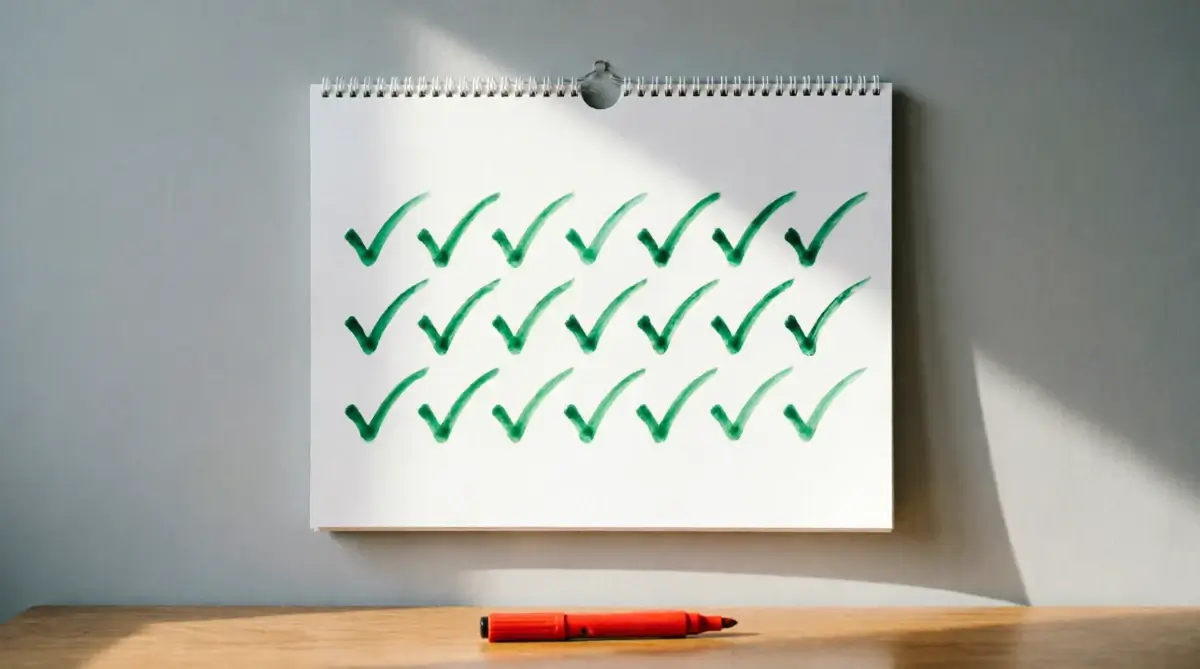
This is why I protect the chain so fiercely the chain is not just a streak; it is the physical manifestation of my direction. When I look at the chain of marked days on my calendar, I see a visual record of who I have been. That record makes it harder to quit, because quitting would mean erasing all that evidence. The chain becomes a barrier against the temptation to stop. You can create your own chain today get a calendar a physical one, a digital one you actually see and mark today with a checkmark if you complete your practice. Tomorrow, add another checkmark. Protect that chain as if your future identity depends on it, because it does.
Noticing When the Direction Feels Shaky and Addressing It Immediately
If I feel my focus slipping, I stop and reconnect to the original purpose. I do not wait for the drift to become a detour. The signs of a shaky direction are subtle: I start negotiating with the start time, I find myself doing “preparation” instead of actual practice, I begin comparing my progress unfavorably to others. When I notice any of these, I do not reprimand myself. I simply pause and ask: “What is the original reason I started?” Usually, the drift happens because I have lost touch with that reason. Reconnecting to it is like tightening a loose bolt. The structure is still sound; it just needed a small adjustment.
You can build a simple check‑in routine once a week, take two minutes to ask yourself: “Is my practice feeling like a chore or an investment? Am I showing up with the same energy I had at the start? If not, why?” Write down the answer. The act of articulating the drift makes it conscious, and conscious drift can be corrected. The dangerous drift is the one you do not notice until you have already stopped.
Building a Track Record That Proves I Can Keep Going
The sum of days I have shown up becomes a personal history I can lean on when doubt reappears. When a new challenge arrives and I hear the inner voice say “you might not make it this time,” I have a response ready. I look at the track record and say: “I have done this before. I have shown up on days when I felt worse. I have pushed through plateaus that lasted months. This is not different.” The track record is a bank of evidence that I can withdraw from whenever my confidence dips.
That track record is built one day at a time you do not need years of evidence to start using this. After a single week of consistent practice, you have a week’s worth of proof. After a month, you have a month’s worth. Each completed session is a deposit into the evidence bank. Over time, the bank balance grows, and the inner critic loses its credibility. When it says “you always quit,” you can point to the chain and say “not this time.”
The track record is not just a mental concept I keep it visible. I have a simple spreadsheet where I record the date, the skill practiced, and the session type full, minimal, recovery. Over months and years, that spreadsheet becomes a dense grid of evidence. When I feel doubt, I open the spreadsheet and look at the many cells, each one representing a day I showed up. The sheer volume of data answers the inner critic. It is hard to argue with a long chain of completed sessions.
You can start this today, with zero cost and minimal effort. Create a new document or grab a notebook. Write today’s date and the practice you completed. Tomorrow, add another line. Do not skip. The journal is not for anyone else. It is for the future version of you who will need proof that they have done this before the proof will be waiting. All you need to do is keep the journal that serves a purpose map: it prevents the revisionist history that the mind likes to create. When I feel like I have been stuck for a long time, the journal shows the actual duration. The objectivity is cuts through the emotional distortion and keeps me grounded in reality that grounding is essential for maintaining direction because false narratives are one of the biggest threats to long‑term consistency.
The Reality That Today Is Never Coming Back
This section is short, but it contains the core truth that underpins everything else in this article. I have placed it here, near the end, because it is the reality that gives urgency to every practice session I have ever completed. Today is the only guaranteed asset I own. If I waste it, the loss is absolute. If I invest it, that investment compounds into a new identity that no one can take away.
Treating the Present Day as Irreplaceable Fuel for the Person I Am Becoming
I treat each day as the only guaranteed asset I own. I have no contract with tomorrow I have no assurance that next week will provide better conditions. The only unit of time I can be certain of is the one I am standing in right now. That perspective shift changes everything. When I view a day as a non‑renewable resource, the decision to spend it on comfort feels like burning money. The decision to invest it in practice feels like buying equity in a company that will pay dividends for the rest of my life.
This is not about living in fear of lost time it is about living with an awareness of time’s value. When I was younger, I treated time as if it were infinite. I postponed effort because I assumed the future would be more convenient. The future arrived, and it was just as inconvenient as the present had been, but now I had less time. I learned that the only effective strategy is to treat today as the precious thing it is. You can adopt this perspective without becoming anxious about it. Just ask yourself each morning: “If I only had today, what would I do with it?” That question cuts through the noise and points directly to the essential action.
I have written before about how to recognize a hard day before it has the chance to win, and the specific internal affirmation I use to override the urge to quit when it first appears that method has kept me on track through every plateau I have ever faced the urgency that comes from knowing a day is irreplaceable is what fuels that script. A lost day cannot be recovered, but a day where I show up even tired, even unmotivated is a day I have invested in the person I am becoming. That investment is permanent. It cannot be taken back, and it cannot be undone. That permanence is what makes every single session matter far more than it appears to in the moment.
Becoming the New Person Through Sustained Action
The ultimate outcome of unshakable direction is not the skill itself. It is the person I become in the process of acquiring it. The skill is the visible product the identity the resilience, the discipline, the self‑trust is the invisible foundation. At the end of this journey, I am not just someone who can do something. I am someone who knows, beyond doubt, that I can learn anything I commit to. That is the real prize. This final section is about recognizing that transformation and carrying it forward into every area of life.
Observing the Shift as the Skill Becomes Part of Who I Am
I notice when the practice stops feeling like a task and starts feeling like a natural extension of my identity. There is a moment usually months into the journey when I realize that the session is no longer something I have to do. It is something I do, like breathing or eating. The internal resistance has faded. The identity has absorbed the practice.
That moment is not announced I notice it in the small things: I wake up before the alarm, I feel restless on rest days, I catch myself thinking in the language I am learning without trying. These are signals that the skill has moved from external effort to internal wiring. When I see those signals, I take a moment to acknowledge them. I look back at the chain of days and I see the path that led here. That retrospective is a ritual of gratitude that reinforces the identity even further. I do not skip past these moments. I pause and let the weight of the transformation settle in. The person who could not understand a single word of a foreign film now watches without subtitles. The person who could not write a coherent paragraph now publishes articles that help thousands. These contrasts are not just achievements; they are evidence of a permanent identity shift.
You can accelerate this shift by consciously looking for the evidence. At the end of each month, ask yourself: what feels different now compared to the start? Write down the answers, no matter how small. Over time, you will accumulate a personal record of transformation that silences any future doubt. When a new challenge arises and the voice says “you might not be able to do this,” you can point to that record and say: “I have already done something harder. I have already become someone I was not before. This is the process.” The record is not just a journal; it is a weapon against self‑doubt, and it is available to anyone who takes the time to keep it.
The shift also changes how I approach new skills the fear of being a beginner the awkwardness, the incompetence, the frustration diminishes because I know that these feelings are temporary. They are the early signals of a process that I have already completed multiple times. I have been the beginner who could not pronounce a single word correctly. I have been the writer who stared at a blank page with no idea what to say. I survived those phases.
More than survived I passed through them and emerged on the other side that memory is my armor. When I start a new skill now, I do not expect to be good immediately. I expect the early struggle, and I welcome it, because I know what it leads to. You can cultivate this resilience by documenting your past transformations. Write down the hardest early moment of your current skill journey, and then write down where you are now. The gap between the two is the proof that you are capable of change. Keep that proof close, and it will fuel your next beginning.
Letting the Legacy of Consistent Learning Speak for Itself
The outcome I create the skill, the mindset, the independence is the evidence that the daily choice to fight was worth everything. I do not need to announce my achievements. The achievements announce themselves through the life I am able to live. The conversation I can have in a language I once could not speak. The article I can write that helps someone else. The confidence I carry into new challenges because I have already proven I can endure.
Legacy is not something I will leave behind when I am gone. It is something I am building right now, in every session, with every choice to show up. The monument is not a distant structure. It is the person I am today, compared to the person I was when I started. That comparison is the only validation I need. And if I keep going, the person I will be a year from now will look back at today and feel the gratitude. You can start building that legacy now, with the very next session you complete. The only thing standing between you and the person you want to become is the daily choice to act. And that choice is always available.
The beauty of a legacy built on consistent learning is that it compounds without additional effort the session I completed three years ago is still paying dividends today, because the knowledge I gained then is part of the foundation I now stand on. The article I wrote a year ago still brings readers to this site, who then explore the library and find value in the newer material. Every deposit I make into the legacy account earns interest indefinitely. That is the power of an evergreen asset whether it is a skill, a body of work, a reputation. It works while I sleep. It continues to grow long after the initial investment was made the method I wrote about for turning early failures into the very momentum that drives long‑term success that how small, consistent actions compound into a permanent asset.
Carrying This Unshakable Direction Into Every Future Endeavour
Once I have built one skill with unwavering direction the inner structure can be applied to any niche I choose. The method remains, and the person I become carries it forward. This is the meta‑skill that makes self‑education a lifelong superpower. I do not need to reinvent the process every time I start something new. I follow the sequence: define the purpose, build the consistency, prepare for the hard days, make the daily choice, let the track record build, and trust the transformation.
The confidence that comes from knowing I can do this that I have done it before is the ultimate competitive advantage. It removes the fear of starting from zero, because I know that zero is simply where every builder begins. The identity I have forged through consistent action becomes the foundation for every future identity. I can become anything I commit to, because I have proven that I can commit that is the unshakable direction that no external event can take away. I carry it with me, and I will continue to carry it, into every room, every challenge, and every new beginning the complete method I use to set my learning identity and sustain it through every phase of the journey is laid out in a dedicated guide that walks through the identity‑first approach to self‑education.
The most liberating realization in this entire process is that direction is not a feeling. It is a structure. Feelings come and go motivation rises and falls, confidence wavers, doubt creeps in. But a structure, once built, stands regardless of the weather inside. The purpose I defined, the consistency I protected, the hard‑day protocols I practiced, the daily choice I made those are the beams of the structure. They do not depend on how I feel. They depend only on whether I keep showing up. And I have trained myself to show up, regardless. That training is available to anyone who is willing to start with a single sentence describing the person they intend to become.
Write that sentence today speak it aloud tomorrow morning. Show up for the smallest possible version of your practice. Then do it again the next day. The direction will build itself from those repeated actions, and before you realize it, you will be the person you once only imagined. That is not a promise of ease. It is a promise of certainty the certainty that consistent, purpose‑driven action, sustained over time, will transform you into whatever you commit to become there is no more valuable skill in the world than the ability to direct your own becoming and it begins, as it always does, with a single choice.