The office was full of noise with the sound of voices. My colleagues spoke the language around me all day greeting each other, discussing tasks, joking during breaks. I had studied hard. I had filled notebooks with vocabulary. I had passed the tests. But when someone turned to me and asked a simple question about the work, I froze. The words I had learned were too broad, too general, too far from the life I was actually living.
I realized something that day that changed the way I learn forever. I did not need more words. I needed the right words. The ones I would actually use in my real day. And I needed to repeat them until my mouth could say them without my brain having to think. That was the moment I began to learn faster by repeating simple material deeply and it was the opposite of everything the textbooks had told me to do.
I sat at my desk and took out a blank piece of paper I did not open a textbook. I did not search online. I simply looked at my day. What did I need to say to the people around me? “Good morning.” “How are you?” “Did you finish the report?” “I need more time.” “Can you help me with this?” “The deadline is Friday.” “Thank you.”
I wrote them all down. There were fifteen phrases not a hundred. Not a thousand. Fifteen. That small list became my only study material for the next two weeks. I stopped learning new words. I stopped chasing new content. I just repeated those fifteen phrases every single morning, out loud, until they felt as natural as my own name.
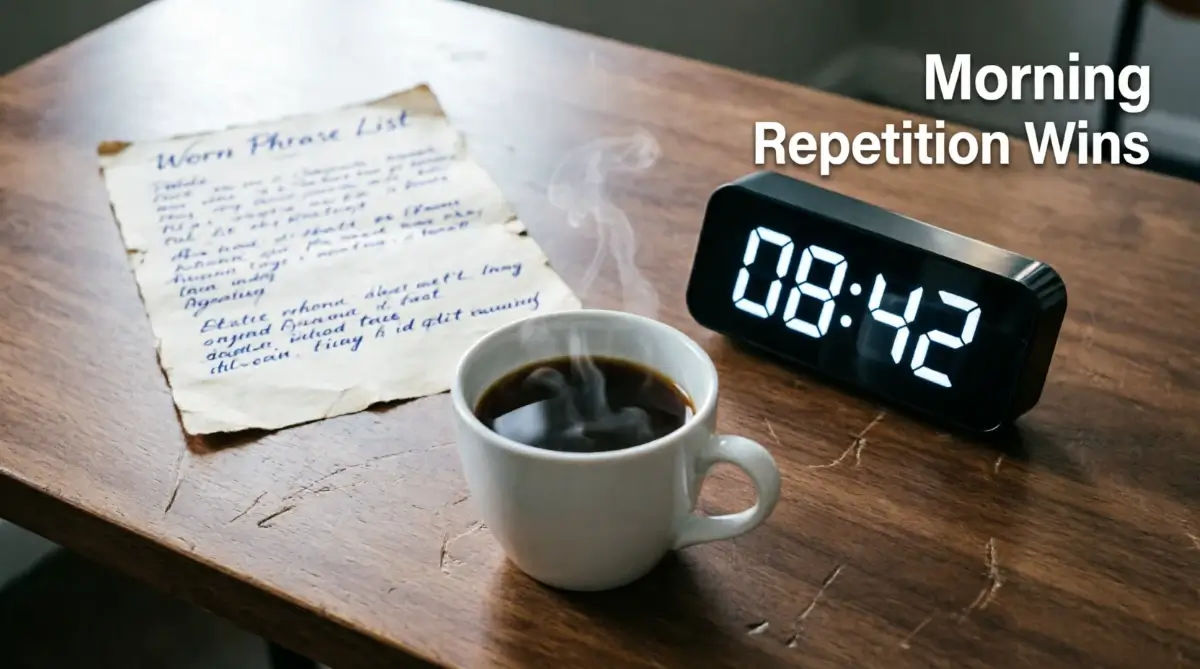
The list is still on my desk the paper is worn now, the ink slightly faded from the light. But those fifteen phrases were the foundation of everything that came after. They taught me that depth beats width. That one phrase, spoken a hundred times, is worth more than a hundred phrases spoken once. The notebook I had filled with thousands of words had become a library I never entered. The single page held the only books I actually read.
Why learning everything left me able to say nothing
I had followed the traditional path for a long time. I opened the textbook. I learned the vocabulary list for the chapter. I did the exercises. I passed the quizzes. But when I walked into work the next morning, none of those words helped me. The textbook had taught me words for the airport, the hotel, the restaurant things I might need someday. But it had not taught me the words I needed today.
The gap between what I was learning and what I was living was huge. And that gap was the reason I could not speak. My brain was full of words that were sleeping, waiting for a context that never came. The office was a different world, and I had not been preparing for it. I remember sitting in my chair one afternoon, listening to my colleagues talk, and feeling like I was standing outside a window looking in. I could see the warmth inside, hear the laughter, but I could not open the door. The words I had learned were not the key.
The turning point when a colleague asked about the report
The turning point came when a colleague asked me about the report. I understood the question. I knew every word he said. But my answer got stuck. I had the vocabulary somewhere in my mind, but it was slow. I had to search for it, translate it, piece it together. By the time I was ready, the conversation had moved on.
That was when I understood the problem was not that I did not know enough. The problem was that I had not repeated the right words enough times for them to become automatic. I had been collecting information, but I had not been training my mouth. And training the mouth requires repetition deep, focused repetition of the same simple material, over and over, until it becomes a reflex I had been trying to build the confidence to practice speaking alone without freezing but confidence is not built by knowing many things. It is built by knowing a few things so well that they never fail you.
The textbook had given me a library but what I needed was a small set of tools I could hold in my hands. Once I had those tools, and I had sharpened them every day, everything began to change. I kept that first list for years. The paper is soft and torn at the edges. But every time I look at it, I remember the moment I stopped chasing everything and started learning what actually mattered. That small piece of paper was the turning point.
How I chose the phrases that actually mattered to my daily life
The process was simpler than I expected I did not need a special method or a teacher. I just needed to pay attention to my own life. I watched myself go through a normal day. I noticed the moments when I wanted to speak but could not. The greeting at the door. The question about a task. The request for help. The simple thank you at the end of a conversation.
I wrote those moments down then I translated the missing phrases into the language I was learning. That was my list. It was not taken from a textbook. It was not chosen by an app. It was chosen by my life. And because it was chosen by my life, I was motivated to learn it. Every phrase on that list was something I genuinely wanted to say. I could feel the need for each one, like an itch I had been unable to scratch. And now I had the tool to reach it.
A short list of work phrases became my only study material for two weeks
For two weeks, I did not open a textbook. I did not watch a video. I did not add a single new word to my memory. I just repeated those fifteen phrases. Every morning. Every evening. Sometimes during my lunch break. I said them out loud. I wrote them down. I imagined the person I would say them to and pictured their face.
The first few days felt strange I worried that I was not making progress because I was not learning anything new. But by the end of the first week, something shifted. The phrases started to come out without effort. I did not need to think about the word order or the grammar. The sounds just flowed. By the end of the second week, I could say all fifteen phrases as easily as I could say my own name. I had turned a small set of words into a permanent part of my speech. I later understood that adults often learn slowly not because of age, but because they do not repeat what matters to them the key was repetition deep, focused, daily repetition of the same simple material until it became automatic.
What if I do not work in an office? How do I choose my phrases? The method works for any situation. If you are a student, choose phrases for the classroom. If you are a parent, choose phrases for talking to your children or their teachers. If you work in a shop, choose phrases for customers. Look at your real day. The phrases are already there, waiting to be named. You just need to notice them. The list was not long. It was not fancy. But it was mine. And because it was mine, I practised it with a purpose that no textbook could ever give me.
The morning habit that made the words automatic
The list sat on my desk, right next to my phone every morning, before the office woke up, before the emails started and the calls came in, I sat in my chair and opened that piece of paper. I did not check messages. I did not read the news. I just started speaking.
“Good morning.” I said it to the empty room then again. Then faster. I imagined my colleague walking through the door. I pictured his face. I said the words as if he were standing right there. Then I moved to the next phrase. “Did you finish the report?” Again and again, until the words felt like they belonged to me, not borrowed from a textbook.
The whole session took maybe ten minutes but those ten minutes were the most important part of my day. They were the moment when the language stopped being something I studied and became something I used. Every repetition was a small step toward automatic speech. Every spoken phrase was building a bridge between my mind and my mouth. And that bridge grew stronger every morning. The empty room became my training ground, and my own voice became the teacher I had been waiting for.
How the repetition stopped feeling like study and started feeling like preparation
At first, the repetition felt strange I was saying the same things over and over, and nothing seemed to change. But somewhere around the fourth or fifth day, I noticed a difference. The pause between thinking and speaking was getting shorter. The words were coming faster. My mouth knew where to go before my brain had to direct it.
I began to look forward to those morning sessions they were no longer a chore. They were a warm‑up, like stretching before a run. I was preparing myself for the conversations that would come later in the day. And the more I prepared, the more confident I felt when those conversations actually happened the simplest way to keep words alive was not to review them on a screen but to speak them out loud, every single day, as if someone were listening.
How long should each morning practice session last? I kept mine short ten to fifteen minutes. Enough to go through every phrase several times, but not so long that I became tired. The goal was consistency, not duration. A short session that I did every day was far more powerful than a long session I did once a week. The morning habit did not feel like study. It felt like preparation. And when the real conversations came, I was not searching for words. I was simply saying what I had already said a hundred times before.
The first time I answered without thinking
The moment arrived on an ordinary Tuesday. I was at my desk, going through papers, when my colleague leaned over and asked about the deadline. “When do we need to send this?” I opened my mouth, and the words were just there. “The deadline is Friday.” I did not pause. I did not translate. I did not search my memory. The phrase I had repeated a hundred times in my empty morning room came out as naturally as if I were speaking my own language.
My colleague nodded and walked away he did not know what had just happened. He did not know about the mornings, the list, the repetition. He just saw a person answering a simple question. But for me, that moment was a turning point. It was the proof that the method worked. Deep repetition had turned those words into a reflex. And a reflex does not need thinking. The silence that used to fill the space between his question and my answer was gone. In its place was simply speech.
That small moment of confidence unlocked something I had been chasing for months
After that first automatic response, something shifted inside me. I began to speak more. I took more risks. I tried new phrases, new combinations, new topics. The confidence I had built from those fifteen phrases gave me the courage to expand. And every time I succeeded in a conversation, the confidence grew stronger.
The cycle fed itself. Repetition built confidence that led to more speaking. More speaking led to more confidence. It was not a straight line there were still mistakes, still moments of frustration but the direction was forward. I was no longer stuck at the starting line. I was moving, and the movement itself was the victory and how to learn any foreign language by myself with a self built system and that system was now strong enough to carry me into real conversations.
How many phrases should I master before I start speaking to real people? Start speaking as soon as you have even one phrase ready. Use it the same day you learn it. The real conversation is not the test at the end of the study period. It is part of the practice itself. Every time you use a phrase with a real person, you strengthen it. Do not wait until you feel ready. Use what you have, today. The first automatic response was not a miracle. It was the result of every morning session, every repetition, every moment I chose to practice instead of waiting. The words had been planted long before they bloomed.
I remember that Tuesday clearly not because anything dramatic happened, but because nothing dramatic happened. The words just came out. That ordinariness was the victory. I had practised so much that speaking had become ordinary. And ordinary, for someone who used to freeze, was everything.
Why deep repetition works better than collecting more words
For months, I had been chasing new words. Every day, a new list. Every week, a new topic. I believed that the more words I knew, the faster I would become fluent. But the math did not add up. I was learning dozens of words each week, but I could barely use ten of them in a real sentence. The rest were visitors that stayed for a short while and left.
When I stopped adding and started digging, everything changed. I took the words I already had those fifteen phrases and I worked them from every angle. I said them slowly. I said them fast. I said them in different tones, with different emotions. I wrote them. I read them. I listened to recordings of native speakers saying them and matched my voice to theirs. I was not learning more. I was learning deeper. Each phrase became a stone I turned over and over in my hand until every edge was smooth.
The same phrases, spoken hundreds of times, became faster, clearer, and truly mine
Each repetition was like a small polishing stone. The rough edges of my pronunciation smoothed out. The awkward pauses between words shrank. The rhythm of the language began to feel natural in my mouth. I was no longer producing sounds. I was speaking.
This is the power of deep repetition that no collection of new words can match. When you repeat a phrase enough times, it moves from your conscious mind into your automatic system. It becomes a reflex. And reflexes do not fail under pressure. When you are tired, nervous, or distracted, the words that come out are the ones you have repeated most. If you have only repeated them once or twice, they will not be there when you need them. If you have repeated them hundreds of times, they will be there before you even call for them.
I had learned that keeping a language alive meant using it, not just reviewing it and deep repetition was the most powerful form of use I had ever found. One phrase, repeated every day, is worth more than a hundred words you met only once. Depth builds what width cannot. The seed you water is the seed that grows. Choose your seeds carefully, and water them with daily repetition the harvest will come.
How many times should I repeat a phrase before moving on? I did not count. I repeated until the words came out without effort. Sometimes that was twenty times. Sometimes it was a hundred, spread over several days. The number does not matter. The feeling matters. When you can say the phrase without pausing, without translating, without thinking, you have done enough. Then you can add another. The new words I collected were like seeds I never planted. The phrases I repeated were seeds I watered every day. And only the watered seeds grew into something I could harvest when I needed them.
The daily discipline that no shortcut can ever replace
There were mornings when the last thing I wanted to do was repeat the same fifteen phrases. The list felt stale. My voice felt tired. The excitement of the first week had worn off, and what remained was the plain, unglamorous work of repetition. Those were the mornings that mattered most.
I learned that discipline is not about feeling motivated. It is about showing up when the motivation is gone. I would sit at my desk, open the paper, and start speaking before my brain had a chance to argue. Within a minute, the resistance faded. The words took over. And by the end of the session, I felt the quiet satisfaction of having kept my promise to myself. The chair became a familiar friend. The list became a ritual. And the ritual carried me through days when nothing else could.
How trusting the hours built a foundation that no app could give me
The world is full of shortcuts that promise fluency in minutes a day. I had tried them. They had left me with nothing. The only thing that worked was the daily repetition, the slow accumulation of hours, the trust that the work was adding up even when I could not see the results. There is no hack for this. There is only the chair, the list, and the voice that keeps speaking.
I stopped counting days I stopped measuring progress by how many new words I had learned. I measured it by how easily the old words came out. And slowly, week by week, the old words became easier. The phrases I had repeated a hundred times were now fast and automatic. The phrases I had repeated two hundred times were part of me.
The apps I had used in the past gave me points and streaks. They made me feel like I was making progress but when I closed the app, the words disappeared. The repetition I did on my own out loud, in my real voice, tied to my real life stayed. The hours were not gamified. There was no reward at the end. But the reward was the voice that finally spoke without fear and that was worth more than any score I had learned that listening mattered more than perfect grammar early on and now I was learning that repetition mattered more than any clever algorithm.
How do I stay disciplined when the repetition gets boring? I made the session so short that I could not make an excuse. Five minutes. That was my minimum. On the days when I felt tired, I told myself I only had to do five minutes. Most of the time, once I started, I kept going. But even if I stopped after five minutes, I had still done something. The key is to lower the barrier so much that doing nothing feels harder than doing a little. The discipline was not glamorous. It was not exciting. But it was the foundation on which everything else stood. The hours I put in, day after day, were the bricks in the wall. And the wall, once built, could not be knocked down.
How office phrases became real conversations
The change happened so gradually that I did not notice it at first. The phrases I had practised in the morning started showing up in conversations without my planning. I would be talking to a colleague about a deadline, and the words “I need more time” would come out naturally. I would greet someone in the hallway, and “Good morning, how are you?” would be there before I could think about it.
These were not new phrases they were the same ones I had been repeating for weeks. But they had moved from the practice room into the world. They were no longer exercises. They were just the way I spoke. And because they came out automatically, I had more mental space to listen, to respond, to be present in the conversation instead of searching for words in my head. The practice had freed me from the prison of preparation.
How a handful of useful sentences opened the door to real communication
The fifteen phrases were not everything I would ever need. But they were the key that unlocked the door. Once I could handle greetings, basic questions, and simple work talk, I had a platform to stand on. From that platform, I could reach for more. I could add a new phrase each week, drill it deeply, and fold it into my conversations. The foundation was solid, and every new addition made it stronger.
This was the opposite of the way I had learned before I used to build outward, collecting words and hoping they would somehow connect. Now I was building upward, adding one stone at a time to a structure that was already standing. The difference was stability. The difference was confidence. The difference was that I could actually speak.
What if I practice phrases but they still do not come out in real conversations? That happened to me at first. The practice felt separate from the real moment. The bridge between them was small, but it needed to be crossed. I started by using the phrase immediately after practising it. The same day, I would find a reason to say it to someone. The more I connected the practice to the real use, the smaller the gap became. Eventually, there was no gap at all. The office phrases were not the end of the journey. They were the beginning. They gave me the footing I needed to climb higher. And once I had that footing, the rest of the climb felt possible.
I remember the first time I had a full conversation at work without a single pause. It was not a deep discussion about philosophy. It was a simple chat about what needed to be done that day. But every word I needed was there, waiting for me. The repetition had done its work, and I had not even noticed. The phrases I had drilled alone in the morning were now carrying me through the day, silent partners in every exchange.
The list is still on my desk, and I still use it every day
The original list is still there, tucked under my phone the paper is soft now, the folds deep, the ink a little faded. I do not need to read it anymore. The phrases are in my bones. I can say them without thinking, and I do, every single day. But I keep the list as a reminder. A reminder that everything I now speak fluently began with a small set of simple words, repeated over and over, in a quiet room, before the world woke up.
The paper has outlasted every app I ever downloaded it has outlasted every textbook I ever bought. It sits on my desk, unassuming and quiet, and it holds more power than any piece of technology I have ever owned. Because it reminds me that the path to fluency is not found in a new tool. It is found in the old, simple act of showing up and speaking.
What I tell anyone who wants to learn faster choose what matters, and repeat until it is yours
If someone asked me today how to learn a language faster, I would not tell them to download an app or buy a course. I would tell them to sit down with a blank piece of paper. To look at their real day. To write down the phrases they actually need to say to the people around them. Then to repeat those phrases every single morning until the words come out on their own.
That is the method it is not complicated. It does not cost anything. It just requires the willingness to do the same small thing, day after day, and trust that the repetition is working even when you cannot see the change. The phrases you choose will become the foundation of everything else. Choose them wisely. Repeat them deeply. And the day will come when you open your mouth and the right words are simply there.
I had learned that the smartest way to study multiple languages without confusion was to anchor each one to real people and real situations the same principle applied here. The phrases were anchored to my real life, and that anchor kept them from drifting away.
The list did not change my life because it was special. It changed my life because I repeated it. And repetition, more than talent or tools or technique, is the quiet engine of all real learning. The method I used was simple. First, I chose the phrases I actually needed the ones that matched my real life, my real job, my real daily conversations. I did not chase thousands of words. I focused on fifteen. Then I repeated those fifteen phrases every single morning, out loud, until my mouth could say them without my brain having to think. I used them in real conversations as soon as possible. The confidence that came from mastering a small set of useful phrases was the engine that drove everything else forward. Depth beats width, every single time.
what do I actually need to say? The answer was not a thousand words. It was fifteen phrases. Greetings. Questions. Simple requests the things I needed every day to work, to connect, to be understood.
I repeated those phrases every morning until they became automatic. I used them in real conversations as soon as I could. The confidence that came from mastering a small set of useful words was the engine that drove everything forward. From that foundation, I expanded. One phrase at a time. One conversation at a time. One day at a time.
There is no shortcut to fluency. But there is a path. It is made of small, simple things, repeated deeply, over and over, until they become part of you. The list on my desk is proof of that. The voice I speak with now is proof of that. And the path is open to anyone who is willing to walk it. The notebook I carried was never the source of my fluency. The page I returned to every morning was and that page, worn and faded, still holds every word I need.