The evening was calm I was on my couch, a warm drink beside me, scrolling through my phone. Not through social media or news through stories. Short, simple tales written in the language I was learning. I had been studying for a long while with textbooks and apps, but something was missing. I knew words. I knew grammar rules. But when I tried to speak, the words came out stiff and separate, like bricks that had not been cemented together. There was a gap between what I knew in my head and what I could produce with my mouth, and that gap had been quietly frustrating me for some time.
That evening, I opened a story about a man who had started a small restaurant. It was not a lesson. It was not a drill. It was just a story about his efforts, his recipes, his first evening when the tables were full and the kitchen ran smoothly. I read it once, following the basic thread. Then again, catching details I had missed the first time. The third time, I read it aloud, and my voice filled the quiet room.
Something shifted inside me. The phrases about food, about effort, about showing up day after day they were not isolated vocabulary items anymore. They were part of a world I could see and feel. I could picture the man standing in his kitchen, wiping his forehead, watching the last table fill up and knowing that something he had worked toward was finally taking shape. I had stumbled upon a way to build fluency through story‑based learning, and it felt nothing like studying.
The restaurant story was not chosen by accident. I had learned, through trying different approaches, that the best stories for language learning are the ones that mirror your real life. I wanted to know how to talk about food, how to talk about effort and craft, how to discuss daily life and small victories. That single tale gave me all three. The man described his dishes there was my food vocabulary, rich and specific. He talked about finding people to support him and keeping things running there was my language for working with others.
He shared his grandmother’s recipe for the signature sauce there was my cooking terminology, warm and sensory. One story. Three areas of language. And because the words were woven into a narrative I cared about, they stayed. The phrases I had learned from lists would slip away. The phrases from the restaurant story stayed, becoming part of my permanent vocabulary. The story was like a kitchen where every word found its own shelf, and I knew exactly where to reach when I needed it.
Why stories stick when word lists slip away
I had spent a long time with vocabulary lists. I would write down many words, review them every day, and soon after I could recall most of them. But when I tried to use those words in a real sentence, they were gone. The lists had given me recognition without ownership. I could point to a word and say, “I know this.” But I could not reach for it when I needed it. The word for a particular action was in my notebook somewhere, but when I needed to use it with someone, it vanished. The word for a cooking technique was on a card I had reviewed many times, but when I stood in front of the stove, it was nowhere to be found.
The problem was not my memory. The problem was that the words had no home. They were stored in a cold, empty room with no furniture, no windows, no reason to stay. A list is not a context. A list is a parking lot. The words were parked there, waiting, but they had nowhere to go. They were like spices still in their sealed packets, never opened, never tasted. I had them, but I had never used them, and so my mind treated them as optional information that could be set aside when something more immediate came along.
The restaurant story was different when I learned the word for “sauce,” I did not just learn a translation. I learned it in the moment when the man described his grandmother’s recipe, the way she stirred the pot slowly, the smell that filled her kitchen, the way she would lift the wooden spoon and close her eyes before adding anything more. The word was attached to that image, that feeling, that small piece of someone else’s life. And because it was attached, it held. It was no longer a spice in a sealed packet. It was a spice I had tasted, and once you taste a spice, you never forget its flavour.
The phrases I learned from a story stayed
This is the quiet power of stories. They give words a place to live. A list is a shelf. A story is a home. And words that live in a home do not leave. I was trying to learn any foreign language by myself with a self built system and stories had become the heart of that system. They turned vocabulary from something I studied into something I experienced. Every word had a scene attached to it, a person who spoke it, a moment when it mattered the list gave me words like items on a receipt. The story gave me words like scenes from a film.
And the scenes stayed long after the receipt was put away. A word without a story is like a key without a door. You can hold it in your hand, but you do not know what it opens. Stories give every word a door. And once you have walked through that door, the word lives inside you. The word for “sauce” no longer belongs to a vocabulary list. It belongs to that grandmother’s kitchen, to the steam rising from the pot, to the look on the man’s face when he remembered her.
How I choose the stories that give me the most useful language
Not every story is a good teacher I learned this after spending time on tales that were full of words I would never use. The stories that taught me the most were the ones that reflected my own world. I spent my days doing ordinary things, so I looked for stories about people doing ordinary things. I enjoyed food and cooking, so I looked for stories about kitchens and meals and the people who prepare them. I was always curious about new places, so I looked for stories about journeys and unfamiliar streets.
The rule was simple if I could not imagine using the words from a story in my real life soon after reading it, I put that story aside. The stories I kept were the ones that gave me language I could use greetings, requests, descriptions, sharing thoughts. Practical language, wrapped in a narrative I enjoyed. I wanted to carry phrases with me that I could use the next day, in the places I went, with the people I met. And the stories that delivered on that became my most treasured companions.
The restaurant story that taught me food, effort, and cooking all at once
The restaurant story was not just about food. It was about a person trying to build something, facing challenges, learning from what did not work, and eventually reaching a place of quiet satisfaction. That meant it contained language from three different areas of life. Food vocabulary ingredients, dishes, flavours, textures. Language for effort and working with others finding support, keeping things going, late evenings and early starts. Cooking vocabulary recipes, techniques, measurements, the difference between one kind of cutting and another, between one kind of heat and another.
I did not plan this. I did not search for a story that would hit three targets. I simply chose a story that interested me, and the language followed. But once I saw how much a single well‑chosen story could teach, I became more deliberate. I looked for stories that sat at the intersection of what I loved and what I needed. A story about someone who travelled and opened a small place to stay taught me words for welcoming others, for giving directions, for making people feel comfortable. A story about someone who grew food and sold it taught me words for the seasons, for colours and shapes, for the names of things I had never seen before. And every time I found one of these stories, my language grew in multiple directions at once. I had learned earlier that keeping a language alive meant finding material that mattered to me personally stories were the richest material I had ever found.
How do I know if a story is at the right level for me? I used a simple test. I read the first paragraph. If I understood most of it and could follow the general meaning, the story was at the right level. If I understood every word, it was too easy, and I would not grow. If I understood almost nothing, it was too hard, and I would feel lost. The sweet spot is where you understand enough to follow the story, but not so much that you are coasting. That is where the learning happens. It is the place where you are slightly stretched, but still able to keep your footing. The stories I chose were not random. They were mirrors of my own life, reflecting back the words I needed most. And because I needed them, I learned them. The restaurant owner’s efforts were familiar to me the uncertainty, the hope, the small daily moments that keep you moving forward. And his words became my words.
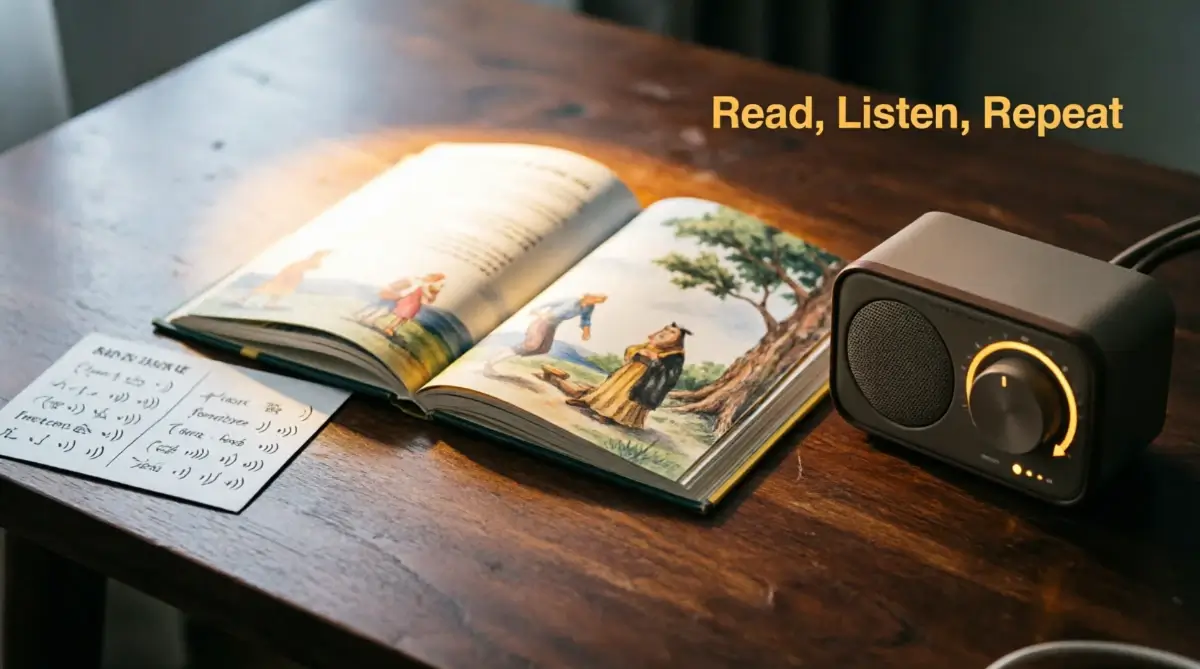
The three step read, listen,repeat method that made the words mine
The first time I read a new story, I did not worry about understanding every word. I simply read it aloud, slowly, letting my mouth feel the shape of the language. The sounds were clumsy at first. My tongue stumbled over unfamiliar combinations, the way it had stumbled when I first learned to shape words in my own language long ago. But the act of reading aloud forced my mind to connect the written symbols to the spoken sounds. It was no longer a passive activity. My voice was involved, and my voice was learning.
I kept a drink nearby something warm, tea or coffee, something to hold between pages and read at a relaxed pace. There was no timer. No test waiting at the end. Just me, the story, and the quiet evening spreading out around me like a blanket. If I hit a word I could not pronounce, I took a guess and kept going. The goal was flow, not perfection. The goal was to let the language become a physical experience, something my mouth could learn the way a hand learns to stir a pot or knead dough through repetition, through touch, through the slow building of memory in the muscles.
Then I listened to the native voice and heard what I had missed
After reading aloud, I played the audio version of the story. The voice of a native speaker filled the room a voice with its own rhythm, its own music, its own way of rising and falling that was completely different from the way I had read it. I closed my eyes and just listened. I heard the rhythm I had missed. I heard the way certain words linked together, the way the voice rose at the end of a question like a bird lifting off a branch, the way it softened when the narrator described something tender or quiet, dropping to a near‑whisper that pulled me closer.
Then I played it again, this time following along with the text. I saw the words I had mispronounced. I saw the phrases I had read too slowly, the places where I had inserted pauses that did not belong. The gap between my reading and the native reading was clear, but it was not discouraging. It was a map. It showed me exactly where I needed to focus. Every difference between my voice and the native voice was a signpost pointing toward the next step.
Finally, I played the audio again and repeated after the speaker, sentence by sentence. I paused after each line and said it back, trying to match the rhythm, the pitch, the speed. If I stumbled, I replayed the sentence and tried again. Sometimes I replayed a single sentence many times before I could match it. This three‑step process read aloud, listen, repeat turned every story into a complete language practice.
I was not just taking in content I was training my voice to sound more like the voices I wanted to understand I was learning sentence patterns not as isolated items but as whole expressions embedded in a flow of meaning the three steps were simple. Read. Listen. Repeat. But together, they turned a passive story into an active practice, and my voice began to change. The voice I heard in the recording was no longer a stranger’s voice. It was the voice I was learning to make my own.
I remember the first time I matched the native speaker’s speed on a full sentence. It was a short one just a greeting, just a few words strung together but my voice and his voice blended into one sound, like two instruments finally playing in tune. I played it back and listened to the recording of my own voice next to his, and for a moment I could not tell where his voice ended and mine began. That small moment gave me more confidence than a great deal of vocabulary practice ever had. It was proof that my mouth was learning, that the repetition was working, that the story was changing me.
The couch the drink and the evening practice
The couch became my classroom. Not because I forced myself to sit there with a textbook, but because I genuinely looked forward to it. After the day was done, after everything was settled, I would settle into the cushions, a warm drink on the side table, and open a story on my phone. There was no pressure. No test. No grade. No one watching or evaluating. Just a tale I wanted to follow, a voice I wanted to hear, a world I wanted to enter.
This was something I had been missing for a long time. When I treated language learning as something demanding, my mind resisted. It found reasons to avoid it. It grew tired. But when I treated it as something restful, my mind welcomed it. It opened up. It became curious. The evening story session became the part of my day I looked forward to most more than the end of any task, more than the moment I finally set everything aside. And because I looked forward to it, I did it every single day. The repetition was built into the enjoyment. I did not need to push myself to keep going. I needed to remind myself to stop reading late into the night.
How the calm of the evening helped the words settle deeper
There was something about the evening that made the words stay better. The day was over. The noise of the world had faded to a low hum, and my mind was calm, like a lake after the wind has died down. In that calm, the language had room to settle. I would read a story before sleep, and the next morning, the phrases were still there, waiting for me. They had not faded overnight. They had not been pushed out by the activity of the day. They had simply stayed, quietly, like guests who had been welcomed and had decided to remain.
This was something I came to trust the mind strengthens memory during rest, and the moments before sleep are especially powerful for learning. I felt it happening, night after night. The words I read at night stayed with me longer than the words I studied in the rush of the morning. The couch, the drink, the quiet these were not distractions. They were the ingredients that made the learning work the simplest way to keep words alive was not to drill them, but to meet them again and again in a context I genuinely enjoyed the evening story session was not a study technique. It was a ritual, and rituals have a power that techniques do not.
How long should each story session last? I kept my sessions to about twenty minutes. Long enough to read a short story twice, listen to the audio, and repeat a few sentences. But the length did not matter as much as the consistency a short session every evening was worth more than a long session done only occasionally. The key was to make it something I simply did, like making tea or closing the curtains at dusk. Something that happened naturally, without debate. The couch did not teach me grammar. But it gave me a place where learning felt like rest. And in that rest, the language grew. The steam from my drink rose and curled in the lamplight, and the words of the story rose and curled with it settling into my memory like spices infusing a warm broth.
Retelling the story in my own words until it became mine
After I had read and listened to a story several times, I did something that felt strange at first. I put the phone down, closed my eyes, and retold the story out loud in my own words. I did not try to memorize the original. I did not try to recite it perfectly. I just told the story as if it were something that had happened to me, as if I were sitting across from someone and sharing a memory.
The first attempts were rough. I forgot details. I used the wrong verb form. I paused for words I should have known, and the pauses stretched out into silence. But I kept going. The act of retelling forced my mind to produce the language, not just recognize it. That switch from receiving to creating was where the real fluency began to grow. It was the difference between watching someone cook and picking up the knife yourself. You can watch many cooking videos and still not know how to chop an onion. But the moment you hold the knife in your own hand, the learning begins.
Changing the ending adding a character how creativity locked the language in
After a few retellings, I began to play with the story. I changed the ending. I added a person. I set the tale in a different place, or a different season. I gave the restaurant owner a daughter who helped him in the kitchen. I moved the story from one season to another and described the cold outside and the warmth inside. These small creative acts did more than entertain me. They forced me to use the language in new ways, with new words, in new combinations. The phrases I had learned from the original story became flexible. I could bend them to fit my own ideas. The vocabulary was no longer tied to a single narrative. It had become a set of tools I could use wherever I wanted.
The confidence I was building and I had once needed before my first real conversation that telling stories was like having a conversation with a kind companion safe, creative, and deeply effective. There was no judgment, no time pressure, no fear of stumbling. There was only my voice and the story and the quiet room. And in that safe space, my fluency grew.
What if I cannot retell the whole story? Start with one scene. Just describe a single moment from the story the opening, the turning point, the ending. Retell that one scene in your own words. As you get more comfortable, add another scene. The goal is not to recite. The goal is to produce language freely, without a script. Every time you retell a scene, you are building the ability to speak naturally. The story was not mine until I told it myself. And when I told it, the words that had once belonged to the author became words that belonged to me. The restaurant owner’s story became my story, and his language became my language.
The first time I retold a full story without stopping, I was lying on the couch, looking up at the ceiling. My voice filled the empty room, and when I finished, the silence that followed felt different from the silence before. It was not an empty silence. It was a full silence, a silence that held the echo of everything I had just said. I had spoken for a long stretch in another language, and it had felt natural. The story had become mine. I had prepared a meal with the ingredients the story gave me, and it was not perfect, but it was something I had made with my own hands and my own voice.
The recipes I made from the stories I read
The restaurant story did more than teach me food vocabulary. It gave me a recipe. The owner had included his grandmother’s method for a sauce I had never tried before a sauce made with tomatoes, onions, a particular kind of pepper I had to search for, and a spice blend that was unfamiliar to me. One quiet afternoon, I decided to make it. I opened the story on my phone, propped it against the spice rack, and started cooking. The steam from the pot fogged the screen, and I had to wipe it clean with my sleeve.
The instructions were in the language I was learning. I had to read carefully. I had to understand each step before I could do it. I measured, stirred, and tasted, speaking the words aloud as I went. “Add the onions.” The knife moved through them, and the sound of chopping was the only music in the room. “Let them soften.” I watched them turn clear in the oil, their sharp edges rounding into sweetness. “A pinch of salt.” I felt the grains between my fingers, the same way the grandmother must have felt them. My hands were busy, and my mouth was learning. The words were no longer just sounds on a page. They were actions. They had weight and heat and smell. They had taste.
By the time the sauce was finished, I had learned many new words without trying. They had stayed because I had used them with my body, not just my eyes. The kitchen had become an extension of the story. And the story had become part of my home. The smell of that sauce lingered in the kitchen for a long while afterward, and every time I walked through the room, I remembered the words.
How making a dish from a story made the vocabulary unforgettable
The sauce I made that day was not perfect. I had used a little too much salt, and the oil I had was not exactly what the recipe described. But the words I learned stayed with me. Long afterward, I could still remember the word for “soften” because I remembered the way the onions looked when they turned clear in the pan, the way they glistened. I could remember the word for “pinch” because I remembered the feel of the salt between my fingers, the tiny grains pressing into my skin. I could remember the word for “stir” because I remembered the motion of the wooden spoon, the slow circles, the way the sauce thickened as I moved it.
This was a kind of learning that no flashcard could ever match. The words were attached to a full sensory experience smell, taste, touch, sound, sight. Every sense was involved, and every sense helped lock the language into my memory. The story had given me the words. The cooking had given them a home. And that home was permanent. If the story I am reading does not have a recipe, I can still bring it into my real life. If the tale describes a place, I can find images of that place and describe them in the language. If it describes an action making something, fixing something, tending a garden I can try doing that action while speaking the steps aloud.
The goal is to connect the words to my hands and my senses. That connection is what makes vocabulary stay. The kitchen taught me what the classroom never could. Words are not just things you know. They are things you do. And when you do them, they stay. Your hands learn faster than your eyes. When you cook, build, draw, or walk while speaking the language, your body remembers what your mind might forget. Let your hands be part of your practice. They will carry the words with them. The wooden spoon I used that day is still in my kitchen, and every time I pick it up, the words come back.
The slow, quiet progress that happened while I was just enjoying myself
There were no tests. No scores. No streak counters. I did not measure my progress with numbers or charts. I measured it with feelings. The feeling of a sentence coming out smoothly that had once been rough and jagged. The feeling of understanding a paragraph without needing to pause or reread. The feeling of laughing at a line I would have missed earlier, a small moment of humour that would have gone past me before. The feeling of reading a story and forgetting, for a few minutes, that it was written in another language entirely.
These were small moments of quiet satisfaction, but they were real. And because I was not constantly checking my progress, I did not get discouraged when the gains came slowly. I just kept reading, kept listening, kept retelling. The enjoyment itself was the engine. The progress was a gift that came alongside the enjoyment, never the main goal.
The first time I used a story phrase in a real conversation
The moment came without warning. I was talking with someone about a meal we had just shared. I wanted to describe the sauce. And the words from the restaurant story the ones I had read, listened to, repeated, and cooked came out before I could think about them. “The sauce was a little too salty, but the flavour was deep.” The sentence formed itself. I did not plan it. I did not translate it. I just said it.
The person I was with nodded and agreed. The conversation moved on. But inside, I felt a small, quiet lift the kind of feeling that comes not from a grand achievement, but from something ordinary working the way it should. The phrase had travelled from the story to my mouth to the real world. It had made the full journey, from the page to the kitchen to the table to the conversation afterward. And that journey was proof that the approach worked. I had learned to keep showing up without anyone checking on me (ID: A‑0089🔎), and the reward was moments like this moments when the language simply worked, without struggle, without the hesitation that used to define every exchange.
How long did it take before I noticed real results? I felt the first small shifts quite soon certain phrases felt easier, certain words came faster. But the deeper, lasting fluency took time and consistent evening sessions. The key was not to rush. The key was to enjoy the process so much that the time passed without feeling like effort. When you are enjoying yourself, time moves gently, and the progress accumulates behind the scenes, like interest in an account you forget you have until one day you notice how much has grown. The progress did not announce itself. It arrived quietly, in the small moments the smoother sentence, the faster response, the word that was simply there when I needed it. The word that was simply there, like a friend who shows up without being called.
The stories are still on my phone, and I still read them aloud
The restaurant story is still on my phone. I opened it again recently, long after that first evening on the couch. The screen is different now the phone is newer but the words are the same. I read it aloud, just as I had done before, and something wonderful happened. I understood everything. Not just the main ideas, but the small details I had missed the first time the way the owner described the colour of the sauce, the way he remembered his grandmother’s hands, the way he paused before opening the restaurant on that first evening, feeling uncertain but hopeful. The words I had once stumbled over were now easy. The phrases I had once repeated clumsily were now smooth, flowing like water over stones.
But even now, the story was not finished teaching me there were still a few words I had not fully absorbed. There were still sentence patterns I wanted to study more closely. A good story is never truly finished. It keeps giving, year after year, as your language grows. It is like a garden that keeps producing, season after season, if you continue to tend it.
What I tell anyone who wants real fluency: find a story you love, and start reading out loud
If someone asked me today how to build fluency through story‑based learning, I would tell them this. Find a story that speaks to your life something about food, or daily work, or relationships, or the places you love. Something you would enjoy reading even in your own language. Then make it part of your evening. Read it aloud. Listen to the audio. Repeat after the speaker. Retell it in your own words. And if there is a recipe, make it. If there is a place, learn about it. Let the story spill out of the page and into your real life.
The stories I read did not just teach me a language. They taught me about food, about people, about showing up, about finding joy in small things. They entertained me while they educated me. And that combination delight and learning together is the most powerful approach I have ever found. The sense of meaning that kept me going through all of this was not just the language itself. It was the world the language opened up. I had found a deep sense of direction in my language journey and that direction was tied to the stories I loved.
Can this approach work if I am still at the beginning? Yes, if you choose very simple stories. Start with short tales, brief dialogues, or very basic narratives. The three‑step method read aloud, listen, repeat works at any level. The key is to find stories where you can follow the general meaning, even if you miss some words. As your level grows, your stories can grow with you.
I also found that returning to the same story again and again was more powerful than chasing many different stories. When I repeated a story until I knew every line, the language became part of me. I learned faster by going deep with simple material and the stories were the perfect material for that depth. The stories did not just build my fluency. They built a world I could live in. And that world, once entered, never closed its doors.
I still have every story I ever read on my phone. They are arranged in a folder, like old friends on a shelf. Sometimes, on a quiet evening, I open one and read it aloud. The words are no longer foreign. They are just words. And that ordinariness, more than any certificate or score, is the proof that the language has become mine.
I read the story aloud, letting my mouth learn the sounds. I listened to a native speaker and heard the music I had missed. I repeated after the audio until my voice matched the rhythm. I retold the story in my own words, changing details, adding ideas, making it mine. And when the story had a recipe, I made it letting my hands, my nose, and my tongue join the learning.
The progress was slow and quiet. There were no scores or streaks. But the words stayed. They stayed because they were attached to something real a story I loved, a dish I made, an evening I enjoyed. The couch became my classroom, and the stories became my teachers.
The kitchen of the story is now my kitchen the voice of the narrator is now the voice I hear when I speak. And the spice I added, clumsily at first, is now part of the flavour of my own words.