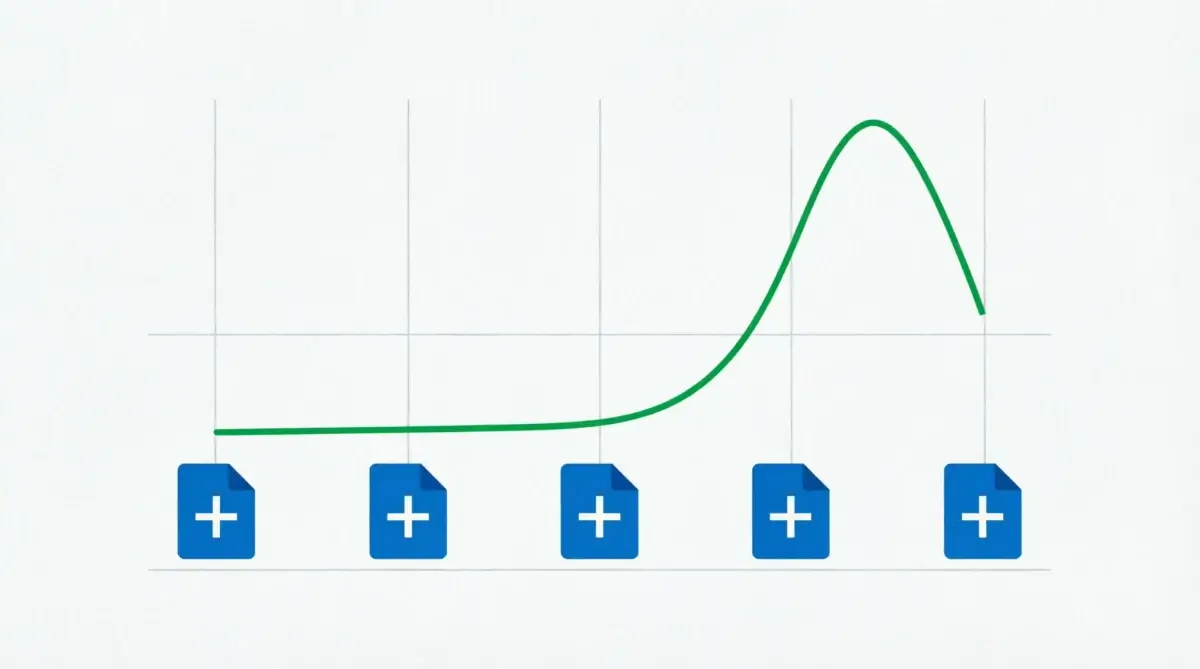
Zero traffic does not mean you are failing it means you are in the first phase of constructing something that is not yet visible to the audience. When I published my earliest articles on this site and looked at the dashboard, I felt a brief flicker of excitement the number looked substantial then I filtered out my own activity and watched it shrink to a handful of real visitors.
That moment taught me more about building a digital asset than any traffic surge ever could. This article is about what the early silence actually means, why it is not a setback, and how to use those invisible weeks to build a foundation that will hold weight long after the visitors arrive.
The Dashboard Number That Looked Like Progress but Was Only My Own Reflection
The analytics platform had been counting every draft preview, every edit, every page load I made while building the site. I had been measuring my own footsteps and calling them a crowd. The visits were not readers. They were me, clicking through my own articles, checking formatting, rereading paragraphs the moment I excluded my own page views, the real audience became visible tiny, but genuine.
That correction felt like a cold splash of reality I could have interpreted the small number as proof that no one cared. Instead, I chose to see it as the first honest data point of a long journey. A few strangers had found their way to my articles without any promotion, without any social media presence, without any established reputation. They had arrived through pure organic search. That was not a failure. That was a seed.
The dashboard had stopped lying to me, and for the first time, I could see the actual starting line. If you are building a site and the early numbers look discouraging, check whether you are counting yourself. Filter your own activity before you draw any conclusions the honest number, however small, is the only one that can guide you correctly.
The technical step of filtering your own views is simple, but the psychological impact is not when I first saw the number drop, I felt a physical sinking in my stomach. I had been telling myself a story of growth that was not true. The inflated number had given me a false sense of momentum, and losing it felt like losing progress. But the truth was that I had not lost anything real. I had only lost an illusion. And losing that illusion was the best thing that could have happened, because it allowed me to build on honest ground. I now recommend that anyone starting a site filter their own activity on the very first day.
Do not let the inflated numbers take root in your mind the longer you believe in them, the harder it is to accept the real figures when they appear. Start with the truth, however small, and let every genuine visitor feel like the victory they actually are. A single real reader who found you through search is worth more than a hundred fake visits generated by your own browser. That single reader is evidence that the system works. The fake visits are evidence only that you have been busy editing.
The experience of seeing inflated numbers is extremely common among new site owners. Analytics platforms are designed to track all activity, and they do not automatically distinguish between the site owner and genuine visitors. Until you set up a filter to exclude your own activity, you are looking at a number that includes your own work many people go months without realizing this, building expectations on a foundation of false data when they finally filter their views and see the real number, the shock can be enough to make them quit.
I was fortunate to discover the discrepancy early within the first few weeks, I noticed that the traffic patterns matched my own working hours too closely. The spikes occurred exactly when I was editing. The geographic location of the visitors matched my own. The pattern was too perfect to be organic. That skepticism led me to investigate, and the investigation revealed the truth. If I had not been curious about the anomaly, I might have continued believing the inflated numbers for much longer, and the eventual correction would have been far more painful. The lesson is not just to filter your views, but to question your data if something looks too clean, too aligned with your own activity, dig deeper.
Beyond just filtering your own IP address, I recommend creating a separate browser profile for viewing the live site. Use one browser for building and editing, and a completely different one for checking how the site appears to visitors. This separation prevents the analytics script from ever capturing your own activity in the first place it is a tiny habit that takes five minutes to set up and saves weeks of false confidence.
I suggest checking the real‑time analytics view occasionally during the first month, not to obsess over numbers, but to verify that the filter is working correctly. If you see a spike in real‑time visitors that perfectly matches your own clicking around, the filter is not active. Fix it immediately an honest dashboard is the foundation of every good decision you will make about your content strategy.
Turning Off Self‑Views Revealed the Honest Count
After I filtered out my own activity, the real visitors became visible. I sat with that figure for a while. It was not the audience I had imagined, but it was real. Every one of those visitors had landed on a page, spent time reading, and left without any prompt from me. They were not friends or family. They were people searching for something and finding my words.
That moment became the most clarifying lesson of the early journey. The tiny count was evidence that the search engine was beginning to test the site, even if only in a minimal way. It meant the infrastructure worked the articles were indexable. The topics were relevant enough to appear in search results, even at the very bottom. I could have interpreted the small number as insignificance. Instead, I saw a foundation. A month earlier, the number had been zero. Now it was growing, however modestly, and it pointed in the right direction. The lesson was not about the number itself. It was about learning to read early signals honestly and refusing to let vanity metrics decide whether I continued.
The number stayed with me it became a reference point, a reminder of where the journey actually began. Whenever I felt discouraged by slow growth in later months, I would think back to that moment and realize how far the site had already come. The early visitors were not just a starting point. They were proof that the mechanism worked. If a handful of people could find the site with no promotion and no reputation then a larger audience could find it with more content and more time.
The power of an honest baseline is that it makes future progress visible. When you start with an inflated number, every subsequent dip feels like failure. When you start with the real number, every genuine increase is a victory you can trust. I recommend that every new site owner establish their honest baseline in the first week and then track from there. The baseline will be small, but it will be true. And from that truth, real growth can be measured and celebrated.
There is a deeper lesson here about the relationship between effort and visibility. In the beginning, the effort you put in is almost entirely invisible. You write for hours, publish article after article, and the dashboard barely moves. This can feel like shouting into an empty room. But the visibility gap is not a sign that the work is wasted. It is a sign that the work is being stored. Every article you publish during the invisible phase is a deposit into a bank account that will start paying interest later.
The interest when it arrives is compound: the articles don’t just attract their own readers, they support each other, link to each other, and collectively build authority. The silent phase is when the principal is deposited. The growth phase is when the interest begins to accumulate. Understanding this banking metaphor changed my emotional relationship to the early silence entirely. I stopped feeling like I was wasting time and started feeling like I was making deposits into an account that would one day generate passive returns.
The Sandbox Is Not a Penalty It Is a Probation Window That Filters Intent
A brand‑new domain does not enter an open field where anyone can see it. It enters a still testing ground, observed by algorithms that have no reason to trust it yet. This period is one of the most misunderstood phases of building a digital asset. It is not a punishment. It is a filter that protects search users from low‑quality sites understanding this changed how I viewed the silent weeks and allowed me to use them productively rather than wasting them in frustration.
How Search Engines Use the First Weeks to Observe, Not to Reward
When a site has no history, the search engine has no way to distinguish it from thousands of others that launch with energy and disappear a month later. The algorithm is designed to protect its users, not to reward new publishers instantly. During the first weeks, the engine observes. It sends a small number of test impressions. It watches whether the publisher continues to add content it measures signals that take time to accumulate: consistency, content depth, user engagement on the few visits that do occur.
I received a tiny number of impressions in the first month barely enough to register, but present. Those impressions were not meaningless. They were the search engine dipping a toe into the water. Each one was a tiny probe, asking whether the site was still alive, still growing, still worth indexing. The engine was not ignoring the site. It was watching, and the only response that mattered was continued publishing. The question to ask during this period is not “why is no one visiting?” It is “am I still adding value?” If the answer is yes, the observations will eventually turn into trust.
The observation period can feel personal, but it is entirely impersonal. The algorithm does not know your intentions. It does not care how hard you have worked. It processes signals, and the signals take time to accumulate. A site that has existed for one month has almost no signal. A site that has existed for six months and published consistently has a clear, measurable track record the difference is not the quality of the content.
It is the weight of the evidence understanding this removed the emotional sting from the low numbers. The search engine was not judging my writing. It was waiting for enough data to make a judgment at all. This is why patience is not optional. It is the fundamental currency of the early months. You cannot rush the accumulation of trust, any more than you can rush the growth of a tree. The tree does not grow faster because you stare at it. It grows because you water it consistently and give it time. The site follows the same pattern. The articles are the water the months are the time and the growth, when it comes, is proportional to both.
There is a practical implication here that I only fully appreciated later. Because the search engine is observing during the sandbox, every article you publish is part of the evidence file. An article published during the probation window carries more weight than it appears to, because it contributes to the pattern of consistency that the algorithm is watching for a site that publishes ten articles in month one and then goes silent for three months looks like a failed experiment.
A site that publishes steadily even at a slower pace, looks like a committed project. The consistency of the publishing rhythm matters more than the volume. I did not understand this at first. I thought I needed to publish as much as possible, as fast as possible, to impress the algorithm. The truth is more nuanced: the algorithm is impressed by sustained effort over time, not by short bursts of intensity.
A consistent velocity of one article per week for six months will outperform thirty articles published in a single month followed by silence. The sandbox rewards the tortoise, not the hare. Once I internalized this, I stopped worrying about the daily count and focused entirely on protecting the rhythm. The rhythm became my most important metric, because the rhythm was what the search engine was actually measuring.
The One Question Being Asked During Those Still Months
Behind every minimal impression, every single‑digit click, a single question sits: will this person still be publishing valuable material months from now? The algorithm has seen too many abandoned projects. It has learned to be patient. It waits until the evidence of commitment is overwhelming before allocating significant visibility. Every article published during the sandbox is a still answer to that question. 10 articles says “I am trying.” 50 articles says “I am serious.”
I did not know about this question when I started I assumed that good content would rise on its own. The reality was more gradual. The search engine needed to see that I was not a flash in the pan before it would risk showing my content to a wider audience. Once I understood that, the still months stopped feeling like rejection and started feeling like an audition I could pass by simply continuing. The method I used to keep showing up each day, even when the dashboard was empty, was the one I had learned years before when starting anything from zero define the smallest possible win and protect it.
The question is not just about commitment it is about quality. The search engine evaluates not only whether you continue publishing, but whether the content you publish satisfies the queries it serves. During the sandbox, the small number of impressions are tests. The engine sends your page to a few users for a specific query and watches what happens. If the user clicks and stays, the page passes the test. If the user bounces immediately, the page fails. Over time, these micro‑tests accumulate into a quality score that determines future visibility.
This means that every article matters even during the silent weeks, when traffic is minimal, the quality of the content is being evaluated on the few impressions it receives. You cannot see these tests happening, but they are happening. The best response is to make every article as useful as possible, because you never know which one will be the test that opens the door to wider visibility the article you write today, with care and depth, might be the one that receives its first impressions tomorrow and signals to the search engine that your site is worth ranking.
This is one of the most actionable insights from the sandbox period. Because every article is potentially being tested on the few impressions it receives, you cannot afford to publish filler. A single low‑quality article that receives a test impression and generates a bounce sends a negative signal. A single high‑quality article that receives a test impression and generates engagement sends a positive signal. Over the course of the sandbox, the ratio of positive to negative signals determines how quickly the probation ends and real traffic begins this means the quality bar must be high from the very first article.
You cannot “fix it later” when the audience arrives because the audience will only arrive if the quality signals are strong during the silent period. The silent period is when your content is being graded. The grade determines when the classroom doors open. Knowing this, I treated every article as if it were the one being tested, because statistically, with so few impressions, each article had a reasonable chance of being the test case.
That pressure forced me to raise my standards before I had any external reason to do so. The result was a library of content that was far better than it would have been if I had been writing for an empty room, because I understood that the room was not empty the search engine was in the corner, watching, taking notes.
Why the Sandbox Separates a Long‑Term Asset From a Weekend Experiment
Projects built on sustained intention survive the sandbox. Those started on impulse or motivated only by a quick return rarely do. The probation acts as a filter that cleans the search results for real users. It may feel frustrating to the eager publisher, but it serves a legitimate purpose: ensuring that the content users find has some staying power behind it. If you can keep publishing during the months when no one is watching, you have proven something important about your relationship to the work. You have shown that the output is driven by more than external validation.
The visitors will come, but only after the engine is convinced that the site will still be there when they arrive. This filter is harsh but fair, and it is one of the reasons that genuinely useful content eventually surfaces while shallow content fades. I learned to respect the sandbox not as an enemy but as a gatekeeper that, once I passed through it, would never stand in my way again.
The process of building hope when there was nothing visible to show for the effort is something I had practiced long before this site existed, in circumstances far more demanding than a still analytics dashboard.
The sandbox serves another purpose that is rarely discussed: it gives you time to develop your skills before a large audience sees your work. The articles I wrote in month one were not my best. The articles I wrote later were significantly better. If the search engine had sent many visitors to my earliest work, some would have left unimpressed and never returned. By holding back visibility until I had published enough to improve my craft, the sandbox protected my future reputation. It gave me space to grow into the writer I needed to become before the spotlight found me.
This perspective reframes the waiting period as a protected apprenticeship you are not being punished. You are being given time to practice. The search engine is not keeping you hidden out of malice. It is waiting until your work is ready for the audience it will eventually send the responsibility during this period is to use the time well to improve, to experiment, to build depth so that when the visibility arrives, the content is worthy of it.
This apprenticeship metaphor is the most empowering reframe available. An apprentice is not failing. An apprentice is learning, under the guidance of a master, in a protected environment where mistakes are expected and corrected without public consequence. The sandbox is that protected environment the search engine is the master, withholding full responsibility until the apprentice has demonstrated competence.
The articles are the practice pieces the feedback, though minimal, is the master’s occasional correction. If you view the early months as an apprenticeship rather than a performance review, the emotional experience transforms completely. You stop asking “why am I not succeeding?” and start asking “what am I learning today?” The first question leads to despair. The second leads to growth. The difference is entirely in the frame, and the frame is a choice available to every builder.
What I Actually Did During the Silent Weeks Instead of Waiting
I did not watch the dashboard I published. I treated the silence as a protected workshop where I could build without distraction. Every day, I added another article. I experimented with different structures, different tones, different ways of opening a piece the absence of an audience gave me the freedom to make mistakes and learn from them without public scrutiny.
The silent weeks were the most productive phase of the entire project. They taught me that action, not traffic, is the builder’s true metric. The number of articles published, the quality of the internal linking, the clarity of the writing these were the measures that mattered while the dashboard stayed flat, the asset grew stronger. That is the secret of the sandbox it hides your growth until the growth is real enough to show.
I developed a simple morning routine during those weeks that I still follow. I would wake up at the early hour, prepare my workspace, and write. I did not check the analytics before I wrote. I did not open email or social media the first hour of the day belonged to creating, not to consuming. That protected hour was the engine of the entire project. During the silent weeks, it produced the articles that would later attract traffic. During the months that followed, it produced the articles that sustained it the routine was not elaborate. It did not require special tools.
It required a decision made the night before and a refusal to negotiate in the morning. The simplicity of the routine was its strength. There were no decisions to make when I sat down. The materials were ready. The topic was chosen. The only remaining action was to write. That removal of friction is what made the daily output possible, and it is a practice I recommend to anyone building a content asset from zero the fewer decisions you have to make before you start the more likely you are to start.
I kept a simple journal during those weeks as well not a complex spreadsheet, just a daily note of what I published and any small observations. Looking back at that data record now, I can see the arc of improvement. The early entries describe articles that felt difficult to write, that required hours of revision. The later entries are more confident, describing articles that came together more naturally the data record captured progress that the traffic dashboard could not see.
It gave me a private record of growth when the public metrics showed nothing. I recommend this practice to anyone in the early stages of building a content asset. Keep a personal journal that tracks output, not outcome. Record what you published, what you learned, what you want to try next. When the public metrics are silent, the private data record is your evidence of movement. And later, when the public metrics begin to rise, the journal becomes a valuable document of the journey a reminder of where you started and how far you have come.
One more practice from the silent weeks deserves mention: I built the internal linking structure deliberately during this period. With no audience to distract me, I had the time to think carefully about how each article connected to the others. I created hub pages, topic clusters, and clear navigation paths between related pieces. This architectural work is invisible to the casual visitor, but it is the skeleton that holds the library together.
Search engines rely heavily on internal links to understand the structure and hierarchy of a site. By building this structure during the silent weeks, I ensured that when traffic arrived, the site was not just a collection of articles it was an organized, navigable resource the early silence is the ideal time for this kind of foundational work, because it requires focused attention and is easy to neglect once the demands of an audience appear.
The Silent Months Were the Most Productive Workshop I Have Ever Had
When no one is reading you have a rare gift: total creative freedom there is no pressure to maintain a brand, no fear of disappointing an audience, no temptation to chase trending topics. The zero‑traffic stretch is a private laboratory, and I used every day of it. This section is about the specific work that happened in that workshop and how it laid the foundation for everything that followed.
Experimenting With Writing Approaches Without the Pressure of an Audience
During those early months, I tried approaches that I would have been too cautious to attempt with readers watching. I wrote extremely long, detailed guides. I wrote short, punchy reflections. I tested subheading patterns, paragraph lengths, and different ways to conclude an article. Some experiments failed. The articles felt clunky and unfocused. Others clicked immediately, and I built on them. The voice you now read on this site was not chosen. It was discovered through trial and error during a period when no one was judging the results.
This freedom to experiment is the hidden advantage of starting small. With no audience to alienate, you can take risks that would be uncomfortable later. You can publish something imperfect and learn from its reception without consequence. The articles that did not land taught me as much as the ones that did.
They showed me what topics resonated, what structures kept me engaged as a writer, and what felt authentic versus what felt forced. That curriculum could not have been designed in advance. It emerged from the doing, and the doing was only possible because the silence gave me space.
One specific experiment that shaped the direction of this site was testing different article lengths. I had read that long‑form content performed better in search results, but I had no personal evidence. So I tried both. I wrote short, focused pieces. I wrote comprehensive guides that stretched much longer. The data, once it began to trickle in, confirmed what the research suggested: the longer, more detailed articles retained readers longer and attracted more return visits.
But the discovery was not just about length it was about depth the articles that performed best were the ones that answered a specific question thoroughly, without fluff, without padding, but with genuine completeness. That insight now shapes every article I write. I do not write to a word count. I write until the question is answered. The length is a byproduct of the depth, not a target in itself. I would not have learned this if I had waited until I had an audience to start experimenting. The zero‑traffic window gave me the space to discover what worked without the pressure of maintaining a standard I had not yet defined.
Another experiment involved the use of personal stories I was unsure whether readers would connect with narratives drawn from my own life whether they would prefer strictly instructional content. So I tried both. I wrote articles that were purely practical, step‑by‑step guides with no personal context. And I wrote articles that wove personal experience into the instruction, showing how I had applied the method myself the articles with personal context consistently outperformed the purely instructional ones.
They had longer session durations and lower bounce rates. That discovery shaped the voice of this entire site. It confirmed that readers want to learn from a person, not from a textbook. The personal element is not a distraction from the value. It is the vehicle that carries the value. I would not have learned this if I had been afraid to experiment in front of an audience. The silence gave me the courage to try, and the data gave me the confidence to continue.
I experimented with different publishing frequencies some weeks I published daily. Other weeks I published every other day. I tracked how each rhythm affected my energy, my writing quality, and the eventual traffic patterns. What I discovered was that a sustainable rhythm produced better long‑term results than an aggressive one the daily publishing weeks produced more content but the quality was inconsistent and I burned out quickly.
The slightly slower pace produced fewer articles but each one was stronger, and I could sustain it indefinitely. The sandbox gave me the data I needed to find my optimal rhythm before an audience was depending on a consistent schedule. I settled into a pace that felt challenging but not draining, and that pace has carried me through hundreds of articles without burnout. I would not have discovered this balance without the experimental freedom of the silent months.
Publishing Imperfect Articles and Learning From What Did Not Land
Some early articles were clunky others covered topics I later realized were too broad. Yet each one taught me something that made the next piece sharper. The mistakes I made without an audience present became the curriculum for everything I published later, when the readers arrived. I learned that certain openings pulled readers in while others lost them immediately. I learned that breaking a long article into clear, labeled sections kept people reading I learned that the simplest language often carried the most weight.
None of these lessons came from a course. They came from publishing, observing, and adjusting. The early articles that felt like failures at the time were actually the most valuable teachers. They showed me what did not work without costing me an audience, because there was no audience yet to lose. That is a luxury that disappears once traffic begins to grow. The silent window is the only time you can fail freely, and I used that freedom completely.
One early article stands out in my memory it was about a topic I cared deeply about, but the writing was dense and the structure was confusing. I published it anyway, and later, when I reviewed the analytics, I saw that almost no one read past the first few paragraphs. That was painful, but it was also instructive. I rewrote the article months later, using everything I had learned in the interim. The revised version performed far better, not because the topic had changed, but because I had learned to write for a reader rather than for myself.
That experience taught me that no article is permanent. Everything can be improved the early, imperfect versions are not failures. They are drafts that teach you what the final version needs. The silence of the early months gives you the chance to write those drafts, learn from them, and refine them before a large audience ever sees them. By the time readers arrived in significant numbers, the worst of my early work had already been revised they saw the edited version, not the first attempt. That is a privilege the silent period grants you, and I used it fully.
Stacking Article After Article Until a Foundation of 30, 50, and More Existed
By the time search engines began sending consistent visitors, the site already had a library of deeply researched posts. That body of work did not appear overnight. It was assembled during the months when the traffic dashboard said almost nothing. The silent period was the construction phase of a digital asset that would later support sustained traffic. I did not wait for approval signals I built. Article by article, the library grew. Each one added another entry point, another page for search engines to index, another piece of the foundation.
The invisible hours I invested during that period are the reason the site has any substance today. Visitors who arrive now do not see the months of silence. They see a full library and assume it was always there. That illusion is the product of the silent workshop. I learned long ago that the work nobody sees is what makes the visible results possible and I applied that lesson to every article I published during those early weeks.
The act of stacking articles is deceptively powerful. Each article, by itself, might attract only a small number of visitors per month. But when you have many articles, each attracting a few visitors, the total begins to compound. The compound effect of a growing library is not visible in the first mont even the second. It becomes visible only after the library reaches a critical mass, and that mass can only be reached by publishing through the silence. I did not understand this compounding dynamic when I started.
I thought each article would succeed or fail on its own the reality is that articles support each other a reader who finds one piece often clicks through to another. A search engine that sees a dense web of interconnected content treats the site as a more authoritative resource. The whole is greater than the sum of its parts, but only if the parts exist. The silent period is when those parts are manufactured. Each article is a brick. Alone, it is unimpressive. Stacked together, it becomes a wall and the wall is what eventually attracts attention.
The Mental Shift From Chasing Early Metrics to Building a Permanent Library
The early silence forces a choice you can interpret the low numbers as failure and quit you can shift your entire framework for measuring success. I chose the second path, and that shift is what protected my motivation through the months when the dashboard showed almost nothing. This section is about the specific mental reframes that turned zero traffic from a discouragement into a teacher.
Why a Single Reader Who Stays for Minutes Matters More Than a Hundred Who Bounce
A small number of visitors who genuinely engage builds a stronger signal than a spike of accidental traffic that leaves in seconds. I learned to value session duration and page depth far more than the raw visitor count. One person who reads an entire article, clicks to another, and stays for several minutes is worth more than many who land, glance, and leave. The engaged reader tells the search engine that the content matched the query the bounced visitor tells it nothing useful.
This perspective protected my motivation when I looked only at the visitor count, the numbers were discouraging. When I looked at session duration and return visits, I saw a different story: the few who found the site were actually reading. They were engaged. That meant the content was working, even if the audience was tiny. The quality of the traffic mattered more than the quantity, and focusing on quality kept me building while others might have stopped.
I learned to read the analytics with a focus on engagement rather than volume. A visitor who arrives on a page and spends several minutes reading, then clicks to another article, is a visitor who found what they were looking for. That single session is a success. A swarm of visitors who arrive, glance, and leave within seconds are missed opportunities. The total visitor count can hide the real story.
A site with many visitors and a very high bounce rate is not healthier than a site with fewer visitors and a low bounce rate. The smaller, more engaged audience is the one building momentum with the search algorithm. This insight protected me from the emotional rollercoaster of early analytics. When I had a day with only a few visitors but a session duration of several minutes, I knew the content was resonating with the people who found it.
The low number was a distribution problem not a quality problem the solution to a distribution problem is more content and more time. The solution to a quality problem is different content. Knowing which problem you have is the first step to solving it, and engagement metrics are the diagnostic tool that tells you.
Treating the Blog as a Long‑Term Asset Rather Than a Traffic Machine
This site was never designed to chase a viral spike it was built as a durable collection of resources, much like a public transcript of what I have learned. The goal is not a quick cash event. The goal is to create something that remains valuable and discoverable for years that mindset change made zero‑traffic months feel like an investment rather than a failure.
A traffic machine needs constant fuel it depends on trends, social media algorithms, and the unpredictable currents of viral attention. A library does not. The library does not need a spike. It needs consistency. Once I adopted that frame, the daily act of publishing became satisfying in itself. I was not waiting for traffic. I was building a permanent resource, and the building was the point the approach I used when learning with almost no resources treating time as the currency and refusing to wait for ideal conditions became the operating system for the site.
A library is measured by its depth, not by the number of people walking through the door on any given day a great library might have still days and busy days, but its value does not fluctuate with the foot traffic. Its value is in the collection itself. That is how I view this site. The articles are the collection. They exist regardless of whether anyone is reading them at this exact moment they will still exist tomorrow, and next year, and the year after that.
Their value is intrinsic, not dependent on real‑time attention. This view has practical implications it means I prioritize completeness and accuracy over timeliness. I write articles that will be as useful in five years as they are today. I avoid references that will date the content. I structure the site so that new articles enhance the existing library rather than replacing it. Every piece is a permanent addition to a growing resource that permanence is what makes the asset compound over time, and it is only possible if you build with a long‑term horizon from the very beginning.
The shift from traffic‑seeking to asset‑building changed my daily relationship to the work. When I was chasing numbers, every low day felt like a personal failure. When I was building a library, every completed article felt like a permanent gain. The difference in my emotional experience was enormous. The library builder goes to sleep satisfied, knowing that the asset grew today regardless of what the dashboard said. The traffic chaser goes to sleep anxious, hoping tomorrow will be better I am not immune to the desire for validation.
I still check the analytics but I check them as an observer, not as a judge the numbers inform me. They do not define me. That separation between what the data says and what it means about my worth is one of the most important mental boundaries I have built. The data is feedback. It is not a verdict. And the feedback is only useful if I keep publishing long enough to collect enough of it to see patterns. The early months, with their sparse data, are not the time for conclusions they are the time for construction.
The Decision to Keep Publishing When Every Metric Suggested Nothing Was Happening
All the early data pointed toward silence I could have interpreted the low numbers as proof that the approach was wrong. Instead, I recognized them as the natural beginning of any project that starts from absolute zero. The act of continuing when nothing seems to move is what separates a real digital asset from a forgotten domain name. Every publisher faces this moment. The dashboard says nothing. The effort feels wasted. The temptation to stop is strong. The ones who build something lasting are the ones who publish anyway.
The decision is not made once it is made every day, in the moment when the alarm goes off at an early hour and the dashboard still reads near zero. Each time I chose to write instead of waiting for validation, I reinforced the identity of a builder. Over months, that identity became stronger than any single disappointing metric. I was not chasing numbers. I was keeping a promise to myself, and that promise did not depend on external results the mental barrier that stops so many people at the very beginning the fear that the first step will be too hard and too uncertain is something I had to confront directly, and I learned that the hardest part is simply starting before you feel ready.
That decision, repeated day after day, is what builds the muscle of persistence. The muscle does not care about talent. It does not care about luck. It cares about repetition. Every day I chose to write built consistency. Every consistency made the next one easier performed in the silence, were the most valuable because they required the most faith. Later, when traffic arrived and the feedback became positive, the reps were easier.
But the habit had already been built during the hard months, and that habit is what sustained the output when the initial excitement of traffic wore off and the work became routine. The ability to keep going when nothing seems to move is not a personality trait. It is a skill, and like any skill, it can be developed through practice. The silent months are the practice field. They are where you develop the persistence that will carry you through every future challenge.
The person who has published many articles with no audience is not afraid of a slow month the person who has only published when motivated will quit the moment motivation fades. The silence, if you let it, makes you bulletproof.
The Core Truth Zero Traffic Crystallized for Me
After the filtering, the sandbox, the silent workshop, and the mental shift, a single truth settled into place: zero traffic in month one is not a verdict on the content. It is a reflection of how trust is built online. The search engine does not know you yet the audience has not found you yet the early silence is not a sign that the work is bad.
It is a sign that the work is new and new work, like a new house, needs a foundation before it can be lived in. The zero‑traffic period is the time when that foundation is poured and set. Once I understood this, the silence stopped being a source of anxiety and became a source of clarity. I was not failing. I was constructing.
Visibility Is a Lagging Indicator
The core truth is this: visibility is a lagging indicator it tells you what happened months ago, not what is happening now. The articles I write today will not show up in the traffic data for weeks. The articles I wrote weeks ago are only now beginning to surface if I had judged my early efforts by the traffic they received in real time, I would have concluded that nothing was working.
But the work was working on a delay understanding the lag changed my relationship to the dashboard completely. I stopped expecting today’s effort to show up in today’s numbers. I started trusting that the effort would show up eventually, in its own time, as long as I kept the pipeline full.
That trust was not blind faith it was based on observing the pattern: articles published in the early weeks began receiving impressions weeks later. Articles published later began receiving clicks after more time had passed the delay was real and measurable, and once I mapped it, I could plan around it the silence of month one was not a mystery it was the leading edge of a wave that had not yet arrived.
There is a profound freedom in accepting the delay. When you stop expecting immediate results, you stop being disappointed by their absence. You start measuring your success by the inputs the articles written, the skills developed, the library grown rather than the outputs, which are delayed by forces you cannot control. This is not a passive acceptance of failure. It is an active redirection of your attention toward the levers you actually control.
The traffic will come but the library will exist either way. The skill will exist either way. The asset will exist either way. And those things, built in the silence, are the real prize. The traffic is just the applause that arrives after the performance is already over.
The First Month’s Silence Was Not Waste; It Was the Price of a Durable Foundation
Those initial weeks of near‑invisible readership taught me that a digital asset is built in the hours that no dashboard records. The sandbox, the low counts all of it was the necessary early phase where the structure was laid. By the time traffic began to arrive, the site already had depth, voice, and substance. The delay was not a setback. It was the most honest investment I could have made.
I think back to that first month often the few real visitors. The minimal impressions. The silence that felt like rejection but was actually preparation. Every article I publish now rests on the foundation that was built during those weeks. The voice I write with was forged in the freedom of an empty room. The library that now attracts readers from around the world was assembled one silent day at a time. Zero traffic did not stop me. It shaped me. It taught me that the work itself is the reward, and that the audience, when it comes, will find something real waiting for them.
If you are in your own silent weeks right now looking at a dashboard that shows almost nothing, wondering if the effort is worth it know that you are in the most important phase of the entire project. You are building the foundation. You are finding your voice. You are proving, to yourself and to the search engine, that you are not a weekend experiment keep publishing the traffic will come.
And when it does, it will find a library, not a landing page. That is the gift of the early silence, and it is available to anyone willing to keep building through it the method I used to stay committed when every external signal said nothing was happening is built on show up do the work, and let the results arrive in their own time.
The Foundation That Still Supports Every Article I Publish Now
The foundation I built during that silent month continues to support every article I publish now. The internal linking structure, the writing voice, the editorial standards all of it was established during a period when almost no one was reading. That is not a coincidence. It is a pattern that I believe holds true for most durable projects: the invisible early work determines the quality of the visible later results. The skyscraper that impresses the skyline rests on a foundation that was poured in a hole in the ground, unseen and uncelebrated, but absolutely essential.
If you are in that hole right now digging, pouring, building what no one can see do not mistake the silence for failure. You are doing the work that makes everything else possible. The traffic will come. The audience will find you. And when they do, they will encounter something solid, something that was built to last, something that did not crumble under the weight of early silence because it was constructed in it.
The early struggle that so many people misinterpret as a reason to stop is actually the most reliable foundation a long‑term project can have, I have learned to stop comparing my beginning to someone else’s middle and to trust that the path I am on, however slow it feels, is building exactly what it needs to build looking back from where I am now, with a growing library and a consistent stream of readers, the silence of month one does not feel like a hardship. It feels like a gift.
It was the period when I could focus entirely on the work, undistracted by the demands of an audience, unpressured by the expectations that visibility brings. I did not know it at the time, but I was living in the most creatively free period the site would ever have. I am grateful for it. That gratitude extends to the first visitors. Wherever they are, whatever they were searching for, they were the first. They arrived before the site had a reputation, before it had backlinks, before it had any of the signals that now bring readers here.
They arrived because the content answered a question they had that is the purest form of connection a writer can have with a reader, and it happened in the first month, when the dashboard said almost nothing the silence was never empty. It was full of small, private beginnings that I would only recognize much later.