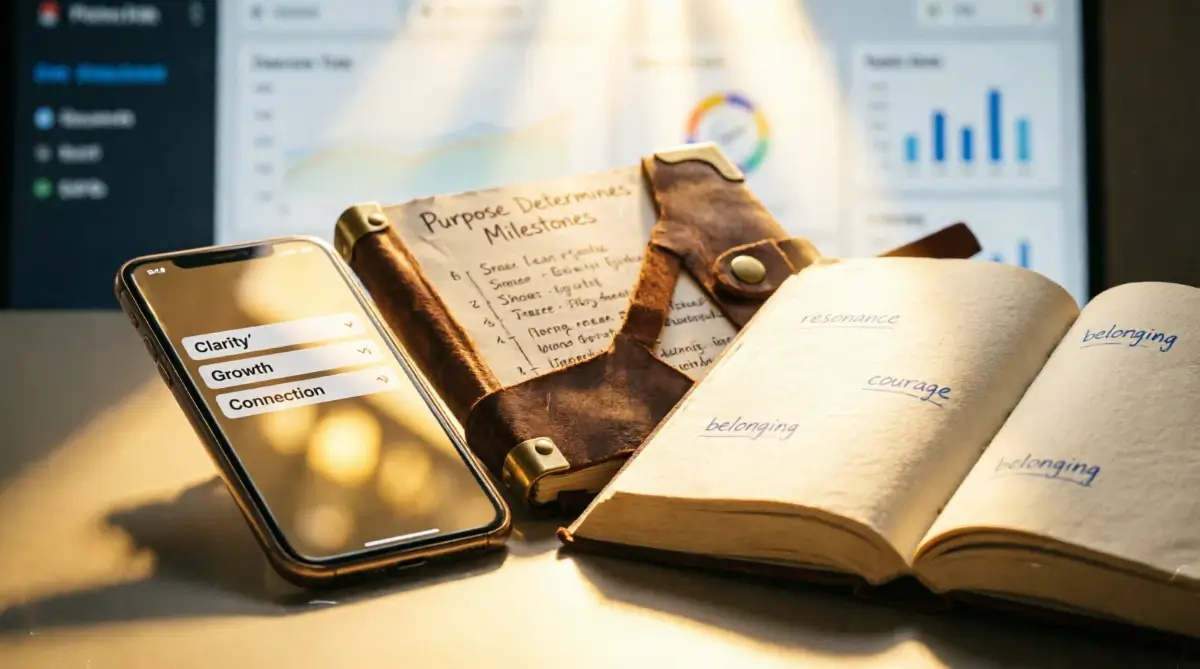
I measure real language learning progress without tests by observing how comfortably I can communicate with a native speaker. When I can express myself freely, without mental translation, without hesitation that breaks the flow of conversation, and without the stress of searching for words that refuse to arrive that is the milestone that matters. Tests and standardized frameworks like CEFR can provide a useful external reference, but they cannot tell you whether the language lives inside you.
They cannot tell you whether a native speaker will speak to you naturally, without slowing down or simplifying their words. They cannot tell you whether you will laugh at a joke in a foreign film because you understood it, not because you read the subtitles. These are the real measurements, and they are available to anyone who knows where to look.
I learned this through necessity. As a displaced person, communication was not an academic exercise. It was survival. I needed to speak, to understand, to connect. The CEFR levels I read about early in my journey were interesting, but they did not reflect my reality. I set unrealistic expectations based on those levels and felt like a failure when I could not reach them on the timeline I had imagined.
The shift came when I stopped measuring myself against a grid and started measuring myself against my own purpose. My purpose was communication. My milestones were the moments when communication became effortless, when a native speaker forgot I was a learner, when I felt the emotion of a story told in a language that was not my own.
Real progress is not a score on a test. It is the distance between who you were when you started and who you are when a native speaker speaks to you as an equal.
The CEFR Framework and Why It Was Not Enough for Me
When I first began learning languages seriously I discovered the CEFR the Common European Framework of Reference for Languages. It divides language ability into levels: A1, A2, B1, B2, C1, C2. Each level has descriptors. A1 means you can introduce yourself. B2 means you can hold a conversation on familiar topics. C2 means you are approaching native‑like proficiency. The framework is logical, structured, and widely respected. It is also, for someone in my position, incomplete.
The CEFR measures language as a set of competencies. It asks whether you can perform specific tasks under specific conditions. What it does not measure is the feeling of the language in your mouth, the ease with which words arrive, the moment when a native speaker stops adjusting their speech for you. These are not competencies. They are experiences. And they are the experiences that told me I was making progress, even when the CEFR grid said I was still at the same level.
I also found that the CEFR levels created a subtle pressure to compare myself to an ideal. I would read the B2 descriptor and think, “I cannot do all of this yet, so I must not be B2.” But I could do some things at B2, some at C1, and some still at A2. The grid was too rigid to capture the uneven, personal shape of my actual ability. I needed a different way to see my growth one that honored the complexity of real language use instead of reducing it to a checklist
The journey of learning to think directly in a language, without translating in your head is different for every learner and cannot be forced into a standardized pattern the grid is a map. My progress is the territory. The map is useful, but the territory is where I live.
The Milestone That Matters Most: Speaking Comfort
For me, speaking is the most important skill in any language. I did not choose this priority. My circumstances chose it for me. As someone who needed to communicate to survive, to build relationships, to navigate a new world, speaking was not optional. It was the first door I had to open. Everything else reading, writing, listening could come later. Speaking had to come first.
So my primary measure of progress became speaking comfort. I did not measure it with a timer or a rubric. I measured it with a single question: can I have a conversation with a native speaker without either of us feeling strained? When the answer moved from “no” to “sometimes” to “usually” to “yes, without thinking about it,” I knew I was progressing. The milestones were not letters on a certificate. They were the gradual disappearance of the barrier between me and the person I was speaking with.
Speaking comfort is not the same as perfection. I still make errors. I still search for words occasionally. But the errors no longer stop the conversation. The searching no longer creates awkward silence. The flow of communication continues, and the mistakes are absorbed into it like small ripples on a river. That is fluency not the absence of errors, but the ability to keep moving despite them.
When a native speaker forgets that you are a learner and speaks to you as they would to anyone else, you have passed the only test that matters.
The Native Speaker Mirror: How Others Reflect Your Progress
The most honest measure of my language progress is not my own assessment. It is the behavior of the native speakers I interact with. They are the mirror. When they slow down their speech, I know I still have work to do. When they simplify their vocabulary, I know I am not yet where I want to be. When they speak to me at full speed, with idioms, with humor, without any visible adjustment that is the moment I know I have arrived at a new level.
This mirror is more accurate than any test because it reflects real communication, not simulated tasks. A test can ask you to respond to a recorded prompt. It cannot tell you whether a native speaker will laugh at your joke or look confused by your word choice. The native speaker’s unguarded reaction is the rawest, most unfiltered feedback you will ever receive. I learned to pay attention to it, to value it, and to let it guide my practice.
I remember the first time a friend spoke to me in Russian without slowing down. He was telling me about his day, and halfway through the conversation, I realized I was not translating. I was just understanding. He had not paused for me. He had not chosen simpler words. He had simply talked, and I had simply listened. That moment was worth more than any CEFR certificate. It was the living proof that the language had taken root inside me.
How to train your ear to distinguish sounds and your mouth to produce them accurately is foundational to being understood but the proof of that training is not in a test score. It is in the face of a native speaker who hears you and responds without hesitation.
Listening Progress Measured by the Laugh That Escapes You
After speaking, listening became my next most important skill. I measured my listening progress not by comprehension tests but by my emotional responses. When I could listen to a podcast and follow the argument without straining, I knew I had improved. When I could watch a film and forget that I was watching it in a foreign language, I knew I had crossed a threshold. And when I could watch a comedy show and laugh at the same moment as a native speaker not because I read a subtitle, but because I understood the joke in real time that was the milestone that told me my listening had reached a new level.
Laughter is an honest signal. It cannot be faked. If you laugh a beat too late, it means you translated the joke before you understood it. If you laugh in unison with everyone else, it means the language entered your brain directly, without the detour through your native tongue. That direct path is the goal of all language learning. It is the state where the language is no longer foreign.
I now measure my listening progress by the number of moments when I forget I am listening to a foreign language. When the language becomes transparent, when the meaning shines through the words without conscious effort, I know I have progressed. The test is not a multiple‑choice quiz. It is a film, a song, a conversation that I absorb without resistance.
Reading Progress Measured by the Emotion You Feel
Reading is the skill that connects me to the culture behind the language. I measure my reading progress by a simple test: can I feel the emotion of the text? When I read a novel in a foreign language and feel sadness at a character’s loss, joy at their triumph, tension at their danger that is the evidence that I am reading, not decoding.
Decoding is what beginners do. They sound out words, piece together meanings, and emerge from a paragraph exhausted. Reading is what fluent speakers do. They absorb the text, hear the voice of the narrator, and respond emotionally without conscious effort. The transition from decoding to reading is gradual, but it is measurable.
I tracked it by the number of pages I could read before fatigue set in. At first, it was half a page. Then a full page. Then a chapter. Then I looked up and realized I had been reading for an hour without noticing the time.
That moment when the language disappears and the story remains is the milestone that tells me my reading has matured. No test can capture it. Only the experience of being lost in a book can confirm it.
Writing Progress and the Freedom of Accepting Imperfection
Writing is the skill I have always found most difficult. I still make mistakes in Persian, my native language. I have seen friends make similar mistakes in their own native languages. There are letters in some alphabets that look identical but change meaning and pronunciation depending on the sentence. My native language has those letters. Even after a lifetime of speaking and writing, I sometimes use them incorrectly. So why would I expect perfect writing in a language I am learning?
This realization freed me I stopped measuring my writing progress by grammatical accuracy and started measuring it by communicative effectiveness. Can I write a message that a native speaker understands? Can I express my thoughts in a way that conveys my meaning, even if the grammar is imperfect? If the answer is yes, I have made progress. The refinement can come later. The communication is what matters now.
I also measure my writing by the ease with which I can produce it. When I first start learning a language, writing a single sentence is a labor. I must think about every word, every ending, every preposition. As I progress, the sentences come faster. The labor becomes less. The writing becomes a tool rather than a task. That shift from labor to tool is the milestone I watch for.
The Purpose That Determines Which Milestones Matter
Not every learner needs to prioritize speaking. Not every learner needs to read novels or watch films without subtitles. The milestones that matter are the ones that align with your purpose. I needed speaking because my circumstances demanded it. Someone else might need reading for academic study. Another person might need listening for their work. The purpose determines the measurement.
I learned to ask myself: why am I learning this language? The answer became my compass. If my purpose was to connect with people, then my milestone was a conversation that felt natural. If my purpose was to access information, then my milestone was an article I could read without a dictionary. The purpose gave me permission to ignore milestones that did not serve me and focus intensely on the ones that did.
This approach is liberating it removes the pressure to be good at everything. You do not need to be a perfect writer to be a fluent speaker. You do not need to understand every film to read a book. The language is a tool. Measure it by how well it does the job you need it to do.
The only progress that matters is the progress that moves you closer to your purpose. Everything else is noise.
The Danger of Measuring Yourself Against a Standardized Grid
The CEFR and similar frameworks serve a purpose. They provide a common language for describing ability. They help institutions place students in appropriate courses. But they can also become a prison. When I measured myself against the CEFR grid, I was constantly aware of what I could not yet do. The gaps felt like failures. The levels felt like judgments.
The grid is not a judgment. It is a tool when I stopped treating it as a measure of my worth and started treating it as a rough map of the terrain, my relationship with it changed. I could look at the B2 descriptors and say, “I can do most of these things, but not all. That means I am somewhere in the B2 range. That is useful to know.” The grid became information, not evaluation.
The danger is not the grid itself. It is the tendency to outsource your self‑assessment to an external standard the grid cannot tell you whether you are making progress in the ways that matter to your life. Only you can do that the practice of keeping a visible record of your accomplishments a journal, a recording, a folder of completed lessons is a more accurate measure of growth than any external scale.
The Real Milestones I Use to Track My Progress
Over years of learning languages I have identified a set of personal milestones that tell me more than any test score. I share them not as a template, but as an example of what self‑measurement can look like.
The first milestone is the conversation that flows. When I can speak with a native speaker for thirty minutes without either of us feeling strained, I know I have reached a functional level of speaking. The second milestone is the laugh that comes naturally. When I watch a comedy and laugh at the right moment, I know my listening has passed a threshold. The third milestone is the book that holds my attention. When I read a chapter without reaching for a dictionary, I know my reading is maturing.
The fourth milestone is the native speaker who forgets I am a learner. When someone who has known me for a long time stops adjusting their speech, stops using simpler words, stops checking whether I understand that is the milestone that tells me I have arrived. They are no longer speaking to a learner. They are speaking to a speaker.
The fifth milestone is the emotion I feel. When a story makes me sad, a song makes me nostalgic, a poem makes me pause that is the evidence that the language has entered my heart, not just my brain. The emotional connection is the final measure of real progress. It cannot be tested. It can only be experienced.
These milestones are not on any exam. They are written in the moments when the language stops being a subject and becomes a part of your life.
The Milestone of Understanding Humor Without Explanation
I remember the first time I watched a comedy show in Russian and laughed at the same moment as the audience. Not because I read a subtitle, but because the joke landed in my brain directly, without translation. That laugh was a milestone. It told me that my listening had crossed a threshold, that the language had become fast enough, deep enough, familiar enough to carry humor the most delicate and culture‑bound form of communication.
Humor is the ultimate test of language progress. A joke requires vocabulary, grammar, cultural reference, timing, and emotional recognition. If any of those pieces is missing, the joke falls flat. You might understand the words but miss the meaning. You might get the meaning but miss the timing. When all the pieces come together and you laugh spontaneously, in unison with native speakers, you have achieved something that no multiple‑choice test can measure.
I now treat the ability to understand humor as one of my primary milestones. When I can watch a stand‑up comedian and follow the set without straining, when I can catch the sarcasm in a friend’s voice, when I can read a satirical article and appreciate the layers of irony I know my language ability has matured. These moments cannot be engineered. They emerge from hundreds of hours of exposure, from the slow accumulation of cultural knowledge, from the deepening familiarity that turns a foreign language into a second home.
The journey to understanding humor is a personal one; it cannot be forced into someone else’s timeline the laugh that escapes you is proof that the language has entered your bones.
The Role of Consistency in Making Milestones Visible
Milestones do not appear on a schedule they emerge from the accumulation of daily practice. The learner who practices for thirty minutes every day will eventually reach milestones that the learner who practices for three hours once a week may never see. Consistency is the engine that makes progress visible.
I learned this through experience when I practiced sporadically, I would sometimes feel like I was improving and sometimes feel like I was regressing. The inconsistency made it impossible to measure progress because there was no stable baseline. When I committed to daily practice, the fluctuations smoothed out. I could see the trend. It was upward, slowly but unmistakably.
The daily practice does not need to be intensive. It needs to be regular. Fifteen minutes of speaking aloud, ten minutes of listening, five minutes of reading. The small doses, repeated daily, compound into milestones that feel almost magical when they arrive consistency over intensity is what compounds into lasting fluency and the learner who practices daily with modest effort will surpass the learner who practices intensely but irregularly.
The Milestone of Using the Language Without Thinking About It
There is a moment when the language shifts from being something you use to being something you inhabit. You are not selecting words. You are not constructing sentences. You are simply communicating, and the language is the medium, not the message. This moment is the culmination of all the smaller milestones.
I first experienced this with English, years after I began learning. I was in the middle of a conversation, and I realized I had been speaking for several minutes without a single conscious thought about the language. I had been focused entirely on what I wanted to say, not on how to say it. The language had become transparent. That transparency is the ultimate milestone.
It does not mean I never make mistakes. It means the mistakes are part of the flow, not interruptions to it. It means the language is a tool I can use without examining the tool. It means I am no longer a learner of the language. I am a speaker of it.
The moment you stop thinking about the language and start thinking in it, you have crossed the border from studying to living.
Measuring Progress in a Language With a Different Alphabet
Some languages have alphabets that look completely different from the Latin script I grew up with. In those languages, a single letter can change meaning and pronunciation depending on its position in a word or the sentence context. My native language, Persian, has those letters. Even now, I make occasional mistakes with them.
This experience taught me that writing is often the last skill to mature, and that imperfection in writing is normal even for native speakers. When I learn a new language with a different script, I do not measure my progress by perfect spelling. I measure it by whether I can read a sign, write a message, and be understood. The refinement comes with time. The functional ability is the milestone.
If you are learning a language with a different writing system, give yourself permission to be imperfect. The native speakers of that language also make mistakes. The goal is communication, not calligraphy learning sentence patterns and practicing them until they become automatic is more effective than obsessing over perfect spelling.
The Milestone of Feeling the Culture Through the Language
Language carries culture. When I read a poem and feel the weight of its history, when I hear a song and understand why it moves people, when I watch a film and recognize the social codes that shape the characters’ behavior these are milestones of cultural understanding that no language test measures.
I now include cultural comprehension in my self‑assessment. Can I understand why a particular phrase is funny? Do I know what historical event a speaker is referencing? Can I sense the politeness level of a conversation and adjust my own speech accordingly? These are advanced skills, but they are real, and they are signs of deep progress.
The cultural milestones are the ones that make the language feel like home. They are the reason I continue learning long after I have reached functional fluency. The language is not just a tool. It is a doorway into a world, and every cultural insight is a step further inside.
The Danger of Waiting for a Certificate to Validate Your Progress
A certificate is a piece of paper. It can open doors for university admission, for job applications, for visa requirements. If you need a certificate for a specific purpose, pursue it. But do not wait for a certificate to tell you that you have made progress. By the time you can pass a CEFR exam, you have already been making progress for months or years. The certificate is a confirmation of what you already know.
I have seen learners delay their own sense of achievement because they were waiting to pass a test. They would say, “I will feel fluent when I have my B2 certificate.” But fluency is not a piece of paper. It is a lived experience. The certificate is evidence of that experience, not the experience itself.
If a certificate serves your goals, get it. But do not let its absence prevent you from recognizing how far you have come. The real milestones are happening every day, in your conversations, your reading, your listening. Notice them. Celebrate them. They are the proof.
How to Start Measuring Your Own Progress Today
If you want to measure your language progress without tests, begin with a simple question: what is my purpose? Write it down. Then identify the milestones that align with that purpose. If your purpose is speaking, your milestone is a conversation that flows. If your purpose is reading, your milestone is a book that holds your attention. If your purpose is listening, your milestone is a film you understand without subtitles.
Once you have identified your milestones, track them. Keep a journal. Record yourself speaking and listen to the recordings months later. Note the moments when a native speaker reacts to you differently than before. Note the first time you laugh at a joke. Note the first time you dream in the language. These are your data. They are more meaningful than any test score.
Review your data regularly. Every month, look back at where you were and compare it to where you are. The progress will be visible. It may not be dramatic, but it will be real. And real progress, acknowledged and celebrated, is the fuel that keeps you moving forward.
You do not need a test to tell you that you are growing. You need a mirror. The mirror is your own experience, honestly observed.
The Freedom of Measuring Progress on Your Own Terms
When I stopped measuring myself against external standards and started measuring myself against my own purpose, I felt a sense of freedom. I was no longer chasing someone else’s definition of success. I was defining it for myself. My milestones were personal, meaningful, and achievable. They reflected my life, my needs, my journey.
That freedom transformed my relationship with language learning. It stopped being a race and became a practice. The pressure to reach a certain level by a certain date evaporated. What remained was the daily satisfaction of noticing small improvements, of feeling the language become a little more my own with each passing week.
I invite you to claim that freedom for yourself. You are the authority on your own progress. The tests and frameworks are tools, not judges. Use them if they help. Ignore them if they do not. The only measure that matters is the distance you have traveled from where you started. And that distance is something no one else can measure for you.
The journey is yours. The milestones are yours. The progress is yours. Claim it.
The Milestone of Dreaming in the Language
One of the strangest and most wonderful milestones I have experienced is the first dream in a foreign language. It does not happen on command. It happens when the brain has absorbed enough of the language to process it unconsciously during sleep. When I woke from a dream in Russian, hearing the words still echoing in my mind, I knew something had shifted. The language had crossed from the conscious, effortful part of my brain into the deeper, automatic part.
Dreaming in a language is not a measure of fluency. The dreams are often fragmented, grammatically incorrect, full of nonsense. But they are a signal. They tell me that the language is no longer a foreign object I am manipulating. It is becoming part of my internal world. That integration is a milestone I value highly, even though no test would ever measure it.
If you have not yet dreamed in your target language, do not chase it. It arrives when it arrives. But when it does, notice it. Write it down. It is a sign that your practice is working at a level beneath conscious control.
Measuring Progress Through the Plateau
The plateau is the most dangerous phase of language learning. It is the long stretch where progress feels invisible. You are practicing daily, but you do not feel any different from last month. The milestones that were once frequent now seem rare. This is when many learners quit.
I learned to measure progress through the plateau by changing the scale of my observation. Instead of looking for monthly improvements, I looked for quarterly ones. Instead of comparing my speaking to last week, I compared it to six months ago. The longer timeframe revealed progress that the daily view obscured. I could hear the difference in old recordings. I could see the difference in old journal entries. The plateau was not a flat line. It was a gentle slope that only became visible from a distance.
The plateau also taught me to value consistency over results. When the results are invisible, the practice itself becomes the measure. Did I practice today? Then I made progress, even if I cannot see it yet. The daily practice is the deposit. The visible milestone is the interest. The interest accrues slowly, but it accrues.
The plateau is not a sign that you have stopped learning. It is a sign that the learning has moved underground, where roots grow before branches.
The Difference Between Active and Passive Progress
I distinguish between active and passive skills when I measure my progress. Active skills speaking and writing require production. They are harder and develop more slowly. Passive skills listening and reading require recognition. They develop more quickly and often outpace active skills.
This gap between passive and active ability is normal. I can understand a podcast that I could not have understood a month ago, but I still struggle to express the same ideas in speech. The listening has progressed. The speaking has not yet caught up. If I measured only my speaking, I would miss the real progress in my listening. If I measured only my listening, I would be frustrated by my speaking.
I now measure each skill separately. I track listening milestones, reading milestones, speaking milestones, and writing milestones. They move at different speeds, and that is fine. The language is not a single ability. It is a collection of abilities, each with its own timeline.
Recording Your Voice to Make Progress Audible
One of the most effective ways to measure speaking progress is to record yourself regularly. I record a short monologue perhaps a minute long every month. I describe my day, my thoughts, or a topic I am interested in. I do not prepare. I just speak. Then I save the recording.
Months later, I listen to old recordings. The difference is striking. The voice on the recording from six months ago hesitates more, makes more errors, and sounds less natural. The voice on the recording from last week is smoother, more confident, more fluent. I would not have noticed the change without the recordings because the daily shifts are too small to perceive. The recordings compress time and make progress audible.
This practice is simple, free, and requires only a smartphone. I recommend it to anyone who wants to see or hear their progress in a way that feels real and undeniable the technique of recording your own voice and comparing it to native speakers is also a powerful tool for improving pronunciation.
Measuring Progress Without Access to Native Speakers
Not everyone has regular access to native speakers. I did not, for long periods. During those times, I measured my progress in other ways. I measured it by the number of podcast episodes I could follow without pausing. By the number of pages I could read without a dictionary. By the speed with which I could write a journal entry. By the feeling of the language in my mind was it still foreign, or was it becoming familiar?
These measures are indirect. They do not replace the native speaker mirror. But they are real, and they kept me going when I had no one to talk to. If you are learning without native speakers, do not let that stop you from measuring your progress. The milestones of listening, reading, and writing are available to you. Track them. Celebrate them. They are the proof that you are moving forward.
The Milestone of Switching Between Languages Effortlessly
As a polyglot, I measure my progress not just in individual languages but in my ability to move between them. When I can switch from Persian to English to Russian without mental friction, I know that each language has its own solid place in my mind. The switching is a meta‑skill that develops over time. At first, switching is clunky. Words from one language intrude into another. I forget which language I am speaking. But with practice, the boundaries become clear.
I now test my progress by deliberately switching between languages. I might have a conversation in Russian for ten minutes, then switch to Turkish, then back to Russian. If the transitions are smooth, I know my proficiency in both languages is stable. If one language feels sticky or slow to activate, I know it needs more attention.
This ability to switch is one of the most satisfying milestones to become a polyglot. It is the proof that the languages are not competing for space in my mind. They are coexisting, each ready to be called upon when needed.
The Milestone of Teaching Others
One of the final milestones I have experienced is the ability to help another learner. When someone asks me a question about a language I speak, and I can explain the answer clearly, I know I have internalized that aspect of the language. Teaching forces you to organize your knowledge, to make it explicit, to understand it at a deeper level than mere use requires.
I do not consider myself a teacher, but I have been asked for help by other learners. Each time I am able to provide it, I recognize it as a milestone. The language has become not just something I use, but something I understand well enough to share. That is a level of mastery that no test could fully capture.
When you can help someone else along the path you have walked, you have arrived at a destination worth reaching.
The Danger of Measuring Only What Is Easy to Measure
Tests measure what is easy to measure: vocabulary size, grammatical accuracy, comprehension of controlled texts. They do not measure what is hard to measure: comfort, spontaneity, emotional connection, cultural understanding. If I only measured my progress by what tests can capture, I would miss the most important parts of my growth.
I have learned to value the unmeasurable. The feeling of ease when I speak. The pleasure of understanding a joke. The satisfaction of reading a poem and feeling its weight. These experiences are the real rewards of language learning, and they are invisible to any external assessment.
Do not let the availability of tests narrow your definition of progress. The most meaningful milestones are the ones you feel, not the ones you can score. Pay attention to them. They are the reason you began this journey.
The Role of Regular Self‑Assessment Without Judgment
Once a month, I sit down and review my progress without judgment. I do not ask, “Am I where I should be?” I ask, “Am I further than I was?” The answer is almost always yes. The journal entries are longer. The recordings are smoother. The conversations are easier. The native speakers correct me less often.
This monthly review is not a test. It is a celebration. It is a deliberate act of noticing how far I have come. It counteracts the brain’s tendency to focus on what is still missing and reminds me of what I have already achieved. That reminder is fuel for the next month of practice.
I recommend this practice to every learner. Once a month, look back. Do not judge. Just notice. The progress is there, even when it feels invisible. The act of looking for it makes it real.
The Milestone of Thinking in the Language During Everyday Tasks
When I catch myself thinking in the target language while doing something ordinary making coffee, walking to the store, planning my day I know the language has integrated into my daily life. These spontaneous thoughts are not planned. They arise naturally, triggered by the same everyday situations that would trigger thoughts in my native language.
I now treat these moments as milestones. The first time I caught myself thinking in Russian while cooking, I stopped and smiled. The language had followed me into the kitchen. It was no longer confined to study sessions. It was part of my life.
These spontaneous thoughts are a sign that the language is becoming automatic. The brain is choosing to use it without being told. That autonomy is the goal of all language learning the ability to use the language without conscious effort. When it happens, even in small ways, it is worth celebrating.
The Milestone of Understanding Regional Accents and Dialects
A deeper milestone I have learned to recognize is the ability to understand different regional accents and dialects within the same language. When I first start learning a language, I can only understand the standardized version the clear, slow speech of a teacher or a news presenter. As my listening improves, I begin to catch variations. The accent from one region. The slang from another. The rapid speech of a particular city.
When I can follow a conversation between speakers from different regions, I know my listening has reached an advanced level. The language is no longer a single, uniform thing. It is a landscape of variations, and I can navigate it. This milestone is especially satisfying because it confirms that my ear has become flexible enough to handle the real, messy, diverse way that people actually speak.
The Journey Continues Beyond Every Milestone
Every milestone I reach reveals a new horizon. When I can speak comfortably, I want to speak eloquently. When I can read a novel, I want to read poetry. When I can understand a film, I want to understand the cultural references that a native speaker would know. The journey does not end. It deepens.
This is not a reason for despair. It is a reason for wonder. The language is an infinite landscape. There is always more to explore, more to learn, more to feel. The milestones are not finish lines. They are viewpoints along a path that extends as far as I am willing to walk.
I measure my progress not by how close I am to the end here is no end but by how far I have come from the beginning. The distance behind me is the proof. The path ahead is the invitation.
The CEFR grid sits on my shelf, untouched. The real measures of my progress are in my ears, in my mouth, in the conversations I have every day. They are in the laughter I share with native speakers, the books I read without strain, the thoughts that form spontaneously in languages that were once completely foreign.
That is how I measure real language learning progress without tests. Not with a score. Not with a level. With a life that has expanded to include new worlds.
The Ultimate Milestone: When the Language Becomes Your Own
There is a moment when a language stops being something you are learning and becomes something you own. It is not a single event. It is a gradual shift that you only notice in retrospect. You realize that you have not thought about grammar in weeks. You have not translated in your head in months. You have simply been using the language, living in it, as if it were your own.
That moment is the final milestone I measure. It is not the end of learning. There is always more to learn. But it is the end of the feeling that the language is foreign. It has become familiar. It has become a part of your identity. You are no longer a visitor. You are a resident.
I have reached that moment with several languages. Each time, it feels like coming home. The language that once seemed impossibly distant is now a room I can enter without knocking. The door is open. The light is on. The voices inside are speaking, and I understand every word.
The measures I have described are available to anyone. They require no registration, no fee, no appointment. They require only that you pay attention to your own experience. Notice when a native speaker stops simplifying their speech. Notice when you laugh at a joke without subtitles. Notice when you dream in the language. Notice when you help another learner. These are the real signs of progress. They are happening all around you, every day, if you know where to look.
The tests will always be there if you need them. But the progress is here, now, in the life you are living with the language. Measure it. Celebrate it. Let it carry you forward.