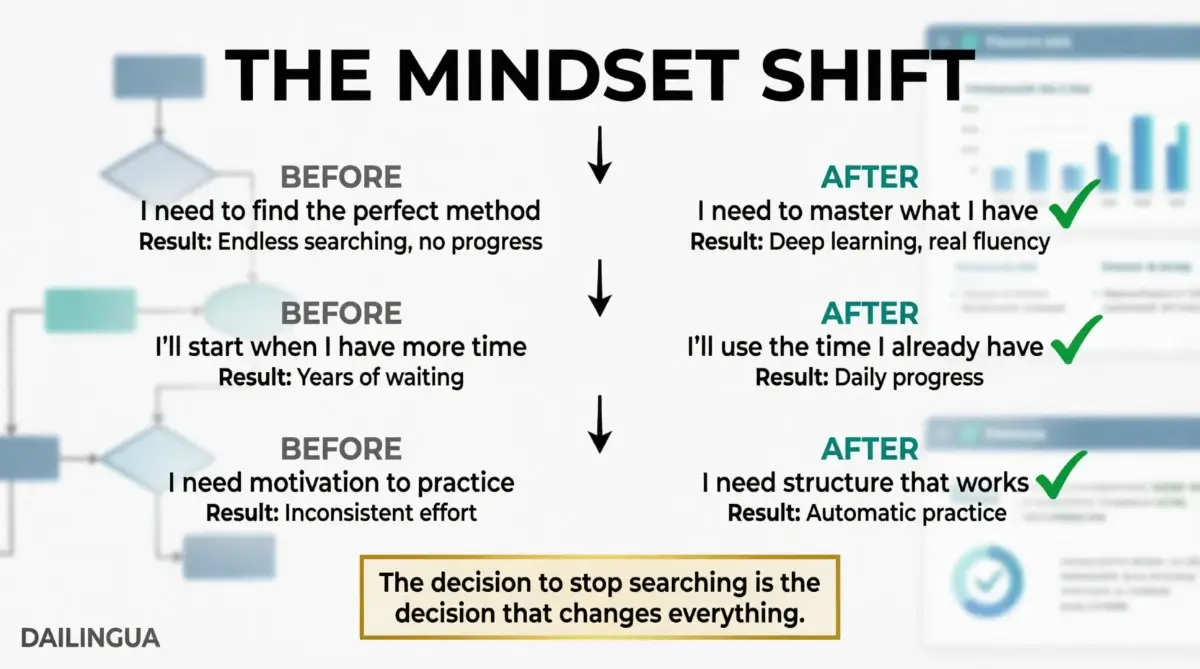
The biggest hidden mistake beginner language learners make is searching for a cheat code that does not exist. I made this mistake for years. Every time a new course promised rapid results, I bought it. Every time an app claimed to have a secret method, I downloaded it. Every time a social media post showed someone speaking a new language after what seemed like a short period, I felt like I was failing because my path looked nothing like theirs.
The search for a shortcut consumed my energy and left me with a collection of half‑finished resources and a language ability that had barely moved. The mistake was not in wanting to learn efficiently. It was in believing that efficiency could replace time, that a magic combination of tools could bypass the hours of practice that every fluent speaker has invested.
This article is about that mistake and the others that accompany it. It is not about which course to choose or which app to download. It is about the hidden traps that keep beginners cycling between excitement and disappointment, always starting over and never building momentum. I fell into every one of these traps. I climbed out by accepting a truth I had been avoiding: language learning is not a puzzle to be solved with the right method. It is a long, slow, deeply personal process that rewards commitment far more than cleverness.
The cheat code you are looking for does not exist. The only code that works is the one you write yourself, day after day, with the resources you already have.
The Trap of Believing in a Magic Method
When I first started learning English, I was overwhelmed by the number of resources available. Every course I found online promised something extraordinary. Some said I could become conversational in a very short time. Others claimed their method was based on science and would transform my brain. The promises were intoxicating. I believed each one, at least for the first week. Then, when the promised results did not appear, I moved on to the next one. I was not learning. I was collecting methods.
The truth that took me years to understand is that no resource can transfer a language into your memory. A great course can explain grammar clearly. A great app can make vocabulary review efficient. But neither can do the work for you. The work is yours. The course is a map. The walking is still required. Believing otherwise is the trap. It keeps you searching for the perfect map instead of walking with the one you have.
This is not to say that resources do not matter. They do. [Learning sentence patterns rather than isolated words, and drilling them until they become automatic, is a far more effective use of time than memorizing vocabulary lists a well‑structured resource accelerates your progress. But it does not eliminate the need for progress. The distinction is critical. A faster car still requires you to drive it. A better course still requires you to study it. The magic method is a fantasy. The good method is a tool. Use the tool. Stop waiting for the fantasy.
Why the Quick Fluency Promise Is So Seductive
The promise of quick fluency is seductive because it speaks to a genuine desire. We want to communicate. We want to connect. We want the barrier between ourselves and another culture to dissolve as quickly as possible. There is nothing wrong with wanting speed. The problem is that the promise of speed is almost always attached to something for sale. A course. A subscription. A dream.
The people selling these promises are not necessarily lying. Some of them achieved impressive results. But what they rarely share is the full context of their achievement. A person learning in the United States with access to top‑tier courses, immersion programs, and private tutors has a different reality from a person in a low‑income country earning a hundred or two hundred dollars a month. The resources available, the time available, the energy available after a day of work all of these shape the timeline. No one can guarantee your fluency in a specific period because your circumstances are unique.
I learned to stop comparing my journey to posts on social media. The person who posts about learning Spanish or Russian in a certain time period does not reveal the reality behind the grinding and practicing, nor what resources or course materials they used. Their results are real, but their path is invisible. Comparing your beginning to their carefully curated highlight is a recipe for discouragement. The only valid comparison is between the you of today and the you of yesterday. Have you practiced? Then you are moving forward.
The timeline of someone else’s success tells you nothing about your own. Focus on your own daily practice, and let the results arrive when they arrive.
The Cost of Jumping From One Resource to Another
The most expensive mistake I made was not financial. It was the loss of momentum. Every time I switched from one course to another, I reset my progress. I would spend the first few weeks of a new program re‑learning material I had already covered elsewhere, just in a different order. The overlap was not progress. It was a treadmill.
Method‑hopping creates an illusion of activity. You feel busy. You feel like you are trying everything. But you are not building anything. You are digging a hundred shallow holes instead of one deep well. The learner who commits to a single course and completes it, even if the course is imperfect, will know more than the learner who samples ten courses and finishes none. The depth of engagement matters more than the breadth of exposure.
I now follow a rule that protects me from this trap. Before I abandon any resource, I must complete it to at least eighty percent. If I still feel it is not serving me after that, I can move on. But I cannot quit in the middle because something new looks more exciting. The excitement of the new is a liar. It fades. The discipline of finishing is what builds the foundation for everything that follows. This principle aligns with the larger truth that consistency over intensity is what compounds into lasting fluency and the learner who practices daily with an imperfect resource will outperform the learner who waits for the perfect one.
The Hidden Mistake of Expecting One Resource to Cover Everything
Even after I committed to a single course, I made a related mistake. I expected that course to teach me everything. When it did not, I felt cheated. I thought the course was incomplete. The reality is that no single resource can cover every aspect of language learning. One course may excel at grammar but provide little speaking practice. Another may offer excellent listening exercises but neglect writing. The solution is not to abandon the course. It is to supplement it after you have mastered its core content.
I now treat my primary resource as the spine of my learning. I work through it systematically until I can use the material automatically. Only then do I look for a secondary resource to address a specific gap. If my listening is weak, I find a podcast‑based method learning languages through audio, even when I understand very little at first trains the ear in ways that textbooks cannot out I do not add that resource until the spine is solid. The spine provides structure. The supplements provide depth. Without the spine, the supplements are just scattered pieces.
This approach prevents the chaos of trying to do everything at once. It respects the limits of my time and attention. And it acknowledges that language learning is a process of layering, not a single event. You build a foundation. You add walls. You furnish the rooms. Each stage requires different tools. But you cannot build the walls before the foundation is set. Master your primary resource first. Then expand.
The Trap of Unrealistic Expectations Set by Others
Social media is flooded with language learning success stories. Some are genuine. Some are exaggerated. All of them are incomplete. They show the result without showing the process. They show the summit without showing the climb. For a beginner, this creates a distorted picture of what learning a language actually feels like day to day.
I remember scrolling through posts from learners in tier‑one countries who claimed they had reached conversational fluency in what seemed like an impossibly short period. The posts showed confident speech, smiling faces, and screenshots of language app streaks. What those posts never showed was the reality behind the grinding the hours of daily practice, the private tutoring sessions, the immersion programs, the financial resources that made it all possible. I did not have those resources. I was comparing my journey to someone else’s without understanding the hidden advantages they had.
The mistake was not in being inspired it was in expecting my results to match theirs on their timeline the journey of learning to think directly in a language,l without translating in your head, is different for every learner and cannot be forced into someone else’s schedule I learned to be inspired by others without measuring myself against them. Their success proves that the destination exists. It does not prescribe the route. Your route is your own, shaped by your resources, your time, your purpose, and your patience.
Let the success of others be a light on the horizon, not a shadow over your own path.
The Socioeconomic Reality That No One Talks About
There is an uncomfortable truth in language learning that is rarely discussed openly. The resources available to a learner in a high‑income country are fundamentally different from those available to a learner in a low‑income country. A person in the United States or the United Kingdom can access premium courses, private tutors, immersion programs, and native speaker communities with relative ease. A person earning one or two hundred dollars a month in a developing economy cannot. Their language learning budget might be zero.
This disparity does not make one learner better than another. But it makes their journeys incomparable. When I see a post from someone in a tier‑one country claiming fluency in a short time, I now ask: what resources did they have that I did not? The answer often reveals that their timeline was accelerated by circumstances I could not replicate. That is not a reason to despair. It is a reason to adjust expectations.
I learned to work with what I had. I used free apps, digital books, online communities, and the spare minutes of my day creating a language learning environment inside my daily life using whatever spaces and tools were available to me, made consistent practice possible even on a tight budget the environment was not expensive. It was creative. It turned my bathroom mirror into a pronunciation coach and my kitchen counter into a vocabulary station. The resources were limited, but the ingenuity was not.
The lesson is not to resent the disparity. It is to recognize it, adjust your expectations accordingly, and focus on what you can control. Your journey will take longer than someone with more resources. That is not a reflection of your ability. It is a reflection of reality. Accept the reality and work within it.
The Hidden Mistake of Learning Without a Clear Purpose
I started learning languages because it seemed like a valuable skill. That vague motivation was not enough to sustain me through the difficult months when progress felt invisible. When the novelty wore off, I had no deeper reason to continue. I drifted. I stopped and started. I almost quit entirely.
The learners who succeed are not necessarily the most talented. They are the ones with a purpose that outlasts the novelty. Some learn to connect with family. Some learn for career advancement. Some learn because they fell in love with a culture. The purpose does not need to be grand. It needs to be specific and personal. A purpose that is tied to your identity or your relationships will survive the days when the language feels impossibly hard.
I found my purpose gradually. At first, it was simply to prove that I could do it. That was enough to start but not enough to continue. Over time, my purpose deepened. I wanted to read literature in the original language. I wanted to speak with people in their native tongue and see their faces light up with recognition. That purpose became the fuel that kept me going through the silent months when no one was reading my practice sentences and no one was applauding my progress.
A strong purpose also protects you from the trap of method‑hopping. When you know why you are learning, you are less tempted by every new promise that appears in your feed. You can evaluate resources against your purpose. Does this tool bring me closer to my goal? If not, you ignore it. The purpose is the filter that keeps your learning focused the learner who finds a meaningful reason to continue will always outlast the learner who is chasing a vague idea of self‑improvement.
The Mistake of Giving Up Before the Purpose Kicks In
Many learners give up in the early months, before they have had time to discover their deeper purpose. They hit the first plateau, feel the frustration of slow progress, and decide the language is not for them. What they do not realize is that the purpose often reveals itself only after you have invested enough time to care deeply about the outcome.
I nearly quit several times in my first year of learning English. The only thing that kept me going was that I had no other choice. I was not in a position where I could afford to give up. That lack of choice was, in retrospect, a gift. It forced me to continue long enough for the purpose to emerge. By the time I had a real reason to learn connection, opportunity, identity I had already built the habits that would carry me forward.
If you are in the early stages and feel like quitting, I would say this: give yourself enough time for the purpose to find you. Do not quit before you have a reason to stay. The reason will come, but only if you continue long enough to meet it.
The purpose you need to sustain your learning may not exist yet. It is built through the act of learning itself. Keep going until it appears.
The Mistake of Not Mastering One Resource Before Moving On
The biggest hidden mistake is the one I described at the start looking for a magic method. But the practical expression of that mistake is the failure to master any single resource. I would complete the first few lessons of a course, feel that I had understood the basics, and then abandon it for something that promised to take me further. I was a perpetual beginner. I knew the first chapter of five different textbooks but had never seen the final chapter of any of them.
The solution is simple to describe and difficult to execute: stick to your current language material, whatever it is, until you have mastered it. Mastery does not mean perfection. It means you can use the material automatically, without hesitation, in real communication. When you can produce the sentences from the course without thinking, when you can understand the audio without straining, when the vocabulary has become part of your active recall then you are ready to move on.
This principle applies to any resource. A textbook. An app. A video series. Master it first. Then find another one. The accumulation of mastered resources, layer by layer, builds a fluency that no single resource could provide a self‑correcting practice structure that moves lessons through stages of active practice, review, and long‑term memory is one way to ensure that you are truly mastering material before moving forward whatever structure you use, the key is the same: depth before breadth.
The Mistake of Treating Language Learning as a Short‑Term Project
Language learning is not a project with a finish line. It is a practice that continues for as long as you want to use the language. The mindset of “I will learn Spanish in six months and then I will be done” is a setup for disappointment. You will never be done. There will always be more vocabulary to learn, more cultural nuances to understand, more depth to explore.
I learned to embrace this. The endless nature of language learning is not a burden. It is a freedom. There is no deadline. There is no final exam. There is only the daily practice and the gradual, satisfying accumulation of skill. When I stopped treating language learning as a race, I started enjoying it. The enjoyment made the practice sustainable. The sustainability produced the results I had been chasing with all the wrong methods.
This shift in perspective is captured in the idea that [the journey of learning to think directly in a language is not a single event but a gradual transformation that happens over months and years the timeline is long. The process is slow. But the direction is forward, and every small step counts.
The language is not a mountain to be climbed and conquered. It is a landscape to be explored, a place to live in for the rest of your life.
The Mistake of Ignoring the Fun in Favor of the Efficient
In my obsession with finding the fastest method, I drained the joy from learning. I treated every practice session like a workout something to be endured for the sake of a future result. I forgot that the process itself could be enjoyable. When I finally allowed myself to engage with the language in ways that felt like play watching shows I loved, listening to music, talking with people about topics I cared about my progress accelerated. Not because the methods were more efficient, but because I practiced more often and with more attention.
The most effective method is the one you will actually use. A scientifically optimized flashcard system that you dread opening is less effective than a messy conversation with a patient native speaker that you look forward to. The enjoyment is not a distraction from learning. It is the fuel that keeps the engine running.
I now choose resources based partly on how much I enjoy them. If a textbook feels like a chore, I find a digital version with audio and interactive exercises that engages me. If a flashcard app feels like punishment, I replace it with physical cards on my mirror and kitchen counter a practice that turns daily routines into language exposure without feeling like work the method that brings a small amount of joy into each session is the method that will survive the months and years required to reach fluency.
The Mistake of Comparing Your Beginning to Someone Else’s Middle
Every expert was once a beginner. Every fluent speaker once struggled to form a single sentence. The highlight reels on social media do not show the years of stumbling that preceded the confident speech. They do not show the thousands of forgotten words, the awkward conversations, the moments of wanting to quit.
When I compared my first month of learning to someone else’s third year, I felt inadequate. I did not realize that the gap was not in talent but in time. They had simply been walking the path longer than I had. The only fair comparison is between my current self and my past self. Had I improved since last month? Could I understand a little more than I could before? Those were the measures that mattered.
This perspective is liberating. It releases you from the pressure of competing with strangers on the internet. Your journey is yours. Your pace is yours. The only thing that matters is that you are still moving forward.
Do not measure yourself against the highlight reel of someone who started years before you. Measure yourself against the person you were yesterday. That is the only comparison that tells the truth.
The Mistake of Believing That Fluency Is a Single Destination
I used to think of fluency as a switch. One day I would not be fluent, and the next day I would be. That image was reinforced by the marketing of language courses that promised to “make you fluent.” But fluency is not a switch. It is a spectrum. You can be fluent in everyday conversation and still struggle with technical vocabulary. You can be fluent in reading and still hesitate when speaking. You can be fluent in a professional context and still miss cultural references in casual conversation.
Accepting that fluency is a spectrum removed the pressure of reaching a mythical finish line. I stopped asking “Am I fluent yet?” and started asking “Can I do more today than I could last month?” The answer was almost always yes. The accumulation of those small yeses, over years, produced a level of ability that looked like fluency from the outside. But from the inside, it felt like a gradual expansion of what I could understand and express.
This shift also made me a better learner. When I stopped chasing the label of fluency, I started focusing on specific skills. I wanted to understand podcasts without straining. I wanted to read a novel without a dictionary. I wanted to tell a joke and make someone laugh. Each of those goals was achievable. Each one, when reached, felt like a genuine milestone. The pursuit of specific, concrete abilities replaced the vague and anxious pursuit of “fluency.”
The Mistake of Not Building a Practice Structure That Outlasts Motivation
Motivation is a wave. It rises and falls. If your practice depends on motivation, your practice will rise and fall with it. The solution is to build a structure that functions even when motivation is absent. I learned this the hard way. During periods of high motivation, I would practice for hours. During periods of low motivation, I would do nothing for weeks. The inconsistency prevented me from building lasting skill.
The structure I eventually built was simple. It did not rely on my feelings. It relied on triggers in my environment. A card on my mirror that I had to see every morning. A flashcard app that sent me a notification at the same time each day. A podcast that downloaded automatically and played during my commute. These triggers did not ask me whether I felt motivated. They simply presented the opportunity to practice, and I took it.
This is the principle behind creating a language learning environment inside your daily life turning ordinary spaces and routines into practice triggers that make engagement inevitable the environment does the work of reminding you. All you have to do is respond. Over time, the response becomes automatic. The practice continues through the peaks and valleys of motivation, and the language grows steadily as a result.
Build the structure. The motivation will come and go. The structure will remain.
The Mistake of Not Speaking Because You Are Afraid of Mistakes
Fear of mistakes kept me silent for a long time. I wanted every sentence to be perfect before I let it leave my mouth. The result was that very few sentences ever left my mouth. I was practicing in private, accumulating vocabulary and grammar rules, but never testing them in real communication. When I finally did speak, I froze. The words I knew perfectly in my head refused to come out under pressure.
The solution was to accept imperfection. I started speaking before I was ready. I made mistakes in every sentence. Native speakers corrected me gently, and I learned from those corrections far more effectively than from any textbook. The fear did not disappear, but it diminished with each conversation. I realized that the fear of mistakes was far worse than the mistakes themselves.
This is not to say that pronunciation and grammar do not matter. They do, training your ear to distinguish sounds and your mouth to produce them accurately is foundational to being understood out you cannot perfect your pronunciation in silence. You must speak, be heard, be corrected, and adjust. The speaking is the practice. The mistakes are the feedback. Embrace both.
The only way to learn to speak is to speak. The only way to stop being afraid is to speak while afraid. Open your mouth. The words will follow.
The Mistake of Neglecting the Culture Behind the Language
Language is not a code. It is the voice of a people, a history, a way of seeing the world. I neglected this for years. I treated language as a technical skill, like programming or mathematics. I learned the rules without learning the people who made the rules. The result was a hollow fluency. I could construct grammatically correct sentences, but I could not understand why certain phrases were used in certain contexts, why humor worked the way it did, why people reacted to my words with confusion even when my grammar was perfect.
When I began to engage with the culture through films, literature, conversations with native speakers about their lives the language came alive. Words that had been abstract symbols became carriers of meaning. Phrases that had seemed arbitrary became windows into a way of thinking. The cultural understanding did not just make me a better speaker. It made the learning meaningful in a way that sustained my motivation for years learning to think directly in a language means accepting its unique structure and not comparing it to your native tongue that acceptance extends to the culture. The language and the culture are inseparable. Learn both, and the journey becomes not just a skill acquisition but a genuine expansion of your world.
The Mistake of Waiting for the Perfect Time to Start
I waited for years. I told myself I would begin when I had more money, more time, more energy. The right moment never came. The years passed while I waited, and my language ability remained at zero. The waiting was the most damaging mistake of all because it prevented all other progress.
The perfect time is a myth there is no season of life that is free from obligations, no month that arrives with a surplus of empty hours. The only time to start is now, with whatever you have. A smartphone. A free app. Fifteen minutes a day. Those resources, modest as they are, are enough to begin. The beginning is everything. Without it, nothing follows.
I stopped waiting when I realized that the conditions I was waiting for would never arrive. I started with what I had. The progress was slow at first, but it was progress. And progress, however slow, is infinitely better than the stillness of waiting.
The cost of waiting is the years you will never get back. The cost of starting is a few minutes of discomfort. The choice, once you see it clearly, is not a choice at all.
The Mistake of Learning Words Without Context
I used to memorize vocabulary lists. I would write a word in English on one side of a flashcard and the translation on the other. I drilled these cards until I could recite them perfectly. Then I would try to use the word in conversation and fail. The word was in my memory, but it was stored as a translation pair, not as a living piece of language. I had not learned the word. I had learned a link between two words.
The solution was to learn words in context. Instead of memorizing isolated vocabulary, I learned words as they appeared in sentences, in stories, in conversations. I saw how the word behaved with other words, what prepositions it attracted, what tone it carried. The context gave the word a home in my mind. When I needed it later, I did not search for the translation. I remembered the sentence where I first encountered it.
This approach takes more time per word, but the words stick. They are available for use, not just for recognition deep repetition of simple material, done consistently, transforms passive recognition into active recall far more effectively than memorizing long lists a hundred words learned in context are worth more than a thousand words learned in isolation.
The Mistake of Not Reviewing What You Have Learned
Learning without review is like filling a bucket with a hole in the bottom. You can pour water in forever, but the bucket will never be full. I learned this the hard way. I would study a chapter, feel confident, and move on without ever looking back. Months later, I would encounter the same material and realize I had forgotten most of it.
Review is not optional. It is the mechanism that moves knowledge from short‑term to long‑term memory. I now build review into the structure of my practice. Every new lesson is followed by a review session the next day, then again after a week, then again after a month. This spacing is not a rigid formula, but a rhythm that keeps material alive in my memory reviewing material before sleep, and again upon waking, is one of the most effective ways to strengthen memory retention the brain consolidates information during sleep, and a quick review before bed gives it the raw material to work with. A morning review reinforces what the brain has processed overnight. This cycle, repeated daily, is the engine of long‑term retention.
The time you spend reviewing is not wasted. It is the time that makes all your other learning permanent.
The Mistake of Not Measuring Your Progress in Concrete Ways
When progress is invisible, motivation dies. I spent months feeling like I was getting nowhere because I had no way to see how far I had come. The daily fluctuations of memory and performance obscured the long‑term trend, which was upward.
I started measuring my progress in concrete ways. I kept a journal in the target language and compared entries from different months. The early entries were full of errors and simple sentences. The later entries were more complex and more accurate. The difference was visible on the page. I recorded myself speaking and listened to old recordings. The improvement in pronunciation and fluency was audible.
These concrete measures gave me proof that my practice was working. When doubt arrived, I could open my journal or play an old recording and see the evidence. The proof did not eliminate the doubt, but it gave me something to counter it with. [The practice of keeping a visible record of your accomplishments is a powerful antidote to the feeling that you are standing still.
What you measure, you can see grow. What you see grow, you can believe in.
The Mistake of Learning Alone Without a Community
Language is communication. Learning it in isolation is like learning to swim on dry land. You can study the movements, but you cannot feel the water. I learned alone for years. When I finally joined communities of learners and native speakers, my progress accelerated. The community provided accountability, encouragement, and real‑world practice that no textbook could replicate.
I joined online forums, language exchange apps, and social media groups where the target language was spoken. I made mistakes in public and received gentle corrections. I saw other learners struggling with the same things I struggled with, and I felt less alone. The community reminded me that the language was not just a set of rules. It was a living thing, used by real people to connect with each other.
If you are learning alone, find a community. It does not have to be in person. An online group, a language exchange partner, a forum where you can post and receive responses any connection to other speakers of the language will enrich your learning and sustain your motivation.
The Mistake of Thinking That Talent Matters More Than Time
I used to believe that some people were naturally gifted at languages and that I was not one of them. I saw polyglots speaking five, six, seven languages and assumed they had a special ability that I lacked. I was wrong. What they had was not a gift but a habit. They practiced every day. They had been practicing for years. Their “talent” was the visible result of invisible hours.
Research on expertise in any field confirms that consistent, deliberate practice over time is the primary driver of mastery. Talent provides a small head start, but it is swamped by the effect of sustained effort. The polyglot who speaks five languages did not wake up one day with that ability. They built it, hour by hour, year by year.
I stopped believing in talent and started believing in time. I could not control whether I had a natural gift for languages. I could control whether I practiced today. The accumulation of those daily decisions, over years, produced results that looked like talent from the outside. From the inside, it felt like showing up.
Talent is a story we tell about people after they have already done the work. The work is available to everyone.
The Mistake of Not Using the Language for Real Purposes
I spent years studying the language as a subject. I analyzed grammar, memorized vocabulary, and completed exercises. But I rarely used the language for something real. I did not read articles that interested me. I did not watch shows that entertained me. I did not write messages to real people. The language remained a classroom subject, not a tool for living.
When I started using the language for genuine purposes, everything changed. I searched for recipes in the target language and cooked from them. I read news articles about topics I cared about. I wrote comments on social media posts and received responses from native speakers. The language stopped being an assignment and became a bridge. That shift in function transformed my motivation. I was no longer studying the language. I was using it to do things I wanted to do anyway.
This is the core of learning a language naturally without depending on textbooks replacing passive study with active, purposeful engagement the digital era makes this easier than ever. You can find content on any topic in any major language. You can connect with speakers of that language anywhere in the world. The tools are available. The only missing piece is the decision to stop studying and start using.
The language becomes yours when you stop treating it as a subject and start treating it as a key. Use it to open doors. The doors are everywhere.
The Mistake of Giving Up When the Initial Excitement Fades
The beginning of language learning is intoxicating. Everything is new. Every word feels like a discovery. The progress is rapid because you are starting from zero. Then, after a few months, the excitement fades. The pace of visible progress slows. The daily practice feels less like discovery and more like work. This is the moment when most learners quit.
I almost quit at this moment. What kept me going was the realization that the fading of excitement is not a sign that something is wrong. It is a sign that the learning is moving from the surface to the depths. The rapid gains of the early months are like the first few feet of a dive. You plunge in quickly and feel the thrill of speed. Then the water deepens, and the descent slows. You are still moving downward, but the progress is harder to see.
The learners who reach fluency are not the ones who never felt like quitting. They are the ones who continued after the excitement faded, through the slow middle months, when the daily practice felt mundane and the progress felt invisible the midpoint of any extended practice is where most people stop, and pushing past it is what separates those who build lasting skill from those who abandon their efforts the excitement will return when you break through to a new level. But you must survive the valley between the peaks.
The excitement of beginning is a gift. The discipline of continuing is a choice. The choice lasts longer than the gift.
The Journey Is the Destination
I have made every mistake I have described in this article. I searched for shortcuts. I jumped between methods. I compared myself to strangers on the internet. I neglected review, avoided speaking, and learned words without context. I gave up and started over more times than I can count. And yet, I speak multiple languages today. Not because I found the secret, but because I stopped looking for one.
The journey of language learning is not a problem to be solved. It is a way of living. It is the daily practice of paying attention, of opening yourself to a new way of expressing and understanding, of connecting with people and cultures that were once closed to you. The mistakes I made were not failures. They were lessons. Each one taught me something that made the next attempt more effective.
If you are a beginner, you will make mistakes. You will fall into traps. You will feel frustrated, discouraged, and tempted to quit. That is normal. That is the path. The only mistake that cannot be recovered from is the decision to stop walking. Everything else is just part of the learning.
Keep your current material. Master it. Move forward. Find your purpose. Build your environment. Review what you learn. Use the language for real things. Speak even when you are afraid. And when the excitement fades, keep going anyway. The language is waiting for you on the other side of the effort.
The One Decision That Changes Everything
The decision to stop looking for shortcuts is the decision that changes everything. It is not a single moment. It is a decision you make again and again, every time a new promise appears in your feed, every time you feel the pull of a method that claims to be faster than the one you are using. Each time you resist that pull and return to your practice, you reinforce the identity of a person who builds rather than searches.
That identity is the real prize. The languages you learn are the visible result. The invisible result is the trust you build with yourself the knowledge that you can commit to something difficult and see it through. That trust is worth more than any language. It is the foundation of every meaningful achievement in your life.
The mistakes I have described are not punishments. They are the curriculum every learner passes through them. The ones who emerge on the other side are not the ones who avoided the mistakes. They are the ones who learned from them and kept going.
You will make mistakes learn from them keep going the language is waiting.
The journey is long the journey is fun. The journey is life itself.