You can learn a language with an empty pocket I did the how begins with a single practice that costs nothing, uses time you already own, and builds a voice you could not buy. That first practice took place under a streetlamp when the last bus had gone. I pushed a single earbud into my ear and repeated a phrase I had downloaded for free. The words came out clumsy and my throat tightened, but the transaction was complete: I had traded waiting time for speaking time, and the only currency I spent was the hour I would have wasted staring at the dark. Every sentence that follows is one I earned inside that trade, and every method I share here came from a life that built strength from starting small.
The Excuse List That Tried to Hold Me Back
For a long time I carried a story in my head. My family spoke only the language we were born into. Nobody around me had learned a foreign tongue without a teacher standing over them with a textbook and a fee. My bank account held almost nothing, and my days were filled by long hours of work that left me staring at a cracked ceiling before sleep. I told myself I would start later, when I had more money, when the schedule loosened, when the stars aligned and the conditions were perfect. Those words felt like protection at the time, a warm blanket against the cold fact that I was standing at the edge of something unfamiliar. Looking back, they were a door I leaned against from the inside, and my own hesitation was the only thing keeping it shut.
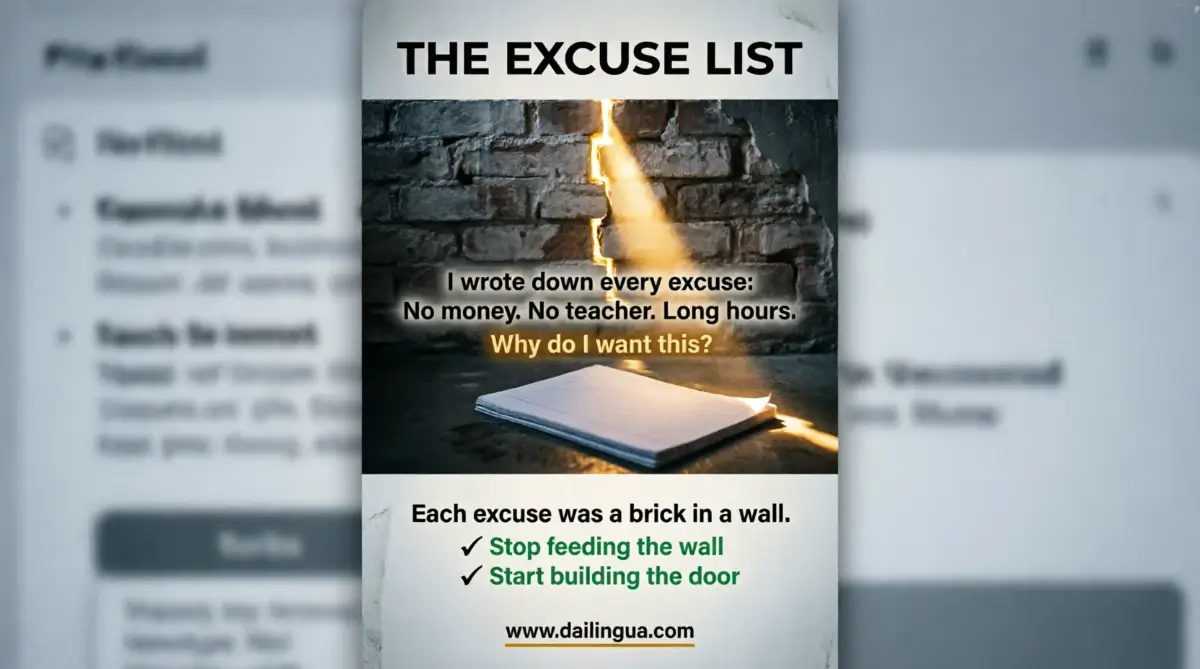
I took a folded page from a notebook the kind with a cover that had traveled with me through many moves and I wrote down every single excuse I had been feeding myself. No money. No teacher. Long work hours. Family never did it, so maybe I cannot. I don’t have the right materials. Everyone else had a head start. When I read the list back under the warm light of a single bulb, I felt something shift in my chest. I saw the list for what it was: a small, familiar game I played to keep myself small. Each excuse was a brick in a wall I had built with my own hands, and I had been living behind it for so long I forgot I was the builder.
I turned the page over and wrote one sentence on the back: Why do I want this language? That question was the spark. Not “how will I learn it” or “what if I fail,” but the deeper, clearer question that sat underneath all the noise. When I found my purpose the grounded, steady reason that had nothing to do with a certificate or a job title or impressing anyone else I began to show up every single day. That purpose was my anchor. Within one month of building a daily practice on that foundation, every excuse on the list had lost its voice. I had not fought them with arguments or motivation; I had simply stopped feeding them my attention, and they faded. I had unknowingly started walking the exact path to start learning from nothing by building daily habits that need no money.
The shift was not dramatic from the outside. I still worked the same long hours. My bank account still held almost nothing. But inside, I had moved from waiting to building, and that movement was everything. I stopped measuring my life by what I lacked and started measuring it by what I built with what I had. That single question why do I want this language? became the anchor I returned to on every challenging day that followed.
The Currency You Already Own That No Bank Can Hold
Many people tell me they cannot afford to learn a language. I understand that feeling because I lived inside it for a season. But here is what I discovered when I stopped looking at my empty wallet and started looking at my day: I ask them what they own that the richest person on earth can never buy more of. Time. Money opens doors, no question. Money can buy private tutors and immersion flights and glossy course subscriptions. But money cannot stretch a single day beyond the sunrise and the stars. It cannot manufacture an extra hour between the evening meal and sleep. I had little money, but I had early mornings before work, lunch breaks taken alone on a bench, and long evenings when the street outside grew still and the only sound was the low whir of the refrigerator. Those became my budget.
Time became the currency I spent with the care of someone handing over their hard‑earned coins. Every free audio file I downloaded, every library ebook I accessed through a digital app, every paused video on the platform where I watched cooking tutorials became a purchase made with minutes instead of dollars. I started to see each twenty‑minute block as a unit of wealth. A single lunch break could buy me ten new phrases spoken aloud. The half‑hour waiting for laundry to finish could buy me a full listening exercise. I learned to carry a small notebook everywhere the cover soft from use, the pages filling steadily and I filled it with words I collected during those moments of deliberate attention.
This simple reframe changed how I saw everything. I was not lacking; I was deliberate. Each twenty‑minute speaking drill replaced twenty minutes of aimless scrolling on a phone with a worn screen. I was investing in a skill no one could repossess. The act of trading an hour of stillness for an hour of deliberate listening built a deep sense of ownership that no paid subscription ever gave me. The language became mine because I had paid for it with the one resource that truly belongs to a human being: my irreplaceable hours. The whole self‑directed approach reminded me of the core principle of learning a foreign language by yourself without relying on anyone else’s budget.
I began to track my time investments not in a spreadsheet I had no computer for that but on a simple piece of paper taped to the wall. Each completed practice session was a small mark, a tally that proved I was building something even when the balance in my bank account stayed at zero. The marks accumulated like coins in a jar, and after a few weeks I could see the physical evidence of my commitment. That visual proof became a source of energy on days when motivation ran low. I could not buy a course, but I could build my own self‑respect with the constant, unglamorous work of showing up.
Why Speaking First Is the Engine Not the Final Exam
I almost made a critical misstep in those early weeks. I waited until I felt ready to speak. I told myself I needed more vocabulary, better grammar, a softer accent before I could open my mouth and let the sounds leave my body. I spent hours listening and reading, filling pages with written exercises, but I kept my voice locked away. Then one night, sitting on that cold bench with the single earbud in my ear, I realized that I could wait forever and never feel ready. Speaking is not the graduation ceremony of language learning. It is the engine that pulls everything else behind it.
The first time I opened my mouth into that single earbud’s microphone, my voice cracked and my tongue felt clumsy and unfamiliar. I sounded nothing like the native speaker in the recording. The words were thick, mis‑accented, halting. But I had spoken. And the next day, I spoke again. Confidence does not wait for readiness; it is born inside the attempt. Each time I forced my mouth to shape an unfamiliar sound, I was building a connection a physical pathway between my intention and my voice.
Speaking builds a specific kind of courage that reading and listening alone cannot touch. When I managed to say a phrase and be understood by an AI conversation assistant that never rolled its eyes, never corrected me with impatience I felt a small, persistent spark of I can do this. That spark grew into consistency, and consistency grew into a grounded belief that I was no longer someone who only dreamed of speaking another language. I had become someone who actually opened my mouth and let sound cross the gap. Speaking first turned the whole journey from a dry textbook exercise into a living, breathing practice that I could feel in my chest and hear in my own ears.
I started carrying my phone everywhere, not to scroll but to record. I would speak into a voice memo app for ten minutes, then play it back and learn from every misstep. Then I would speak again, refining one sound at a time. The recordings were my free teacher. They held up a mirror to my pronunciation and let me hear what I actually sounded like, not what I imagined. If I had known then what I know now, I would have used the method for practicing speaking alone without freezing by rehearsing conversations with an AI conversation assistant the assistant gave me a safe space to practice freely, and that space was invaluable.
The shift was gradual. After a few weeks of daily speaking, I noticed that the words came a little faster. The pauses between sentences grew shorter. I still made mistakes many of them but the hesitation around making them had begun to loosen its grip. I was learning that the world keeps turning when you mispronounce a word. The sky stays intact. The bench remains solid beneath you. And the next opportunity to speak is always waiting, like an open door you can walk through whenever you choose.
The Ocean of Free Resources and the Single Net I Cast
The internet is an ocean of free language material. Videos, apps, podcasts, social‑media accounts, downloadable PDFs all promising a shortcut to fluency if you just follow their specific method. In the first weeks I drifted in that ocean. I downloaded five applications, watched three different teachers on a video platform, started a free course, then set it aside the moment a new one glittered on the screen. My progress stalled not because the material was lacking, but because I never let any of it sink in. I was sampling a hundred dishes and never eating a full meal.
One night, after another round of app‑hopping, I made a rule for myself that changed everything. I would find a single free resource a series of lessons on a video platform, a well‑structured free course I had found through a library app, or a budget‑friendly audio program I had saved small amounts to afford and I would not look at another resource until I had used every exercise, repeated every dialogue, and could produce the language without hesitation. I treated that one resource like a small patch of soil. I watered it every morning, I removed the weeds of distraction, and I refused to glance at anyone else’s field. Depth, not breadth, became the strategy that carried me forward.
I practiced until the phrases were automatic I would wake at the same early hour, sit at the same small table, open the same lesson, and work through it until I could close my eyes and hear the sentences running through my mind without any effort to translate. I would write out the dialogues from memory, speak them to the empty room, then record myself and compare my voice to the original. When I could do all of that without stopping, I allowed myself to look for the next piece of the puzzle. Only then.
This approach kept me safe from the shiny‑object trap that keeps so many self‑taught learners circling forever. I stopped chasing shortcuts. There is no quick transfer of knowledge into long‑term memory, no secret button that bypasses the hours of repetition. Everything that stuck did so because I repeated it patiently, consistently, and without looking for an exit for learning a foreign language without endless word lists by focusing on high‑frequency words and deep repetition.
The discipline of staying with one source also taught me something about myself: I could be trusted to finish what I started. In a world that had told me I didn’t have the resources, finishing that first course was a victory. I had not purchased anything, but I had earned the right to move forward. And that feeling of completion the genuine, earned satisfaction of mastering one full set of material gave me more confidence than any external motivation ever could.
A Stretch of Weeks When the Practice Felt Hollow
There was a long stretch I could not mark when exactly, only that the mornings stayed dark and the practice felt empty where I would sit down at my small table before dawn and go through the motions of speaking, writing, listening, and feel nothing shift. The earbud went in, the audio played, my mouth moved, but the words seemed to pass through me without leaving a trace. I had been at it for months. I could hold a simple conversation in my head, but whenever I tried to speak to a real person or record myself without a script, the words tangled and the old heat of self‑consciousness rushed back. Growth felt like something that was happening to other people, not to me.
I kept going anyway. Not because I felt motivated I felt nothing but a low, steady hum of commitment but because I had made a promise to myself that the practice did not depend on my mood. Some mornings I only whispered the phrases so lightly that I could barely hear myself. Some evenings I only listened to the same ten‑minute dialogue over and over, letting the sounds wash over me without even trying to repeat them. I had no breakthrough in that period. No sudden clarity. Only the slow, determined accumulation of hours that felt like they were adding up to nothing.
But I understand now that those hours were the most valuable ones I ever gave. They taught me that a practice built on purpose does not need to feel productive every day to be productive. The roots were growing in the dark, and I would see the green shoots much later. In that empty stretch, I was learning endurance the kind that comes not from excitement but from a deep, grounded commitment that does not require recognition. That lesson was the heartbeat of staying disciplined without a mentor using daily physical marks to build self‑trust when studying alone.
I remember one particular morning during that gray period. I had been sitting for an hour, the earbud pressing into my ear, the sound of rain against the window the only other noise. I had not managed to speak a single full sentence. My throat felt tight, and the thought of stopping came to visit not as a dramatic storm, but as a soft suggestion that maybe this was enough, maybe I had tried and it was time to rest. I did not open the door to that suggestion. I sat with it, acknowledged it, and then I picked up my pen and wrote a single word in my notebook: “Continue.” That word became my practice for the day. I did not need to be fluent; I just needed to keep going.
How a Cold Bench and a Phone With No Charge Became My Classroom
The bench where I missed the last bus became a symbol I returned to again and again. In the months that followed, I recreated the conditions of that wait in other corners of my life. I turned a ten‑minute walk to work into a listening session, a single earbud feeding me words while my feet moved along the pavement. I converted my lunch break into a speaking drill, murmuring into a voice memo app while I ate a simple meal of bread and something warm from a thermos. I turned the half‑hour before sleep into a writing practice, filling pages with sentences I had learned that day, the ink sometimes smudged by my tired hand.
Each small pocket of time, once spent worrying about what I lacked, became a classroom that cost nothing but attention. I began to see opportunities everywhere. The five minutes waiting for water to boil became a review of vocabulary cards I had cut from scrap paper. The fifteen minutes of sitting on a park bench after work became an immersion session, my ears filled with the soundtrack of a language I was slowly claiming as my own. The world was full of open spaces, and I learned to fill them with practice.
What I want to hand to anyone standing at the beginning is the truth that the resources are truly limitless once you stop scrolling past them. A search for “beginner language audio” opens thousands of hours of free material. Public libraries offer digital access to language courses that would have cost a fortune a generation ago. The video platform where I watched cooking tutorials turned out to hold entire channels dedicated to slow, clear speech in my target language, and I could pause, rewind, and shadow the speaker’s mouth until my own muscles memorized the shape of each sound. The world pours free material at your feet; the only fee is the discipline to pick up one thing and carry it all the way home.
I also discovered the power of repetition in those makeshift classrooms. I would listen to the same ten‑minute audio clip every day for a week, until I could anticipate every pause, every inflection, every breath the speaker took. At first it felt repetitive, but then it became a rhythm I could settle into. The sounds stopped being unfamiliar and started feeling like a melody I had heard so many times I could hum it without thinking. That familiarity was the foundation on which I built real comprehension.
The Self‑Consciousness That Became My Tuition
I wish I could say I always felt capable. But the truth is I walked through many days with a low heat of self‑consciousness sitting under my ribs. I mispronounced words so thoroughly that the AI conversation assistant could not recognize them. I once tried a simple greeting with a native speaker I encountered at a market stall and saw polite confusion wash over their face. My cheeks grew warm, and the thought of abandoning the whole project crossed my mind. That night I sat on my bed and stared at the wall, revisiting the moment.
But self‑consciousness, I discovered, is not a stop sign. It is a checkpoint. Every time I spoke imperfectly and continued forward, the hesitation lost a little of its grip. The worst had happened I looked uncertain and I was still standing, still breathing, still able to try again the next morning. I started to treat those uncomfortable moments as the investment I made in growth instead of comfort. Each moment of heat was proof that I was reaching beyond what I knew, and that is exactly where expansion lives. I did not need a paid tutor to guide me; my own reflection in the mirror was honest enough to show me where I could improve.
The unexpected gift of learning alone with no financial safety net was that I had nothing to lose but my reluctance. I could not hide behind the reason of a subpar teacher or an expensive program that did not deliver. Every misstep was mine, which meant every correction was also mine. I began to keep a small log of my uncomfortable speaking moments not to dwell on them, but to document them as evidence of effort. “Tried to order food, said the wrong word, received a blank stare.” “Mispronounced a greeting, face went warm, tried again, got it right.” Each entry was a small marker of courage.
Over time, the self‑consciousness transformed. It did not vanish it still visits me sometimes but it became a signal rather than a wall. When I feel that heat rise, I know I am at the edge of my comfort zone, and the edge is where growth happens. I learned to lean into the unfamiliar, to let it sit beside me without handing it the steering wheel and why active language learning beats passive input output from day one forces real growth.
The Day I Closed My First Resource and Saw the Road Ahead
When I finally closed the last page of that first free course when I could speak every dialogue, write every exercise from memory, and understand the audio without pausing I felt something unexpected. It was not a dramatic celebration. It was a calm, grounded awareness that I had built a foundation with my own hands, and now I could see
I found a second free resource, this time focused on listening to fast, natural speech. I applied the same method: master it completely before searching for more. I listened to the same short conversations until I could hear the words in my sleep, until the rhythm of the language became a pulse I could feel. The process felt slower than the quick hits of app‑hopping, but the knowledge stayed. I was not collecting introductions to ten different approaches; I was walking one path all the way to its end, and then building the next segment of the road myself. I had become not just a learner, but the architect of my own curriculum, and it cost me nothing except the time I had already decided was mine.
The shift in identity from passive consumer to active builder was profound. I stopped looking for the perfect resource and started making the resources I had work for me. I learned to extract every drop of value from a single piece of content. A ten‑minute dialogue could become a pronunciation drill, a listening exercise, a writing prompt, and a speaking practice all in one. I was no longer dependent on the generosity of app developers or the algorithms that fed me content. I had taken ownership.
That realization reminded me of the approach I later wrote about for building speaking confidence before your first real conversation through role‑play and deliberate rehearsal just as I rehearsed conversations alone before facing a real person, I learned to rehearse my learning process itself, refining it until it became a system that ran on nothing but time and intention.
The Small Unseen Hours That Compound Into a Voice
There is a folded receipt I kept taped above my workspace, and on it I wrote: “Show up before you’re ready, stay until you’re changed.” I looked at that receipt every morning when the alarm pulled me out of sleep and my body asked for another hour of rest. The practice did not feel heroic. It felt like brushing teeth necessary, repetitive, invisible to the world. But those unseen hours are the ones that compound.
After three hundred hours of practice, I noticed I could understand snippets of a radio broadcast without translating word by word. After six hundred, a stranger in a market asked me for directions and I answered without freezing. The thousand‑hour mark arrived not with a trumpet but with a still recognition: the language had become a room inside me, one I could walk into whenever I chose. I did not need to prepare or psych myself up; I could simply open my mouth and the language was there, waiting.
No bank account could have purchased those hours for me. No expensive immersion program could have guaranteed the daily discipline that turned a scattered wish into a reliable skill. The absence of money taught me to build a relationship with the language that was entirely my own, unmediated by a teacher’s approval or a certificate’s deadline. I learned to trust the process because the process was the only thing I had that I learned why adults can actually learn languages faster when they stop treating learning like a school subject and start treating it like a lived practice.
The receipt is still there, yellowed and curling at the edges. The ink has faded, but the words are still visible if I hold it close. It reminds me that the journey is not measured in money spent or certificates earned, but in hours logged and voice strengthened. Every morning I look at it before I begin, and every evening I look at it again, a silent witness to the slow, compounding miracle of showing up.
What I’d Say to the Person Who Thinks the Door Is Locked
If you are reading this and feeling the weight of an empty wallet and a packed schedule, I want to offer you what I learned while leaning against that door. The path is open. It is not without challenge, but it is open. The only true admission fee is the willingness to treat your time as the precious, non‑renewable resource it is, and to commit to one good source until it has given you everything it can. You do not need a dozen applications, a private tutor, or a plane ticket. You need a reason that can carry you through the hard days, and the determination to show up even when your voice shakes.
The challenging days will come that is a promise, not a warning. There will be afternoons when you feel like you are moving backward, evenings when you want to close the notebook for a long time, mornings when the alarm feels like a hurdle. But every one of those moments is a teacher if you let it sit beside you without handing it the controls. I walked through them, and on the other side I found a version of myself who could reach across a language barrier and connect with another world. The money I never had did not stop me; it clarified what I did have, and it taught me that the most valuable things in life are often the ones we already carry.
When I needed to reinforce the mental strength to keep showing up, I turned to the kind of deep repetition of simple material that makes fluency automatic, not fancy I would return to the most basic phrases, the ones I thought I had mastered months ago, and I would practice them again until they felt like breathing. That practice grounded me. It reminded me that fluency is not about complexity; it is about automaticity, and automaticity comes from doing simple things thousands of times.
So here is the honest truth from a former streetlamp student who still uses a single earbud and still pronounces words imperfectly from time to time: can you learn a language from zero with no money? Yes. You absolutely can. And the how is not hidden behind a paywall. It is time, spent with purpose, on one good thing at a time, until the language no longer feels like a subject you study but a voice that has taken up permanent residence in your chest.
And once you have built that voice, you will want to protect it which is exactly why keeping a language from fading by becoming an active user every single day because a language is not a static achievement. It is a living thing that needs to be fed, spoken, and used. The good news is that feeding it costs nothing. A conversation, a video, a page in a book all of it is free once you have built the foundation. And that foundation, I promise you, can be built with nothing but time and a single earbud.